Blog Archives
The Warren Legacy Under Fire: What the Evidence Shows—and What It Does Not
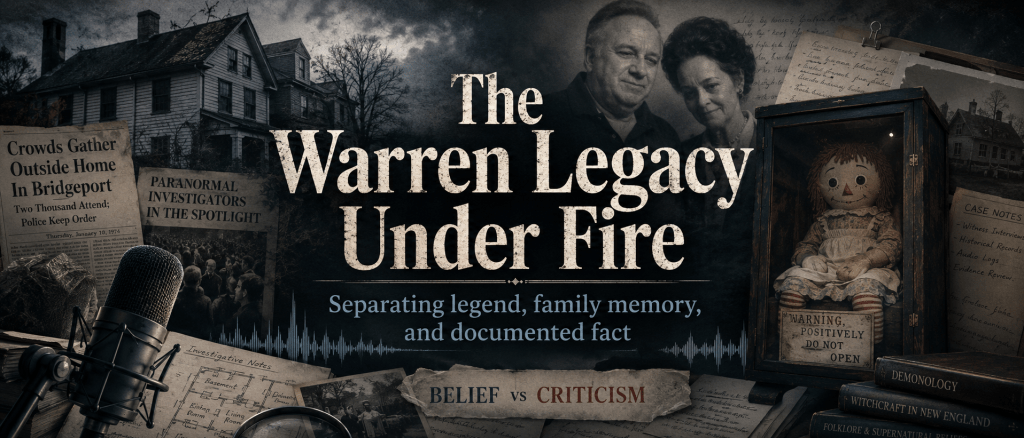
A recent video challenging Ed and Lorraine Warren’s history has prompted a public response from their grandson. Between accusations, family loyalty and decades of paranormal folklore, the truth is more complicated than either side’s strongest supporters may wish to admit.
Few names carry as much weight in paranormal culture as Ed and Lorraine Warren. To supporters, they were compassionate pioneers who entered frightening situations when families had nowhere else to turn. To critics, they were talented storytellers whose most famous cases became increasingly dramatic as books, lectures and films expanded their audience.
That long-running debate has resurfaced following a YouTube discussion featuring paranormal investigator Jason Hawes and researcher Stevie Etay of the Truth or Demons Podcast. The video examines the Warrens’ career, their celebrated cases and several objects associated with their collection.
Chris McKinnell, the Warrens’ grandson, subsequently published a personal defence of his grandparents. His statement did not portray them as flawless. Instead, he argued that they were imperfect people working in a field that had no established guidebook, and that later generations benefited from knowledge unavailable to the Warrens when they began.
The disagreement raises two separate questions that should not be confused: Were the Warrens good people who sincerely tried to help others? And were all the stories connected to their work historically accurate?
What the video argues
The video makes a broad case that stories surrounding the Warrens changed over time and that some claims attached to their cases and museum objects cannot be independently verified.
Among the subjects discussed are:
- The date and circumstances under which the Warrens began investigating paranormal claims.
- Different versions of the Annabelle story.
- The Warrens’ limited involvement in the Enfield poltergeist investigation.
- Alleged accidents and deaths associated with Annabelle.
- The origins of objects displayed as haunted or dangerous.
- The commercialization of the Warren name and collection.
- Serious allegations concerning the Warrens’ private lives.
The discussion includes references to newspaper articles, recordings, reverse-image searches and conversations with people connected to various cases. Some of those points are valuable and potentially verifiable. Others depend on personal recollections, unnamed sources or interpretations of incomplete records.
The video is best understood as a critical interview presenting research leads and arguments, rather than a finished historical investigation proving every allegation it contains.
Was NESPR founded in 1952?
The New England Society for Psychic Research identifies itself as having been founded by Ed and Lorraine Warren in 1952. That remains the organization’s official account. (warrens.net)
The video questions this timeline because its guest says she could not locate contemporary newspaper coverage showing the Warrens publicly working as paranormal investigators that early. She says the earliest material she found focused on their artwork, with clearer public references to paranormal work appearing much later.
This is a fair historical question, but it does not settle the matter.
An organization can exist informally before appearing in newspapers, directories or public records. Conversely, a date repeated by an organization many years later is not automatically independent proof that it was formally operating in its later-recognizable form at that time.
The responsible conclusion is that 1952 is the officially stated founding date, while the extent of the organization’s documented activity during its earliest years remains open to further research. The video does not prove that the date is false.
What happened in Bridgeport in 1974?
McKinnell’s statement refers to the widely publicized disturbances at a house on Lindley Street in Bridgeport, Connecticut. He argues that his grandparents did not manufacture the publicity: the family called for help, police arrived, the press followed and the situation quickly became uncontrollable.
The documented sequence substantially supports that portion of his statement.
Police reports reproduced in William J. Hall’s research describe officers being sent to the Goodin family home on November 24, 1974. Officers reported finding the interior in disarray, with broken dishes, overturned furniture and frightened occupants asking for assistance.
The story then attracted reporters, investigators and large numbers of onlookers. Accounts have placed the crowd outside the property in the hundreds.
None of this proves that a poltergeist was responsible.
Police eventually announced that the Goodins’ young daughter had been observed attempting to create at least one disturbance and had reportedly admitted to staging activity. Some witnesses nevertheless maintained that she could not explain everything they believed they had seen, including incidents said to have occurred when she was absent.
The facts establish that a frightened family contacted authorities, police documented considerable disorder and the case became a genuine media spectacle. Whether all the disturbances were fraudulent, misunderstood or paranormal remains disputed.
This distinction is important. Evidence that an incident occurred is not necessarily evidence that its supernatural explanation was correct.
The Warrens’ role in the Enfield case
One of the strongest factual criticisms in the video concerns the Enfield poltergeist, which inspired The Conjuring 2.
The central investigators were Maurice Grosse and Guy Lyon Playfair, who spent extensive periods with the Hodgson family and produced large quantities of notes and recordings. The Society for Psychical Research credits Grosse and Playfair with conducting the long-term investigation.
Playfair later stated that, apart from a casual visit, the Warrens did not investigate the case.
That does not mean the Warrens never entered the home or had no contact with people involved. It means that their role was far smaller than the central position given to them in the Hollywood version.
On this issue, the criticism is well supported: the film dramatically enlarged the Warrens’ importance to the Enfield investigation.
Hollywood adaptation, however, should not automatically be treated as evidence that the Warrens themselves authored every fictional element. Responsibility may also lie with screenwriters, studios and the demands of a film franchise. The historical record and the cinematic story must be evaluated separately.
Annabelle: documented doll, unproven explanation
The existence of the Raggedy Ann doll known as Annabelle is not in question. Neither is the fact that the Warrens displayed it and associated it with a disturbing case.
The official NESPR account says that a medium identified the presence as a seven-year-old girl named Annabelle, while the Warrens concluded that the doll was being manipulated by an inhuman or demonic force.
Those are claims, not scientifically demonstrated conclusions.
The video argues that details changed between early newspaper reports, books, television appearances and later retellings. Changing details matter, especially when names, ages, deaths, accidents or the supposed origin of an entity are presented as factual history.
At the same time, inconsistencies do not automatically reveal why a story changed. Possible explanations include faulty memory, careless retelling, dramatization, misunderstanding or deliberate invention. Determining which explanation applies requires side-by-side examination of the original sources.
The most honest conclusion is that Annabelle’s paranormal reputation has not been independently proven, and reported inconsistencies give investigators valid reasons to question the legend. That is not the same as proving that every witness intentionally fabricated every experience.
The motorcycle-death legend
One frequently repeated story claims that a young man mocked Annabelle and later died in a motorcycle crash.
The video correctly identifies a major evidentiary problem: publicly repeated versions generally fail to provide a verifiable name, exact date, police report, hospital record or clearly identified accident location.
Without those details, the story cannot responsibly be reported as established fact.
It is possible that an accident occurred and that identifying information was withheld. It is also possible that an unrelated accident became attached to the doll through repeated storytelling. Until primary documentation is produced, the appropriate classification is unverified legend—not proven history and not necessarily conclusively disproven.
Questions surrounding museum objects
The video also attempts to trace the origins of objects described as a “fire doll” and a mysterious baboon-like figure.
Reverse-image searching can be useful. It may reveal that an object closely resembles a commercial doll, Halloween prop or mass-produced collectible. In the case of an object supposedly connected to an older tragedy, evidence that the model was manufactured decades later would present a serious contradiction.
But resemblance alone is not complete authentication.
A conclusive identification would ideally include:
- Manufacturer records or markings.
- Clear photographs showing distinguishing features.
- Purchase or donation records.
- Statements from the object’s creator or original owner.
- A documented chain of custody.
- Evidence showing when the paranormal story was first attached to it.
The video raises legitimate questions that deserve answers. It does not, based on the interview alone, establish the full provenance of every disputed object.
When real deaths are incorporated into the history of a supposedly haunted artifact, the standard of evidence should be especially high. Families and victims should not become supporting characters in a paranormal attraction without a documented connection.
Is the video respectful?
The video begins from a reasonably balanced position. The host acknowledges the Warrens’ influence and says viewers should examine facts and reach their own conclusions.
As the conversation continues, however, the tone becomes less neutral. The speakers occasionally laugh about disputed stories, use dismissive language and make broad judgments about the Warrens’ honesty and legacy. The programme does not include a representative of the Warren family or NESPR responding to the specific evidence.
That does not invalidate its accurate points. Evidence remains evidence regardless of whether it is presented gently. But tone matters, particularly when discussing deceased people, grieving families and allegations that have never been tested in court.
The video would have been stronger had it more consistently separated four categories:
Documented fact, reasonable inference, unverified testimony and personal opinion.
At times, those categories are blended together.
What McKinnell’s post gets right
McKinnell’s response is considerably more restrained than many online arguments surrounding the Warrens.
He does not demand that his grandparents be considered perfect. He acknowledges that they made mistakes and argues that modern investigators have benefited from decades of additional research and experience. He also objects to turning real human beings into flawless heroes who must either remain on a pedestal or be completely destroyed.
That is a fair observation.
Historical figures should be examined honestly without being reduced to saints or villains. The Warrens can have helped frightened people, influenced the paranormal field and sincerely believed portions of their work while also making errors, exaggerating claims or using methods that would not satisfy modern standards.
Multiple things can be true simultaneously.
However, McKinnell’s post is primarily a defence of his grandparents’ intentions and character. It does not directly answer most of the video’s documentary questions. Saying that someone had a good heart cannot establish that a particular story was accurate. Likewise, identifying contradictions in a story does not prove that the person involved had a bad heart.
Character testimony and factual verification are different forms of evidence.
So who is in the wrong?
Neither side is entirely right or entirely wrong.
The video’s participants are right to examine the Warrens’ stories, challenge inconsistent accounts and demand primary documentation. No person’s fame, family status or influence should place their claims beyond examination.
They are on weaker ground when they treat missing evidence as definitive proof of fabrication, rely on hearsay, make conclusions from visual resemblance alone or use ridicule in place of careful argument.
McKinnell is right that his grandparents were human beings rather than fictional horror characters. He is also substantially correct that the Bridgeport case became a public spectacle after the family contacted authorities, rather than appearing to have begun as a publicity event created solely by the Warrens.
His defence becomes less persuasive only if positive memories or good intentions are treated as answers to specific historical contradictions.
A legacy between pioneering and mythology
The Warrens unquestionably helped bring paranormal investigation into popular culture. NESPR continues to describe their work as an effort to investigate paranormal and demonic phenomena and assist people reporting frightening experiences. (warrens.net)
Their influence does not establish the truth of every case attributed to them. Nor do inconsistencies in some cases erase every family they comforted, every event they attended or every person who sincerely believed they had been helped.
The paranormal community does not need to choose between unquestioning devotion and total condemnation.
A mature assessment of the Warren legacy should preserve original documents, identify the sources behind each claim, distinguish films from case histories and acknowledge uncertainty where evidence is missing. Supporters should not fear legitimate questions. Critics should not present speculation as proof simply because it points in a skeptical direction.
Ed and Lorraine Warren’s legacy is neither the flawless love story portrayed by Hollywood nor a case that can be dismissed with a few online discoveries.
It is a complicated piece of paranormal history—part investigation, part personal belief, part popular entertainment and, in some places, unresolved controversy.
The truth will not be protected by placing the Warrens on a pedestal. It will not be found by knocking them from it, either.
NEW ARTICLE PUBLISHED PART 2.
When the Search for the Unknown Meets the Search for Clicks: A Respectful Look at the State of Paranormal Investigating FT: Ghosts On Trent
The paranormal community has always been driven by curiosity. Whether it’s exploring allegedly haunted locations, researching local history, testing new equipment, or simply trying to understand experiences that defy explanation, most investigators begin with the same goal: to search for answers.
Over the last decade, however, the paranormal world has changed dramatically. Social media platforms like YouTube, TikTok, Facebook and Instagram have introduced the subject to millions of people around the world. That has undoubtedly helped the community grow, but it has also changed the way investigations are presented and, in some cases, the motivations behind them.
A recent post by Ghosts On Trent has sparked discussion across the paranormal community. Their message suggests that genuine investigation is increasingly being overshadowed by entertainment, social media popularity and influencer culture.
It’s a thought-provoking point, but like most things in the paranormal world, the reality isn’t quite as simple as one side being right and the other being wrong.
The Main Concerns
Ghosts On Trent raise several important issues.
They question whether some investigators are becoming influencers before they become researchers. They suggest that popularity on social media can sometimes outweigh experience and credibility, and they express concern that paranormal events may be favouring creators with the largest audiences over those with years of investigative knowledge.
They also argue that chasing views, revenue and online recognition risks damaging the credibility of paranormal investigating. Whether you completely agree or not, these concerns are worthy of discussion.
Social Media Has Changed the Paranormal
There is little doubt that social media has transformed the paranormal community. Years ago, investigations were shared through local groups, forums, DVDs and word of mouth. Today, a single investigation can reach hundreds of thousands of people within hours. That’s not necessarily a bad thing.
Social media has introduced thousands of people to paranormal investigating who may never have discovered it otherwise. It has allowed small teams to reach global audiences, encouraged collaboration and opened conversations that simply weren’t possible twenty years ago.
However, social media also rewards excitement. Videos with dramatic music, emotional reactions, bold claims and eye-catching thumbnails naturally attract more attention than a quiet investigation where very little happens. Unfortunately, that creates pressure.
A completely honest investigation that ends with “we didn’t capture anything conclusive tonight” rarely performs as well as one claiming to have found undeniable evidence.
When Views Start Driving Investigations
Good investigations take time. Researching a location’s history. Learning about previous reports.
Testing equipment. Ruling out natural explanations before jumping to paranormal conclusions. None of these things make particularly exciting short videos, yet they’re often the most important parts of an investigation.
The danger is that investigators can begin feeling pressure to make every unexplained noise, shadow or equipment anomaly seem paranormal because that’s what audiences have come to expect.
That doesn’t automatically mean they’re being dishonest. Sometimes it’s simply the reality of creating content in an online world where excitement is rewarded.
Clickbait: Part of the Modern Landscape
One word that’s become almost impossible to avoid is clickbait. It’s often used as criticism, but the truth is that almost every successful creator uses eye-catching titles and thumbnails to some degree. That’s not unique to the paranormal community—it’s simply how YouTube and social media work.
Even many of the most respected paranormal channels use intriguing titles designed to make people curious enough to click. Without them, their content may never reach the audience it deserves. The important distinction isn’t whether a title is dramatic.
It’s whether the investigation delivers on that promise. There’s nothing wrong with making people curious enough to watch. Problems begin when evidence is exaggerated, speculation is presented as certainty, or ordinary events are deliberately made to appear paranormal simply for entertainment.
Perhaps that’s where the real conversation should be. Not whether creators use exciting titles—because almost everyone does—but whether the investigation itself remains honest, balanced and transparent.
Everyone Wants Their Work to Be Seen
One point that’s often overlooked is this: if someone uploads their investigations to social media, they clearly want people to watch them. That’s true whether they’re a small local team with a few hundred followers or a channel with hundreds of thousands of subscribers.
People share their work because they want it to be seen. They want discussion. They want feedback.
They want their investigations to reach an audience. In that sense, everyone is chasing views.
The difference is that for many investigators, views are simply the way their work reaches people—they’re not the reason they investigate.
There’s nothing wrong with wanting your hard work to be watched and appreciated. The problem only begins if the pursuit of views becomes more important than honesty, evidence and integrity.
The Convention Debate
Ghosts On Trent also questioned whether paranormal conventions are favouring creators with the biggest online audiences.
There is some truth to the idea that popular creators help sell tickets. Event organisers are businesses, and successful events need visitors to survive. However, that’s only part of the picture.
Many event companies actually invite a mixture of guests. Alongside well-known YouTube personalities, you’ll often find historians, authors, experienced investigators, equipment specialists and researchers who take a far more scientific or evidence-based approach.
That’s because visitors attend these events for different reasons. Some enjoy hearing exciting investigation stories. Others want to learn about historical research, investigation techniques or the science behind certain equipment.
A balanced line-up benefits everyone. It allows attendees to hear different viewpoints, compare methods and decide for themselves what resonates most.
Rather than seeing these different styles as competitors, perhaps they’re simply serving different parts of the same community.
Popularity Doesn’t Equal Credibility
It’s also important not to assume that having a large audience automatically makes someone less credible.
Many successful creators invest enormous amounts of time researching locations, improving their methods and presenting investigations responsibly, Equally, having a small audience doesn’t automatically make someone an expert.
Credibility isn’t measured by subscriber counts, It’s measured by honesty, consistency, transparency and a willingness to question your own conclusions—even when they aren’t exciting.
The Importance of Critical Thinking
Perhaps the biggest danger in paranormal investigating isn’t social media at all, It’s confirmation bias.
When investigators arrive expecting paranormal activity, it’s easy to interpret every sound, shadow or equipment response as evidence, Responsible investigators challenge themselves.
They look for ordinary explanations before extraordinary ones, Ironically, doing so often makes genuinely unexplained experiences even more compelling.
A Community That Needs Every Perspective
Perhaps the most interesting aspect of this debate is that every part of the paranormal community depends on the others more than many people realise.
Entertainment-focused channels introduce huge numbers of people to paranormal investigating. For many viewers, these creators are the gateway into the subject. Without that exposure, the paranormal community would almost certainly be much smaller.
At the same time, evidence-based investigators, sceptics and debunkers play an equally important role. They encourage critical thinking, test claims and remind the community that extraordinary claims deserve careful examination.
In many ways, it’s a catch-22, Without exciting investigations attracting large audiences, there would be far fewer claims for researchers and debunkers to analyse. Likewise, without people asking difficult questions and challenging evidence, investigative standards would likely suffer.
Whether people realise it or not, both sides help shape the paranormal community, Neither exists entirely in isolation.
Respect Matters
One thing Ghosts On Trent deserve credit for is that their post focused on wider trends rather than publicly attacking individual creators, Healthy discussion benefits the community, Respectful disagreement encourages better standards.
Personal attacks rarely solve anything, The paranormal world has always been filled with different beliefs, different methods and different opinions. That’s part of what makes it fascinating.
Is Ghosts On Trent Completely Right?
Not entirely, The concerns they raise are genuine, but the situation is more complex than simply blaming social media or content creators, Social media has undoubtedly encouraged some sensationalism.
At the same time, it has also helped grow the paranormal community, introduced new generations to investigating and given independent researchers opportunities that simply didn’t exist twenty years ago.
Like any tool, social media depends entirely on how it’s used, The real issue isn’t technology, It’s integrity.
The Balance
Perhaps the future of paranormal investigating lies somewhere in the middle, Creators should be able to produce entertaining, engaging content without exaggerating evidence.
Researchers should embrace modern platforms without abandoning good investigative methods, Audiences should recognise that not every investigation ends with dramatic proof—and that’s perfectly acceptable.
Paranormal Magazines Ending statement.
Ghosts On Trent have started an important conversation, and that’s something the paranormal community should welcome.
Whether you’re an experienced investigator, a content creator, a sceptic or simply someone fascinated by the unknown, credibility should always remain at the heart of what we do.
At the same time, we should recognise that the paranormal community is made up of many different voices. Some educate through historical research. Some entertain through immersive investigations. Some challenge claims through sceptical analysis. All have contributed, in one way or another, to making the paranormal more accessible than ever before.
Perhaps the goal shouldn’t be deciding which approach is “right,” but encouraging every creator to be honest about what they present. Views will always matter because they allow investigations to reach an audience. Selling tickets will always matter because events need to survive. Entertainment will always matter because it inspires curiosity.
But above all else, integrity should matter most.
If the paranormal community can hold on to that, then there is room for researchers, entertainers, sceptics, historians and investigators alike—each playing their own part in the continuing search for the unknown.
there will be a part 2 more focused on produced fake evidence and the damage,
visit PARANORMAL DEBUNKED to view all our articles like this.

Podcast Episode: Britain’s Haunted Bridal Doll
Pip: Welcome to Paranormal Magazine UK — where even a train journey to a morning chat show can apparently become a paranormal incident report.
Mara: Today we’re looking at a story that’s been building for over a decade in British paranormal circles — a haunted bridal doll named Elizabeth, her growing media footprint, and the recurring question of whether she belongs in the same conversation as Annabelle. projectreveal has been tracking this case closely.
Pip: Let’s start with the strangest stop on Elizabeth’s itinerary — St Pancras station.
Elizabeth and the Haunted Doll Legend
Mara: The central claim here is that Elizabeth doesn’t just cause strange events in haunted locations — the disturbances seem to travel with her. The St Pancras incident is the sharpest example of that pattern.
Pip: The post lays out the backstory plainly: Elizabeth was heading to London for an ITV This Morning appearance, and the trip itself became the story. The post notes that “reports linked to the trip included hotel lighting problems, alarms activating while travelling, and a strange moment at London’s St Pancras station where platform display boards reportedly began showing repeated delays as the doll passed through.”
Mara: So the upshot is that it wasn’t one anomaly in a controlled setting — it was a sequence of reported disruptions across an entire journey, in public, mundane spaces.
Pip: And the post is careful not to oversell it. Train screens fail. Systems glitch. The rational explanation is right there on the page. What makes the St Pancras moment stick is that it lands inside a much longer list — fire alarms, flickering lights, recording equipment malfunctioning, phones freezing — that follows Elizabeth wherever she goes. One data point is noise; a pattern is harder to dismiss.
Mara: Right, and that pattern is exactly what the broader coverage is amplifying. A separate piece covers how Manchester Evening News and Yorkshire Live recently featured Elizabeth, bringing the case to a new audience entirely. The post makes the point that “more than a decade after the story first emerged, fascination with Elizabeth remains as strong as ever.”
Pip: A haunted doll with genuine regional press staying power — Annabelle’s publicist must be nervous.
Mara: The Annabelle comparison is actually the explicit frame of a third piece, which asks whether Elizabeth might be more haunted than the Warren doll. It focuses on footage from the YouTube channel Paranormal Tapes, where an investigator uses an EVP spirit box to question Elizabeth — and gets back what the post describes as “a chilling, direct, and hostile message from the other side: Stop recording.”
Pip: That’s a more decisive answer than most press junkets produce.
Mara: The piece notes that unlike Annabelle’s soft Raggedy Ann form, Elizabeth is an ornate bridal doll — pale face, glass case — and argues the aggression of that response puts her in serious contention for the title. Believers point to the volume and consistency of reports; sceptics point to suggestion and expectation. The St Pancras post lands somewhere in between, calling it “one of the most unusual public moments linked to Elizabeth” precisely because it happened in the open, not in a curated paranormal setting.
Pip: The legend grows whether or not the screens were actually her fault — and that tension between evidence and atmosphere is where the story lives.
Mara: What’s striking across all of this is the longevity. Most paranormal stories peak and fade. Elizabeth keeps generating new headlines, new audiences, new incidents.
Pip: Same question, new stations. We’ll see what follows her next.
Haunted History: Searching for the Gray Lady at Dudley Castle
Video Title: THE GRAY LADY OF DUDLEY CASTLE: NEW EVIDENCE & GHOST HUNT
Channel: Ghosts Of Britain
Location: Dudley Castle, West Midlands, UK
Dudley Castle has long been a focal point for paranormal enthusiasts, primarily due to the legend of the Gray Lady. In their latest investigation, the Ghosts of Britain team—Lee, Sarah, and Nick—returned to this historic site to test new evidence, explore the labyrinthine undercroft, and see if the castle’s spirits were ready to communicate.
The Mystery of the Gray Lady
The video centers on a famous photograph of an apparition taken at the castle keep. The team begins by recreating the shot at the top of the keep [01:51].
Using long-exposure photography, they analyze whether the “figure” seen in the windows is a genuine spirit or a case of pareidolia (the mind seeing familiar shapes in random patterns). Lee notes at [22:03] that the uneven brickwork and shadows in the doorway could easily be mistaken for a head and shoulders when viewed from a distance. While they remain open-minded, the team provides a grounded look at how modern “ghost photos” are often created by the environment itself.
The Dark History of the Castle
Before diving into the hunt, the team discusses the castle’s grim past:
- The Witch Trial: A local story tells of Margaret and her brother John. John reportedly had Margaret tried as a witch at the very top of the keep by throwing her over the edge [07:07].
- The Phantom Cheetah: A unique legend involves a former owner who kept a pet cheetah. The animal has reportedly been seen running through the courtyard as a spirit [08:00].
- The Undercroft Legend: A cleaner once reported seeing only the boots and lower legs of a figure walking in the undercroft, which ended abruptly at the waist [06:15].
Investigation Highlights: The Undercroft “Carnage”
The most intense segment of the video takes place in the undercroft, a warm, humid space filled with coffins and ancient brickwork.
- Physical Symptoms: Almost immediately, the team experiences physical effects. Sarah reports feeling quite sick at [13:58], while Nick suffers from a sudden headache. This is often attributed to high electromagnetic fields or the oppressive atmosphere of haunted locations.
- The “I Clean” EVP: During a voice recorder session, Sarah asks what job the spirit did when they were alive. At [15:09], a faint but clear voice seems to respond, “I clean,” potentially corroborating the story of the ghostly cleaner mentioned earlier.
- The Thomas Connection: A spirit naming itself “Thomas” becomes a recurring theme. The team eventually links this to a small coffin that was moved to the site from St. Thomas’s Church [30:53].
- The “Batshit” Session: Toward the end of the video, the equipment begins to trigger uncontrollably. At [31:25], Lee describes the situation as “gone absolutely batshit,” with the REM pod and motion sensors firing off in rapid succession. During this “carnage,” a voice on the Ovilus device is heard saying “Thomas” and “December” [26:48].
Scientific Skepticism vs. Paranormal Proof
What makes this Ghosts of Britain episode compelling is the balance of skepticism. Even while their equipment is “belting out words” at [32:26], Lee and Nick continue to question the sources of the sounds, checking for radiator cooling or interference.
However, the sheer volume of activity in the undercroft—ranging from clear vocal responses to the drain of a flashlight battery that went “dead flat” instantly at [35:09]—leaves the team convinced that Dudley Castle remains one of the UK’s most active sites.
Conclusion
Whether the Gray Lady is a spirit or a trick of the light remains up for debate, but the intelligence captured in the undercroft is hard to ignore. From the mention of “Thomas” to the physical illness felt by the team, Dudley Castle continues to guard its secrets closely.
Watch the full investigation here: https://youtu.be/yXLqHR0TYsY
Do you think the Gray Lady photo is pareidolia or a real ghost? Have you ever felt sick in a haunted location? Share your thoughts below!

