Blog Archives
How Responsible Are Paranormal / debunkers / podcast Content Creators for Their Comment Sections?
In the paranormal podcast and debunking community, online arguments are nothing new. But when comment sections turn toxic, how much responsibility should fall on the person who made the content?
The paranormal community has always had its disagreements. Believers, investigators, sceptics and debunkers often have very different opinions, and that’s perfectly fine. Questioning evidence and challenging claims are part of a healthy discussion. But sometimes those discussions turn nasty, particularly in the comment sections of podcasts, YouTube videos and social media posts.
When this happens, you’ll often hear creators say, “I’m not responsible for what other people comment. Everyone has their own opinions.” And to a certain extent, they’re right. Nobody can control what another person thinks or chooses to write online.
But does that mean content creators have no responsibility at all?
The Tone Starts With the Creator
Something that often gets overlooked is how much the tone of a video or podcast can influence the people watching or listening.
Think about it. If a debunker makes a funny, light-hearted video about a piece of paranormal footage, there’s a good chance the comments will follow that same tone. People will make jokes, have a laugh and perhaps share their own thoughts about the evidence. Now imagine that same footage being discussed in an angry video. The creator is clearly frustrated, speaking aggressively and getting worked up about the people involved. It’s hardly surprising if the comments become more heated too.
Then there’s the content that relies heavily on insults, mocking people and making them look stupid. When a creator spends an entire video putting someone down, should they really be surprised when their audience starts doing the same? Of course, not everyone will react in the same way. Even the friendliest videos can attract horrible comments.
But the tone you set often influences the tone you get back.
And this isn’t just a paranormal community problem. You’ll see exactly the same thing in gaming, sports, politics and just about any other online community.
There’s a Difference Between Criticism and Personal Attacks
Debunking paranormal evidence is not toxic in itself.
There’s nothing wrong with pointing out that a supposed ghost might be dust, an insect or a camera effect. Equally, there’s nothing wrong with a paranormal investigator questioning a debunker’s explanation. That’s how conversations should work.
The problem starts when the focus shifts away from the evidence and onto attacking the person. You can disagree with someone’s footage without calling them stupid. You can question someone’s investigation without insulting their appearance, their intelligence or their character. And this works both ways. Paranormal investigators can be just as guilty of encouraging negativity towards debunkers and sceptics.
Nobody should be above criticism, but criticism doesn’t have to be cruel.
So Who Is Actually Responsible?
Ultimately, the person writing a nasty comment is responsible for what they say. That shouldn’t be forgotten. However, creators also have some responsibility for the community they encourage.
If a podcast host or debunker constantly mocks people, uses insulting language and then laughs along with abusive comments, they’re helping create an environment where that behaviour feels acceptable.
Likewise, if a creator encourages respectful disagreement, doesn’t join in with personal attacks and makes it clear that harassment isn’t welcome, that can influence the audience in a more positive direction. It doesn’t mean creators should have to police every single comment or take the blame for everything their followers do. But there’s a big difference between not being able to control your audience and having absolutely no influence over them.
Can Things Be Better?
The paranormal and debunking communities don’t need to agree on everything. In fact, they probably never will, and that’s not necessarily a bad thing.
A bit of humour, healthy debate and even the occasional heated disagreement are all part of discussing subjects people feel strongly about. But perhaps creators on both sides could think a little more about the atmosphere they’re creating.
Are they encouraging people to question the evidence, or simply encouraging them to dislike the person presenting it? Are they making jokes about a situation, or turning an individual into the joke? And when their comment sections become hostile, are they genuinely surprised, or does that hostility reflect the tone of their own content?
Final Thoughts
I don’t believe content creators should be held responsible for every comment left on their videos or podcasts. People have their own minds and should be accountable for their own words.
But I also don’t believe creators can completely distance themselves from the communities they build.
If you create content that’s funny and welcoming, you may encourage a funny and welcoming audience. If you create content built around anger and insults, you shouldn’t be surprised when some of that anger and those insults appear in your comments.
It won’t happen every time, but the influence is there. And whether you’re a paranormal investigator, a podcast host, a believer or a debunker, the same principle applies. You can’t control everything your audience says, but you can certainly influence the kind of conversation you start.
the question isn’t whether creators are responsible for every comment. It’s whether they’re willing to take responsibility for the tone they set.
The Lodge’s Knocking Spirit: Paranormal Activity or Something That Could Be Recreated?
Is the famous table knocking at The Lodge really the work of a spirit, or could there be another explanation? After studying old footage and exploring different possibilities, I’ve come up with a few theories worth discussing. But this isn’t about accusing anyone of faking paranormal activity. It’s about asking questions, examining evidence and keeping an open mind.
The Mystery of the Knocking Spirit
If you’ve followed paranormal investigations at The Lodge, you’ll probably be familiar with the mysterious knocking sounds that have become a talking point among investigators and viewers.
What interests me most is how frequently these knocks appear to happen in certain videos.
I’ve watched a lot of paranormal footage over the years, and one thing I’ve rarely witnessed is a supposed spirit producing knocking sounds so consistently and reliably.
That doesn’t automatically mean anything suspicious is happening. However, when an unexplained phenomenon appears to happen regularly, I think it’s reasonable to ask whether there could be another explanation.
When Beardo visited with the GTI lads, for example, the knocking didn’t seem to happen with anything like the same consistency.
That got me thinking.
Why would the knocking appear so frequently during some investigations but not others?
Could it be genuine paranormal activity? Could environmental factors be involved? Or could the sounds potentially be recreated using ordinary methods?
I decided to explore that last possibility.
Theory One: A Hidden Knocking Device Inside a Candle
One of the first ideas I came up with involved something as simple as a candle sitting on the table.
Imagine a candle or decorative object containing a small hidden knocking mechanism. If activated, that mechanism could strike the table and produce a sound resembling the knocks heard during paranormal investigations.
Depending on how it was constructed, the device could potentially be triggered remotely.
Now add CCTV cameras into the equation.
Someone watching a live camera feed could theoretically see what investigators were doing and activate a hidden device at particular moments, creating the impression that something unseen was responding.
I want to be absolutely clear: I’m not saying this is happening at The Lodge.
I have no evidence that a candle contains a hidden mechanism or that anyone is remotely controlling the knocks.
This is simply one possible method I thought of for recreating a similar effect under controlled conditions.
And that’s an important distinction. Demonstrating that something could be recreated doesn’t prove that it has been recreated that way.
Theory Two: Something Hidden Inside the Table Legs
Another possibility came from brainstorming ideas with Beardo.
We discussed whether a knocking mechanism could potentially be concealed inside one of the table legs.
A small device hidden within the structure of a table might produce tapping or knocking sounds without any obvious movement on the tabletop.
Again, depending on the design, it could theoretically be activated remotely.
This would make it difficult for someone simply watching the table to identify where the sound was coming from.
It’s another interesting possibility, and one that could be tested with a replica setup.
But once again, this is a hypothetical method, not an allegation against The Lodge or anyone associated with it.
We were exploring ways the phenomenon could be reproduced, not claiming to have discovered how the original knocks were made.
Then Twinvestigate and Pursuit Of The Paranormal Podcast Captured Something Interesting
Things became even more interesting when Twinvestigate and Pursuit Of The Paranormal Podcast visited The Lodge.
In footage they captured, there appeared to be a possible physical explanation for at least one of the knocking sounds.
Attention was drawn to a staff member who was in contact with the table. The footage appeared to show the person’s arm muscles tensing around the time a knock was heard.
One possibility is that pressure from the arm caused the table or its structure to make a cracking or knocking sound.
Even relatively small amounts of pressure can cause certain pieces of furniture to creak, click or crack, especially where wooden joints or other components are under tension.
If that’s what happened, it could potentially explain a knocking sound without needing to involve anything paranormal.
However, there are important limitations to this observation.
The footage alone does not establish that the staff member caused the sound, and it certainly doesn’t establish that anyone deliberately tried to mislead investigators.
The timing could be coincidental. The noise could have come from another part of the table or room. Further testing would be needed to determine whether the same movement reliably produced the same sound.
Nevertheless, I think it’s a possibility worth examining rather than ignoring.
Does This Mean The Lodge Is Faking Paranormal Activity?
Not 100% proven without a shadow of a doubht. And I want to make that absolutely clear.
I’ve presented three possible explanations worth investigating:
- A concealed knocking device inside a candle or another object on the table.
- A mechanism hidden within the table legs.
- Natural cracking or knocking sounds caused by physical pressure on the table.
The first two are ideas for how the effect could potentially be recreated. The third is a possible explanation prompted by what Twinvestigate captured.
None of these possibilities, on their own, proves that anyone has 100% faked anything, it just looks that way.
Just because a paranormal effect can be reproduced doesn’t mean the original event was fraudulent, however the arm movements do match the knocks which doesnt look good and could be a cause and people have the right to call it fake for that reason. also we need to bare in mind this is one person of the team not the entire team.
Equally, just because a sound happens during a paranormal investigation doesn’t automatically make it evidence of a spirit.
Both possibilities deserve fair consideration.
My Thoughts
I’m not writing this to attack The Lodge, its staff or the investigators who have visited.
I’m writing it because I believe paranormal investigations should be open to questioning. The knocking sounds are interesting, particularly because of how consistently they appear in some footage compared with other investigations. After looking back through old videos, I started thinking about how a similar effect could be recreated. That led to the candle idea, the table-leg theory I discussed with Beardo, and now the possible pressure-related explanation raised by Twinvestigate’s footag, which does seem to look like a possible answer based on the person in the video muscle and knocks timing.
These are possibilities on how i coud recreate it, that doesnt mean it was done that way tho, however especally the last one with pressure on the tabe is more likely, not 100% proven tho. But I also don’t think we should dismiss ordinary explanations simply because a location has a reputation for being haunted.
Paranormal investigating should be about finding the truth, not protecting a particular conclusion.
That’s what fair, transparent investigating should be about.
Spirit Box Videos on the Recently Deceased Need to Stop
There is something about recent spirit box videos that does not sit right with me, When somebody has only just passed away, especially if their death is all over the news, it feels wrong to see channels rushing to make ITC or spirit box videos about them.
The family may still be grieving, the funeral may not have even happened yet, and strangers are already putting that person’s face in thumbnails and claiming they have made contact with them. That is where paranormal investigation starts to look more like content chasing. Spirit boxes also need to be treated with a lot more caution than they often are.
These devices scan radio frequencies, so if somebody’s name is already being mentioned on the radio, in news reports, interviews or talk shows, then hearing that name come through a spirit box is not automatically paranormal. Of course certain names, places or details might appear, They are already being talked about everywhere.
That is why a name coming through during a session on a recently deceased famous person should never be treated as solid proof that the person is communicating, Editing can also make these sessions look far more convincing than they really are.
A session might last an hour, but the viewer only sees the few moments that seem to match the questions being asked. Add subtitles telling people what they are supposed to hear and suddenly a random bit of radio sounds like a clear response. This does not mean every investigator is deliberately misleading people, but it does mean viewers should be careful.
There is also another side to this that does not get talked about enough, people who disagree with these channels and do commentary can sometimes fall into the same trap without realising.
If a creator makes a video saying that spirit box channels are exploiting a recently deceased person, but then uses a huge photograph of that same person in the thumbnail and puts their name in the title to attract clicks, there is a contradiction there, the intention may be different, but the deceased person is still being used to sell the video in a different way more then likely not fully thinking about it.
these videos does not always need the deceased person’s face plastered across the thumbnail. The focus should be on the behaviour, the method and the ethics of what is happening. a title such as “Why Recent-Death Spirit Box Videos Are a Problem” makes the point without turning the person who died into the main attraction.
Sometimes a screenshot or image may be needed for context, and there is nothing wrong with discussing a case responsibly, but there is a difference between showing something for explanation and using somebody’s death as clickbait. The same rule should apply to everyone.
ITC channels, paranormal investigators, debunkers and commentary channels should all remember that behind the story is a real person and a real family. Whether you believe spirit communication is possible or not, there should still be some respect. i understand its coming from the right place in heart for the debunkers and commetnery channels. If the ITC channel wasnt making the HIDOUS videos in the first place this wouldnt be happening.
If a person has only just died, maybe the most respectful thing is not to rush to contact them, debunk them, react to them or build content around them. Sometimes people should simply be allowed to rest.
abit of a contreversial one but interesting i would love to know your thoughts on this.
Sick Emojis Spark Paranormal Feud as Nick Groff Fires Back at Adam Berry Over Cripple Creek ParaCon
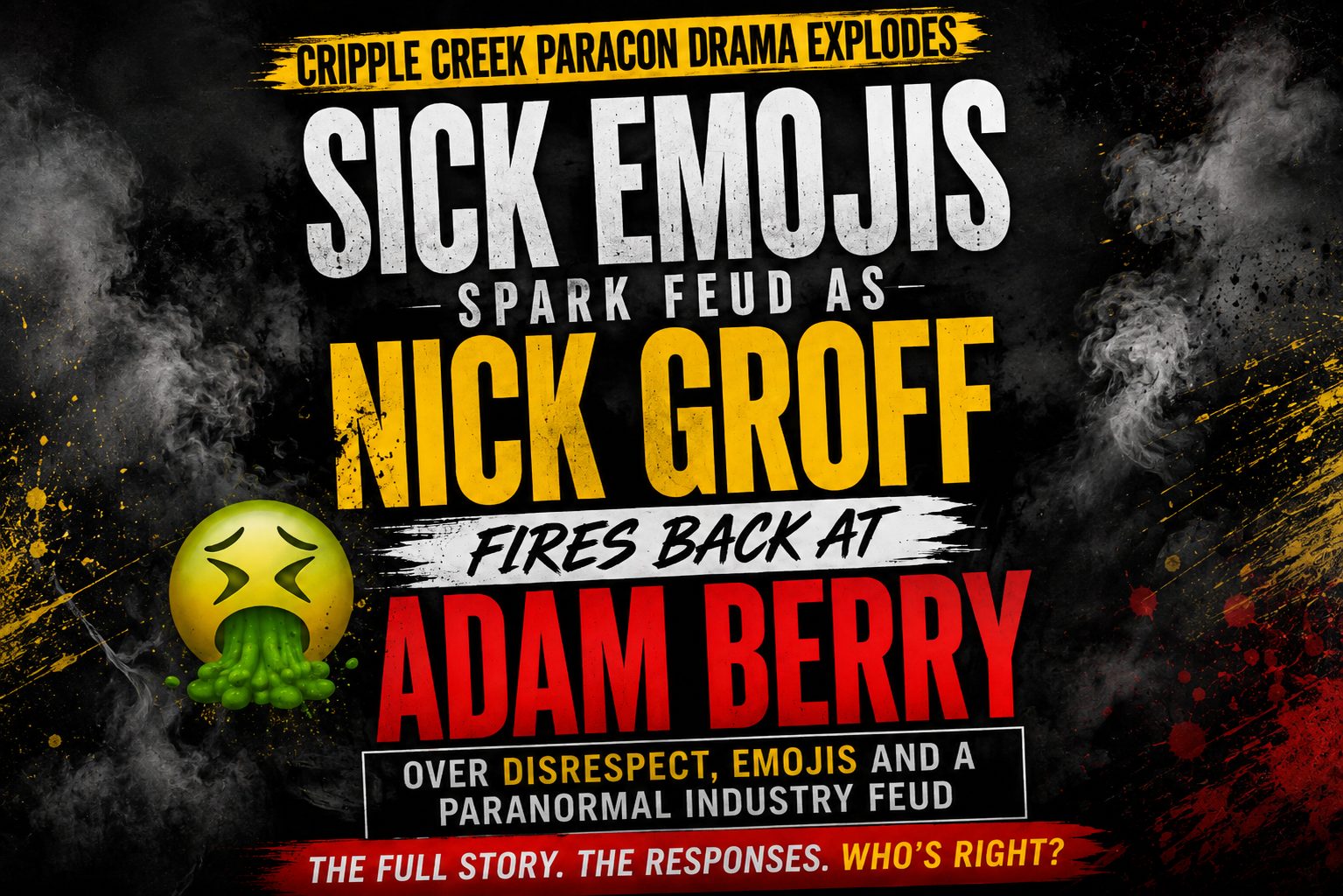
A handful of emojis appear to have helped ignite one of the paranormal community’s latest public fallouts, after Nick Groff responded furiously to Adam Berry following Berry’s reaction to the Cripple Creek ParaCon 2027 lineup.
What might initially have looked like a relatively ordinary complaint about not being invited back quickly escalated into something much more personal, with Groff accusing Berry of disrespecting both himself and his wife, Tessa Groff, before bringing years of alleged behind-the-scenes tension into the open.
But did Adam Berry actually accuse Nick Groff of getting him removed from the event?
From what we can establish from the posts circulating online, that isn’t quite what happened.
And that distinction could be important.
Adam Berry Wasn’t Happy About the New Lineup
Berry had previously appeared at Cripple Creek ParaCon and made it clear on social media that he was disappointed about apparently not being invited back for the 2027 event.
In the post being shared around the paranormal community, Berry said he was confused by the decision, pointing out that he had supported the event and believed they had enjoyed a successful turnout.
He described it as feeling like a “slap in the face” and joked that he would now have to find another event to attend that weekend.
However, the part that appears to have really caused trouble wasn’t simply Berry saying he was disappointed.
It was his reaction to who was apparently appearing instead.
Berry used sick or disgust-style emojis when referring to or reacting to members of the announced lineup — a lineup which included Nick Groff and Tessa Groff.
And Nick clearly didn’t see the emojis as an innocent joke.
Were the Emojis Aimed at Nick and Tessa?
This is where interpretation becomes important.
Putting a sick or disgusted emoji beside somebody’s name or photograph can obviously be interpreted as insulting.
If Berry intended the emojis to represent his opinion of the people appearing at the convention, it’s understandable why Nick would regard that as disrespectful toward both himself and his wife.
But an emoji is still not the same thing as a written accusation.
There is an important difference between saying:
“Nick Groff got me removed from this event.”
and posting a disgusted reaction to seeing Nick and Tessa on the lineup after discovering you are no longer appearing yourself.
The latter can certainly be rude.
It does not, by itself, establish that Berry accused either of them of orchestrating his removal.
That distinction appears to have become somewhat lost once the argument exploded.
Nick Groff Responds: “None of Us Had Anything to Do With Adam Not Being Invited Back”
Groff responded with a lengthy public Facebook statement, opening by saying:
“Adam Berry publicly brought my name and my wife Tessa Groff name into his complaint about not being invited back to Cripple Creek Paracon 2027.”
Nick then made his position crystal clear.
He said neither he nor Tessa had anything to do with Berry not returning to the convention.
Groff also said that he hadn’t even known Jason Hawes and Shari DeBenedetti were appearing at the event with himself and Tessa.
That is arguably the most relevant part of Nick’s response.
If Berry’s emojis gave followers the impression that Nick or Tessa were somehow responsible for him being excluded, Groff had every right to correct that impression.
At present, there is no evidence in the material we’ve seen showing that Nick or Tessa had any involvement in deciding whether Adam Berry appeared at Cripple Creek ParaCon 2027.
But Nick Didn’t Stop There
This is where the dispute went from an argument over emojis to a full-scale paranormal-industry feud.
Instead of simply saying, “We didn’t have anything to do with this, please leave us out of it,” Groff unleashed years of apparent frustration.
Nick accused Adam Berry and Amy Bruni of what he described as attacks, poor behaviour, false accusations and false narratives.
He wrote:
“Unfortunately, I’ve had to deal with Amy and Adam’s attacks, poor behavior at events, false accusations and narratives…”
Groff also accused the pair of subsequently portraying themselves as victims.
Those are substantially more serious claims than anything conveyed by a sick emoji.
And Groff wasn’t finished.
Why Did Amy Bruni Get Dragged Into It?
Perhaps the strangest element of Nick’s statement is that Amy Bruni apparently wasn’t involved in Adam Berry’s post at all.
Nick actually acknowledges this himself.
He wrote that Amy wasn’t part of Adam’s post but argued that Adam and Amy had worked together professionally and personally for years.
That history is clearly relevant to how Nick personally views the situation, but it doesn’t necessarily make Amy relevant to the specific Cripple Creek ParaCon dispute.
Nick’s response therefore appears to demonstrate that this wasn’t really just about an emoji.
The emoji may have been the match. There was already plenty of fuel underneath it.
Groff appears to have regarded Berry’s post as the latest incident in a much longer-running conflict involving himself, Tessa, Adam and Amy.
That helps explain the intensity of the response.
Whether it justifies it is another question.
Nick: “If You’re Not Being Invited Back… Take a Look at Yourself”
Groff then delivered perhaps the harshest part of his statement.
He suggested that if somebody wasn’t being invited back to events, they should consider whether their own behaviour might be responsible rather than blaming others.
That significantly changed the nature of the exchange.
Nick was no longer merely denying responsibility.
He appeared to be suggesting there could be another reason why Adam wasn’t invited back.
However, Nick didn’t provide evidence showing why Cripple Creek ParaCon made its decision.
Unless the organisers themselves confirm the reason, people should be cautious about assuming Berry’s alleged behaviour caused his removal.
“I Have the Receipts”
Nick finished his response with what may turn out to be the most significant sentence in the entire argument:
“I know the facts. And I have the receipts.”
That’s a powerful statement.
But receipts only settle an argument when they’re actually produced.
Nick may well possess messages, emails or other information supporting what he has alleged about previous encounters with Adam Berry and Amy Bruni.
At the time of the post shown to us, however, those receipts weren’t included.
Until they are made public, Nick’s broader accusations remain Nick Groff’s account of events, rather than independently proven facts.
Daniel Klaes Sides With Nick
Paranormal investigator Daniel Klaes also weighed into the discussion underneath Nick’s post.
Klaes argued that publicly attacking other talent or the convention itself was unlikely to help somebody’s chances of being invited back.
He wrote that there were “far more professional ways” to deal with disappointment or disagreements privately.
His point raises a fair question.
Even if Berry had every right to be annoyed, was using sick emojis against people on the replacement lineup the right way to express it?
Probably not.
If those emojis were intended as an insult toward Nick, Tessa or others appearing at the event, then it was an unnecessary public swipe.
Berry could have criticised the organisers’ decision without making the other guests look responsible for something they may have had absolutely nothing to do with.
But Did Nick Overreact?
This is where our assessment becomes more nuanced.
Nick had a legitimate reason to be annoyed.
If somebody publicly put a sick or disgusted emoji next to a lineup featuring you and your wife, it’s perfectly reasonable to take that personally.
Nick was also entirely entitled to make it clear that neither he nor Tessa was responsible for Adam not being invited back.
That could have been the end of it.
Instead, Nick’s response expanded into allegations about years of behaviour involving Adam and Amy Bruni, accusations about victim narratives, comments suggesting Adam should examine his own behaviour and a declaration that he possesses “receipts.”
In other words, Adam threw a small social-media grenade. Nick responded with the paranormal equivalent of an artillery barrage.
Whether that response was justified depends heavily on whatever history exists between them that the public hasn’t seen.
So Who Was in the Wrong?
There are really two separate questions.
Was Adam wrong to use the sick emojis?
If those emojis were aimed at Nick, Tessa or the other announced guests, yes — it was petty and unprofessional.
Those guests are not necessarily responsible for who a convention books.
Being disappointed with the organisers doesn’t justify publicly insulting other people simply because their photographs appear on the new lineup.
It also creates an obvious implication.
Followers seeing Adam react with disgust to Nick and Tessa appearing where he expected to appear could understandably conclude there was bad blood or that Berry somehow associated them with the decision.
That’s exactly the impression Nick appears to have objected to.
Was Nick wrong to respond?
No — not for correcting the record.
Nick had every right to say neither he nor Tessa had anything to do with Adam not being invited back.
In fact, making that clarification publicly was probably sensible considering Adam had made his reaction public.
But Nick’s response went much further than correcting the record.
Dragging Amy Bruni into a post she apparently wasn’t involved with and raising years of alleged incidents transformed what could have been a simple clarification into a much larger personal feud.
Those broader accusations now carry their own burden of proof.
Our Verdict
On the original disagreement, Nick Groff has the stronger argument.
Adam Berry was perfectly entitled to be disappointed about apparently not returning to Cripple Creek ParaCon.
He was perfectly entitled to question the organisers.
But directing sick or disgusted emojis towards a lineup containing fellow paranormal personalities was always going to be interpreted as a public insult.
Nick and Tessa didn’t organise Adam’s post.
They didn’t choose the emojis.
And, based on the evidence currently available, there is nothing showing they made the decision not to invite him back.
Nick therefore had every right to tell Adam to leave his and Tessa’s names out of it.
Where Nick potentially went too far was turning the dispute into an indictment of Adam Berry and Amy Bruni’s behaviour over several years.
Those allegations may have history behind them, but they are much bigger claims than the original emoji incident and haven’t been proven by the Facebook statement alone.
So, in simple terms:
Adam appears to have started this particular confrontation with an unnecessary public dig.
Nick was justified in responding — but then escalated it considerably.
And perhaps the most revealing part of the whole controversy is that something as simple as a few sick emojis was enough to expose what appears to be years of unresolved tension between some of the paranormal world’s best-known names.
The ghosts might not be fighting — but the ghost hunters certainly are.
Editor’s note: This article distinguishes between comments visible in the circulating social-media posts and broader allegations made by those involved. Claims concerning past behaviour have not been independently established and are attributed to the individuals making them.

