How Responsible Are Paranormal / debunkers / podcast Content Creators for Their Comment Sections?
In the paranormal podcast and debunking community, online arguments are nothing new. But when comment sections turn toxic, how much responsibility should fall on the person who made the content?
The paranormal community has always had its disagreements. Believers, investigators, sceptics and debunkers often have very different opinions, and that’s perfectly fine. Questioning evidence and challenging claims are part of a healthy discussion. But sometimes those discussions turn nasty, particularly in the comment sections of podcasts, YouTube videos and social media posts.
When this happens, you’ll often hear creators say, “I’m not responsible for what other people comment. Everyone has their own opinions.” And to a certain extent, they’re right. Nobody can control what another person thinks or chooses to write online.
But does that mean content creators have no responsibility at all?
The Tone Starts With the Creator
Something that often gets overlooked is how much the tone of a video or podcast can influence the people watching or listening.
Think about it. If a debunker makes a funny, light-hearted video about a piece of paranormal footage, there’s a good chance the comments will follow that same tone. People will make jokes, have a laugh and perhaps share their own thoughts about the evidence. Now imagine that same footage being discussed in an angry video. The creator is clearly frustrated, speaking aggressively and getting worked up about the people involved. It’s hardly surprising if the comments become more heated too.
Then there’s the content that relies heavily on insults, mocking people and making them look stupid. When a creator spends an entire video putting someone down, should they really be surprised when their audience starts doing the same? Of course, not everyone will react in the same way. Even the friendliest videos can attract horrible comments.
But the tone you set often influences the tone you get back.
And this isn’t just a paranormal community problem. You’ll see exactly the same thing in gaming, sports, politics and just about any other online community.
There’s a Difference Between Criticism and Personal Attacks
Debunking paranormal evidence is not toxic in itself.
There’s nothing wrong with pointing out that a supposed ghost might be dust, an insect or a camera effect. Equally, there’s nothing wrong with a paranormal investigator questioning a debunker’s explanation. That’s how conversations should work.
The problem starts when the focus shifts away from the evidence and onto attacking the person. You can disagree with someone’s footage without calling them stupid. You can question someone’s investigation without insulting their appearance, their intelligence or their character. And this works both ways. Paranormal investigators can be just as guilty of encouraging negativity towards debunkers and sceptics.
Nobody should be above criticism, but criticism doesn’t have to be cruel.
So Who Is Actually Responsible?
Ultimately, the person writing a nasty comment is responsible for what they say. That shouldn’t be forgotten. However, creators also have some responsibility for the community they encourage.
If a podcast host or debunker constantly mocks people, uses insulting language and then laughs along with abusive comments, they’re helping create an environment where that behaviour feels acceptable.
Likewise, if a creator encourages respectful disagreement, doesn’t join in with personal attacks and makes it clear that harassment isn’t welcome, that can influence the audience in a more positive direction. It doesn’t mean creators should have to police every single comment or take the blame for everything their followers do. But there’s a big difference between not being able to control your audience and having absolutely no influence over them.
Can Things Be Better?
The paranormal and debunking communities don’t need to agree on everything. In fact, they probably never will, and that’s not necessarily a bad thing.
A bit of humour, healthy debate and even the occasional heated disagreement are all part of discussing subjects people feel strongly about. But perhaps creators on both sides could think a little more about the atmosphere they’re creating.
Are they encouraging people to question the evidence, or simply encouraging them to dislike the person presenting it? Are they making jokes about a situation, or turning an individual into the joke? And when their comment sections become hostile, are they genuinely surprised, or does that hostility reflect the tone of their own content?
Final Thoughts
I don’t believe content creators should be held responsible for every comment left on their videos or podcasts. People have their own minds and should be accountable for their own words.
But I also don’t believe creators can completely distance themselves from the communities they build.
If you create content that’s funny and welcoming, you may encourage a funny and welcoming audience. If you create content built around anger and insults, you shouldn’t be surprised when some of that anger and those insults appear in your comments.
It won’t happen every time, but the influence is there. And whether you’re a paranormal investigator, a podcast host, a believer or a debunker, the same principle applies. You can’t control everything your audience says, but you can certainly influence the kind of conversation you start.
the question isn’t whether creators are responsible for every comment. It’s whether they’re willing to take responsibility for the tone they set.
The Lodge’s Knocking Spirit: Paranormal Activity or Something That Could Be Recreated?
Is the famous table knocking at The Lodge really the work of a spirit, or could there be another explanation? After studying old footage and exploring different possibilities, I’ve come up with a few theories worth discussing. But this isn’t about accusing anyone of faking paranormal activity. It’s about asking questions, examining evidence and keeping an open mind.
The Mystery of the Knocking Spirit
If you’ve followed paranormal investigations at The Lodge, you’ll probably be familiar with the mysterious knocking sounds that have become a talking point among investigators and viewers.
What interests me most is how frequently these knocks appear to happen in certain videos.
I’ve watched a lot of paranormal footage over the years, and one thing I’ve rarely witnessed is a supposed spirit producing knocking sounds so consistently and reliably.
That doesn’t automatically mean anything suspicious is happening. However, when an unexplained phenomenon appears to happen regularly, I think it’s reasonable to ask whether there could be another explanation.
When Beardo visited with the GTI lads, for example, the knocking didn’t seem to happen with anything like the same consistency.
That got me thinking.
Why would the knocking appear so frequently during some investigations but not others?
Could it be genuine paranormal activity? Could environmental factors be involved? Or could the sounds potentially be recreated using ordinary methods?
I decided to explore that last possibility.
Theory One: A Hidden Knocking Device Inside a Candle
One of the first ideas I came up with involved something as simple as a candle sitting on the table.
Imagine a candle or decorative object containing a small hidden knocking mechanism. If activated, that mechanism could strike the table and produce a sound resembling the knocks heard during paranormal investigations.
Depending on how it was constructed, the device could potentially be triggered remotely.
Now add CCTV cameras into the equation.
Someone watching a live camera feed could theoretically see what investigators were doing and activate a hidden device at particular moments, creating the impression that something unseen was responding.
I want to be absolutely clear: I’m not saying this is happening at The Lodge.
I have no evidence that a candle contains a hidden mechanism or that anyone is remotely controlling the knocks.
This is simply one possible method I thought of for recreating a similar effect under controlled conditions.
And that’s an important distinction. Demonstrating that something could be recreated doesn’t prove that it has been recreated that way.
Theory Two: Something Hidden Inside the Table Legs
Another possibility came from brainstorming ideas with Beardo.
We discussed whether a knocking mechanism could potentially be concealed inside one of the table legs.
A small device hidden within the structure of a table might produce tapping or knocking sounds without any obvious movement on the tabletop.
Again, depending on the design, it could theoretically be activated remotely.
This would make it difficult for someone simply watching the table to identify where the sound was coming from.
It’s another interesting possibility, and one that could be tested with a replica setup.
But once again, this is a hypothetical method, not an allegation against The Lodge or anyone associated with it.
We were exploring ways the phenomenon could be reproduced, not claiming to have discovered how the original knocks were made.
Then Twinvestigate and Pursuit Of The Paranormal Podcast Captured Something Interesting
Things became even more interesting when Twinvestigate and Pursuit Of The Paranormal Podcast visited The Lodge.
In footage they captured, there appeared to be a possible physical explanation for at least one of the knocking sounds.
Attention was drawn to a staff member who was in contact with the table. The footage appeared to show the person’s arm muscles tensing around the time a knock was heard.
One possibility is that pressure from the arm caused the table or its structure to make a cracking or knocking sound.
Even relatively small amounts of pressure can cause certain pieces of furniture to creak, click or crack, especially where wooden joints or other components are under tension.
If that’s what happened, it could potentially explain a knocking sound without needing to involve anything paranormal.
However, there are important limitations to this observation.
The footage alone does not establish that the staff member caused the sound, and it certainly doesn’t establish that anyone deliberately tried to mislead investigators.
The timing could be coincidental. The noise could have come from another part of the table or room. Further testing would be needed to determine whether the same movement reliably produced the same sound.
Nevertheless, I think it’s a possibility worth examining rather than ignoring.
Does This Mean The Lodge Is Faking Paranormal Activity?
Not 100% proven without a shadow of a doubht. And I want to make that absolutely clear.
I’ve presented three possible explanations worth investigating:
- A concealed knocking device inside a candle or another object on the table.
- A mechanism hidden within the table legs.
- Natural cracking or knocking sounds caused by physical pressure on the table.
The first two are ideas for how the effect could potentially be recreated. The third is a possible explanation prompted by what Twinvestigate captured.
None of these possibilities, on their own, proves that anyone has 100% faked anything, it just looks that way.
Just because a paranormal effect can be reproduced doesn’t mean the original event was fraudulent, however the arm movements do match the knocks which doesnt look good and could be a cause and people have the right to call it fake for that reason. also we need to bare in mind this is one person of the team not the entire team.
Equally, just because a sound happens during a paranormal investigation doesn’t automatically make it evidence of a spirit.
Both possibilities deserve fair consideration.
My Thoughts
I’m not writing this to attack The Lodge, its staff or the investigators who have visited.
I’m writing it because I believe paranormal investigations should be open to questioning. The knocking sounds are interesting, particularly because of how consistently they appear in some footage compared with other investigations. After looking back through old videos, I started thinking about how a similar effect could be recreated. That led to the candle idea, the table-leg theory I discussed with Beardo, and now the possible pressure-related explanation raised by Twinvestigate’s footag, which does seem to look like a possible answer based on the person in the video muscle and knocks timing.
These are possibilities on how i coud recreate it, that doesnt mean it was done that way tho, however especally the last one with pressure on the tabe is more likely, not 100% proven tho. But I also don’t think we should dismiss ordinary explanations simply because a location has a reputation for being haunted.
Paranormal investigating should be about finding the truth, not protecting a particular conclusion.
That’s what fair, transparent investigating should be about.
Lee steer claims the Deborah Davies HAUNTED DOLL Collection, that contains annabelle and more.
In the world of paranormal research, taking custody of high-energy spirit vessels is never routine business. But when Lee Steer and the Ghosts of Britain (GOB) team hit the motorway to collect a notorious haul of haunted dolls from celebrity psychic medium Deborah Davies, they expected a standard transport run.
What transpired on the journey home has sent shockwaves through the UK paranormal community and ignited a fresh wave of debates over item-bound attachments and spirit contagion.
The Handover: Passing the Torch
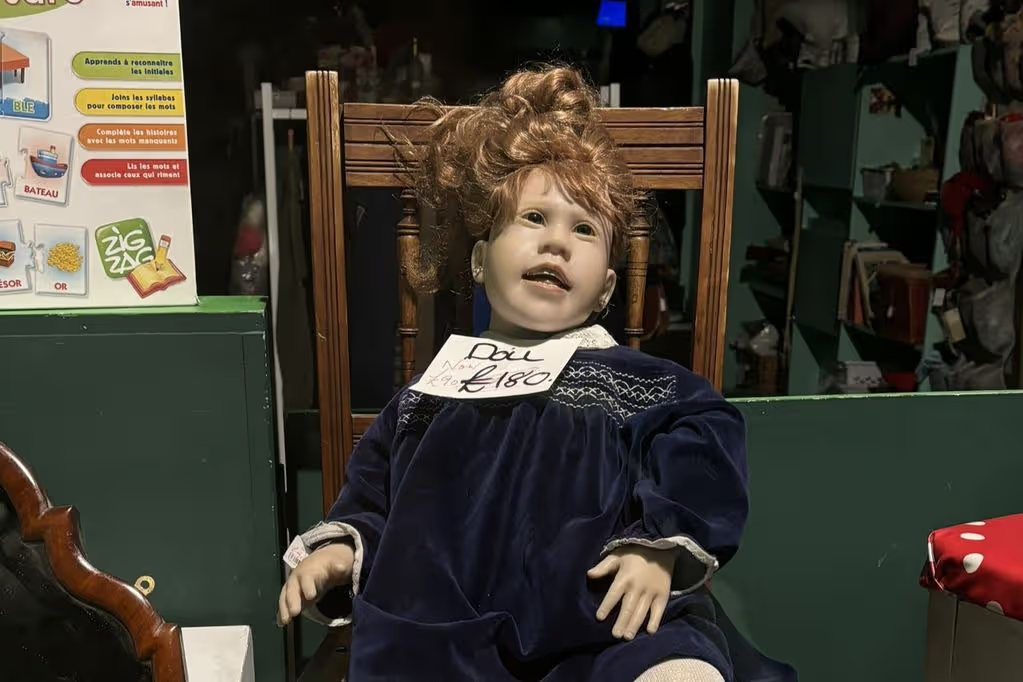
The collection—which includes infamous vessels like “Annabelle”, the viral Edinburgh charity shop doll that captured national headlines on ITV, BBC, and Sky News—had been causing escalating physical and emotional distress. Recovering from health battles, Deborah made the difficult decision to purge her home of the items to protect her own well-being and energy.
Lee Steer and the GOB crew answered the call, agreeing to take full custody of the dolls and transfer them to their secured research facilities in Rotherham.
“Annabelle”: The Edinburgh Charity Shop Doll
Few objects in recent memory have captured the public imagination—and terrified local shoppers—quite like the porcelain doll known as Annabelle. Her journey from a quiet Scottish charity shop window to national television headlines represents one of the fastest viral paranormal cases in UK history.
Timeline of a Viral Haunting
The Window Warning
Early 2024
The vintage 1970s porcelain doll, clad in a blue velvet dress, is donated to St Columba’s Hospice Charity Shop in Morningside, Edinburgh. Volunteers and shop patrons report feeling unnerved by her piercing, lifelike expression.
Going Viral & Price Slashing
February 2024
A photograph of the doll posted in the shop window goes viral on social media after shoppers joke about her sinister appearance. Originally marked at £180, shop staff repeatedly cut the price to £90 to quickly find her a new home.
Celebrity Acquisition
March 2024
Former Real Housewives of Cheshire star and psychic medium Deborah Davies purchases the doll, naming her Annabelle. Davies reports immediate paranormal activity at her home, including unexplained knocks, footsteps, and electronic glitches.
Mainstream Media Frenzy
Spring 2024
Annabelle becomes a national sensation, making headlines on BBC News, Sky News, and featured live on ITV’s This Morning as Davies discusses the vessel’s attached energy.
The GOB Handover
October 2026
Following health battles, Deborah Davies announces she is rehoming her vessel collection. Lee Steer and Ghosts of Britain (GOB) take custody of Annabelle, leading to the infamous, illness-plagued transport journey home.
Vessel Specs:
- Type: Vintage Porcelain / Composition Body
- Origin: St Columba’s Hospice Charity Shop (Morningside, Scotland)
- Reported Phenomena: Nausea upon approach, temperature drops, electrical interference, residual attachment
Taking custody of active vessels rarely goes smoothly, but the journey back to Rotherham proved particularly harrowing for the GOB crew.
Shortly after loading the sealed containers and hitting the motorway, the environment inside the transport vehicle shifted dramatically. Team members reported all of this below.
Within miles, multiple occupants experienced severe, simultaneous physical symptoms:
- Acute Nausea & Dizziness: Unexplained, violent disorientation affected the crew while driving.
- Electrical Failures: Live-stream feeds, mobile devices, struggled to work..
- TEETH started to tingle – john and john both felt strange feelings on their teeth like they started to tingle..
A National Paranormal Landmark
Compared to single-item events—such as Neil Packer’s famous WWII hospital wheelchair featured on ITV’s This Morning—the transfer of Deborah Davies’ full collection to Rotherham stands as one of the most significant UK paranormal stories in recent years.
Now residing within The Haunted Objects Museum Poltergeist House in Rawmarsh, Rotherham, items like Annabelle and Elizabeth undergo continuous baseline monitoring, thermal tracking, and electromagnetic field analysis.
For Lee Steer and the Ghosts of Britain team, housing these entities under one roof remains an ongoing experiment in containment, research, and respect for the unexplained.
Smug Puppy, Beardo and the Cost of Defending a Lie
Smug Puppy has now admitted that the paranormal videos which helped build the channel were staged. But the fakery itself is not really the worst part of this story. Plenty of people make fake paranormal content. If Smug Puppy had made the videos, kept quiet when people called them fake, and then revealed the truth later, this could have ended up being a clever little experiment.
The problem is what happened when people started questioning it. Debunkers such as Beardo Gets Scared, PSI had been calling the videos fake for years, and instead of simply ignoring them, Smug Puppy kept defending the footage. People who questioned the videos were pushed back on, and some critics say they were mocked or blocked. That is what makes the confession look so much worse now. It is one thing to fool people with a video. It is another to keep defending something you already know is false.
The money side does not help either. Smug Puppy has argued that the money came from adverts rather than directly from viewers, but that is a pretty weak distinction. The viewers created the traffic, the traffic created the advertising value, and the content was being monetised while a large part of the audience believed they were watching genuine paranormal activity. Nobody outside Smug Puppy can honestly say exactly how much they made without seeing the platform records, but the fact money was being earned from the content makes the trust issue harder to brush aside.
This could have been handled far better. If it really was an experiment, the easiest thing to do would have been to say nothing when people called it fake. Ignore the comments, refuse to explain how the videos were made, then reveal everything at the end and show the tricks. That would have kept the mystery without leaving years of denials behind. Instead, the lie was defended for so long that coming clean was always going to look bad.
Coming clean was still better than carrying on, but by that point a lot of the damage had already been done. Beardo’s criticism now is not really about proving the ghosts were fake anymore, because Smug Puppy has already done that themselves. It is about the fact that people were saying it for years and were repeatedly told, directly or indirectly, that they were wrong.
That is the real problem here. The ghosts being fake is almost the least interesting part. The damage came from defending the story long after people had started seeing through it. Once you spend years telling people something is real, admitting later that it was not is always going to come with a price.

