Blog Archives
The Lodge’s Knocking Spirit: Paranormal Activity or Something That Could Be Recreated?
Is the famous table knocking at The Lodge really the work of a spirit, or could there be another explanation? After studying old footage and exploring different possibilities, I’ve come up with a few theories worth discussing. But this isn’t about accusing anyone of faking paranormal activity. It’s about asking questions, examining evidence and keeping an open mind.
The Mystery of the Knocking Spirit
If you’ve followed paranormal investigations at The Lodge, you’ll probably be familiar with the mysterious knocking sounds that have become a talking point among investigators and viewers.
What interests me most is how frequently these knocks appear to happen in certain videos.
I’ve watched a lot of paranormal footage over the years, and one thing I’ve rarely witnessed is a supposed spirit producing knocking sounds so consistently and reliably.
That doesn’t automatically mean anything suspicious is happening. However, when an unexplained phenomenon appears to happen regularly, I think it’s reasonable to ask whether there could be another explanation.
When Beardo visited with the GTI lads, for example, the knocking didn’t seem to happen with anything like the same consistency.
That got me thinking.
Why would the knocking appear so frequently during some investigations but not others?
Could it be genuine paranormal activity? Could environmental factors be involved? Or could the sounds potentially be recreated using ordinary methods?
I decided to explore that last possibility.
Theory One: A Hidden Knocking Device Inside a Candle
One of the first ideas I came up with involved something as simple as a candle sitting on the table.
Imagine a candle or decorative object containing a small hidden knocking mechanism. If activated, that mechanism could strike the table and produce a sound resembling the knocks heard during paranormal investigations.
Depending on how it was constructed, the device could potentially be triggered remotely.
Now add CCTV cameras into the equation.
Someone watching a live camera feed could theoretically see what investigators were doing and activate a hidden device at particular moments, creating the impression that something unseen was responding.
I want to be absolutely clear: I’m not saying this is happening at The Lodge.
I have no evidence that a candle contains a hidden mechanism or that anyone is remotely controlling the knocks.
This is simply one possible method I thought of for recreating a similar effect under controlled conditions.
And that’s an important distinction. Demonstrating that something could be recreated doesn’t prove that it has been recreated that way.
Theory Two: Something Hidden Inside the Table Legs
Another possibility came from brainstorming ideas with Beardo.
We discussed whether a knocking mechanism could potentially be concealed inside one of the table legs.
A small device hidden within the structure of a table might produce tapping or knocking sounds without any obvious movement on the tabletop.
Again, depending on the design, it could theoretically be activated remotely.
This would make it difficult for someone simply watching the table to identify where the sound was coming from.
It’s another interesting possibility, and one that could be tested with a replica setup.
But once again, this is a hypothetical method, not an allegation against The Lodge or anyone associated with it.
We were exploring ways the phenomenon could be reproduced, not claiming to have discovered how the original knocks were made.
Then Twinvestigate and Pursuit Of The Paranormal Podcast Captured Something Interesting
Things became even more interesting when Twinvestigate and Pursuit Of The Paranormal Podcast visited The Lodge.
In footage they captured, there appeared to be a possible physical explanation for at least one of the knocking sounds.
Attention was drawn to a staff member who was in contact with the table. The footage appeared to show the person’s arm muscles tensing around the time a knock was heard.
One possibility is that pressure from the arm caused the table or its structure to make a cracking or knocking sound.
Even relatively small amounts of pressure can cause certain pieces of furniture to creak, click or crack, especially where wooden joints or other components are under tension.
If that’s what happened, it could potentially explain a knocking sound without needing to involve anything paranormal.
However, there are important limitations to this observation.
The footage alone does not establish that the staff member caused the sound, and it certainly doesn’t establish that anyone deliberately tried to mislead investigators.
The timing could be coincidental. The noise could have come from another part of the table or room. Further testing would be needed to determine whether the same movement reliably produced the same sound.
Nevertheless, I think it’s a possibility worth examining rather than ignoring.
Does This Mean The Lodge Is Faking Paranormal Activity?
Not 100% proven without a shadow of a doubht. And I want to make that absolutely clear.
I’ve presented three possible explanations worth investigating:
- A concealed knocking device inside a candle or another object on the table.
- A mechanism hidden within the table legs.
- Natural cracking or knocking sounds caused by physical pressure on the table.
The first two are ideas for how the effect could potentially be recreated. The third is a possible explanation prompted by what Twinvestigate captured.
None of these possibilities, on their own, proves that anyone has 100% faked anything, it just looks that way.
Just because a paranormal effect can be reproduced doesn’t mean the original event was fraudulent, however the arm movements do match the knocks which doesnt look good and could be a cause and people have the right to call it fake for that reason. also we need to bare in mind this is one person of the team not the entire team.
Equally, just because a sound happens during a paranormal investigation doesn’t automatically make it evidence of a spirit.
Both possibilities deserve fair consideration.
My Thoughts
I’m not writing this to attack The Lodge, its staff or the investigators who have visited.
I’m writing it because I believe paranormal investigations should be open to questioning. The knocking sounds are interesting, particularly because of how consistently they appear in some footage compared with other investigations. After looking back through old videos, I started thinking about how a similar effect could be recreated. That led to the candle idea, the table-leg theory I discussed with Beardo, and now the possible pressure-related explanation raised by Twinvestigate’s footag, which does seem to look like a possible answer based on the person in the video muscle and knocks timing.
These are possibilities on how i coud recreate it, that doesnt mean it was done that way tho, however especally the last one with pressure on the tabe is more likely, not 100% proven tho. But I also don’t think we should dismiss ordinary explanations simply because a location has a reputation for being haunted.
Paranormal investigating should be about finding the truth, not protecting a particular conclusion.
That’s what fair, transparent investigating should be about.
Do Paranormal YouTubers Really Need Clickbait to Get Views?
A recent statement from paranormal investigation team Ghosts On Trent, responding to criticism of some of their YouTube titles and thumbnails, got me thinking about something that goes far beyond one channel.
Their statement inspired this article, but this isn’t intended as another piece about Ghosts On Trent. The bigger question is one that affects almost everyone making paranormal content today:
Do you actually need clickbait to succeed on YouTube?
Spend ten minutes scrolling through paranormal videos and you would be forgiven for thinking the answer is yes.
There are shocked faces everywhere. Red arrows pointing towards dark corners. Figures standing in doorways that somehow look much clearer in the thumbnail than they ever do in the actual footage. Words such as DEMON, ATTACKED, TERRIFYING and POSSESSED appear with remarkable regularity.
Then there are the titles.
“We Should Never Have Gone Inside.”
“This Was Our Most Terrifying Investigation Ever.”
“Something Followed Us Home.”
“We Were NOT Alone.”
You know the sort.
It has become part of paranormal YouTube culture, and there seems to be a growing belief among creators that this is simply what you have to do if you want people to watch.
I don’t think that’s true.
You need to give people a reason to click. Of course you do. YouTube is full of videos competing for somebody’s attention.
But clickable and clickbait are not the same thing.
And if your entire channel depends on viewers believing that your investigations are genuine, repeatedly overselling what happened could eventually cause more damage than a disappointing view count, this is way ghosts on trent may be facing the critisum which ia fair.
What Do We Actually Mean By Clickbait?
This is probably where some of the disagreement starts.
Not every catchy title is clickbait.
If you investigate an old Victorian property with decades of reported paranormal activity, there is absolutely nothing wrong with calling the video:
“We Spent the Night Investigating a Victorian House With 100 Years of Ghost Stories.”
That’s a decent title.
It tells me where you’re going, what you’re doing and why I might be interested.
Compare that with:
“Paranormal Investigation #38.”
Which one are you clicking? Making something sound interesting isn’t dishonest. You should make it sound interesting.
The problem begins when the title or thumbnail promises something the video doesn’t contain. If your thumbnail shows a black figure standing behind an investigator but that figure wasn’t actually there, that’s a problem.
If the title says:
“DEMON CAUGHT ON CAMERA”
and the big moment turns out to be a faint knock from another room, you’ve oversold it.
You may have got my click. You probably haven’t earned my trust. And that distinction matters enormously in paranormal content.
The Click Isn’t Everything
There seems to be a strange idea that YouTube only cares about getting somebody to click on a video. It obviously cares whether people click. Why wouldn’t it?
But think about this from YouTube’s point of view.
Suppose I see an incredible thumbnail and click immediately.
Within 45 seconds I realise the thumbnail was wildly exaggerated, nothing is happening and the video isn’t what I expected.
So I leave. Was that really a successful recommendation? Probably not.
Now imagine another video with a less ridiculous thumbnail. I click it, become interested in the investigation and watch for 25 minutes. Which viewer behaviour would you rather have?
This is why chasing clicks at any cost is short-sighted. A title and thumbnail have one job: get the right person into the video.
Then the video has to do the rest.
Paranormal Channels Have an Extra Problem: Trust
This is where paranormal creators are different from many other YouTubers.
If you review phones, your audience doesn’t particularly need to believe that strange unexplained events happened to you last night. A paranormal investigator does.
You’re asking viewers to examine noises, movements, possible voices and strange pieces of footage where the explanation isn’t always obvious. Trust is everything.
If I already think you’re exaggerating what happened in the thumbnail, why shouldn’t I wonder whether you’re exaggerating what happened during the investigation?
That doesn’t mean somebody using a dramatic thumbnail is faking evidence. Those are two very different accusations.
But audiences make associations.
If every video is apparently the most terrifying investigation you’ve ever conducted, eventually “most terrifying” doesn’t mean very much. If every building contains a demon, sooner or later I am going to start wondering why demons seem to keep such a reliable filming schedule.
There has to be room for an investigation where very little happens. In fact, I would argue that those investigations are important.
What If Nothing Happens?
This is probably the hardest problem for genuine paranormal investigators on YouTube.
You’ve booked the location. You’ve travelled there. You’ve filmed for eight hours. You’ve paid for accommodation, fuel and equipment.
And then…
Nothing. No footsteps. No apparitions. No mysterious voices. No doors slamming. Nobody gets touched. Nobody screams. Nothing follows you home.
Now what?
Do you upload a video where nothing happened? I think you should.
The mistake is believing that the paranormal activity has to be the story. It doesn’t. The investigation can be the story.
Give Me a Question to Follow
Rather than starting with:
“Tonight we’re at another haunted location to see what happens…”
give me something specific. For example:
“Staff working here have reported footsteps crossing this upstairs corridor for more than 20 years. Tonight the building is empty apart from us, and we’re going to see whether we can work out what’s causing them.”
I’m interested already. Not because you’ve promised me a ghost. Because you’ve given me a mystery. That mystery now has an ending whether anything paranormal happens or not.
Maybe you hear the footsteps. = Maybe you don’t. Maybe you discover a heating pipe knocking inside the wall. Maybe traffic outside sounds completely different at night. Maybe you can’t explain it.
All of those are valid endings.
This is where paranormal investigation can learn a lot from documentaries.
A documentary doesn’t need the answer to be supernatural.
It just needs a good question.
A Quiet Night Doesn’t Have to Make a Boring Video
There is a difference between an uneventful investigation and an uneventful video.
If absolutely nothing happens during a 30-minute vigil, I don’t need to watch all 30 minutes.
Tell me:
“We stayed in this room for approximately half an hour. Nothing unusual happened, so we moved upstairs.”
That’s enough. Editing does not automatically make paranormal footage dishonest.
Cutting dead time isn’t faking evidence. What matters is that, when something significant does happen, you give viewers enough context to judge it properly.
Show the original moment. Let us hear the audio. Explain where everyone was.
Try to reproduce it. Look for ordinary explanations. Then move on.
I’d much rather watch a tightly edited 35-minute investigation where the team genuinely found very little than a two-hour upload containing endless silent vigils simply because somebody believes uncut automatically means authentic.
History Can Carry a Paranormal Video
If the ghosts aren’t performing, tell me about the building.
One of the strangest things about some paranormal videos is that teams gain access to genuinely fascinating historic locations and then barely tell us anything about them.
Who lived there? What happened there? Where did the ghost stories actually come from?
When was the first reported sighting? Have different witnesses described the same thing?
Changes to the building that might explain why certain noises occur?
That is interesting.
And it makes the paranormal side stronger because now we understand what is supposedly being investigated.
Some locations have far better real histories than ghost stories.
Use them.
One Good Claim Is Better Than Twenty Random Experiments
Another thing that can make paranormal videos drag is the lack of any clear purpose.
“We’re going to use every piece of equipment we’ve brought and see what happens” isn’t much of a story.
Take one claim and investigate it properly.
Perhaps people repeatedly report a woman humming on a staircase.
Great. Put recorders on different floors. Work out whether voices carry from outside.
Check whether nearby rooms produce similar acoustics. Speak to witnesses. Try to reproduce the sound.
Now there is something for the audience to follow. Or perhaps staff say a particular door opens by itself.
Monitor the door. Check airflow. Check the hinges. Check whether changes in pressure affect it.
Film it continuously.
If it moves, investigate why. If it doesn’t, that’s still useful information. You don’t need twenty gadgets flashing in the dark when one properly thought-out experiment can carry the episode.
You Don’t Need a Fake Ghost in the Thumbnail
There’s also an assumption that a paranormal thumbnail has to look like a horror film poster.
It doesn’t.
A genuinely creepy building can make a fantastic thumbnail on its own. An empty corridor can be interesting if that corridor is central to the story.
An investigator standing at the bottom of a staircase can work. An actual frame from the investigation can work. A historic photograph can sometimes work. You could even use something very simple.
A photograph of the location with the words:
“HAUNTED?”
There’s a question immediately.
What matters is that the thumbnail represents the video you’re actually about to show me.
And there may even be an advantage to being restrained. When every other paranormal thumbnail contains glowing eyes, a screaming face and three red arrows, a simple atmospheric photograph can actually stand out.
Don’t Confuse Honest With Boring
This is important. I’m not suggesting paranormal creators deliberately make terrible titles. You shouldn’t upload:
“We Went Somewhere and Not Much Happened.”
That’s honest, but it’s also terrible marketing. You have to find the interesting part of the truth.
Instead of:
“Nothing Happened at This Haunted House.”
you could use:
“We Spent Eight Hours in This Famous Haunted House — Here’s What We Actually Found.”
Instead of:
“Quiet Investigation at Old Hotel.”
try:
“Is Room 6 Really Haunted? We Spent the Night Finding Out.”
Neither promises paranormal evidence. Both create curiosity.
That’s the sweet spot.
Stop Giving Away the Answer
Another mistake paranormal creators make is telling us exactly what we’re supposed to believe before we’ve even watched the evidence.
“Ghost voice says my name!” Well, now you’ve already told me what I’m meant to hear.
Instead, let me listen first. Play the recording without subtitles.
Ask viewers what they hear. Then explain what the investigators thought it sounded like.
The same goes for visual evidence. Show the clip.
Replay it.
Show the normal-speed version before the zoomed and slowed-down version. Let the audience investigate with you.
That involvement can be far more engaging than simply announcing:
“That’s definitely paranormal.”
If Nothing Happens, Make That the Story
Imagine going to a location advertised as extremely haunted and recording absolutely nothing unusual.
Don’t hide it. Lean into it.
“Everyone told us this was one of the most active locations in the area. We spent the entire night here and found almost nothing. So we decided to look more closely at where the stories came from.”
That’s interesting. Now investigate the reputation itself. How old are the haunting claims?
Are they all coming from one source?Did the ghost stories appear after the building became a paranormal venue? Do historical records match the stories told on ghost hunts?
Have independent witnesses genuinely reported similar things?
Suddenly your failed ghost hunt has turned into a completely different investigation.And possibly a better one.
A Normal Explanation Can Be a Great Ending
Paranormal investigators shouldn’t be disappointed when they debunk something. That’s investigating.
Suppose you’re called to a property because the owner hears a mysterious knocking every night.
You spend hours investigating and eventually discover that changing temperature causes an old pipe behind the wall to move.
No ghost.But that is still a successful investigation. You had a mystery.You tested it. You found an explanation.
That is satisfying television.
And if your audience knows you genuinely try to find normal explanations, they’ll pay far more attention when you eventually encounter something you can’t explain.
Build Trust Before You Need It
This may be the biggest argument against constantly exaggerating paranormal videos.
Trust builds slowly.
If I watch ten investigations from your channel and you’ve been prepared to say:
“Nothing happened.” “We debunked this.” “We think that was probably somebody outside.” “This recording isn’t clear enough to call evidence.” “We simply don’t know.”
Then on investigation number eleven you say:
“We have tried everything we can think of and we still cannot explain this.”
I’m going to pay attention. You’ve earned that moment. Compare that with a channel where every thumbnail has contained a demon for the previous six months. Which unexplained clip carries more weight?
So, Do You Need Clickbait to Win?
No..
Most importantly, you need to find the most interesting truthful thing about the investigation and build the video around it.
Don’t ask:
“How can we make this look terrifying?”
Ask:
“What was actually interesting about tonight?”
Maybe you captured something strange. Maybe you disproved one of the location’s best-known ghost stories. That’s interesting too. Maybe you uncovered fascinating history.
Use it. Maybe you tested six claims and every one of them failed. Tell us.
Maybe the building everybody calls haunted wasn’t particularly spooky at all. That’s still a story.
And maybe, after reviewing everything, the only responsible conclusion is:
Nothing happened.
That’s fine. Paranormal investigation isn’t supposed to guarantee ghosts.
It is supposed to investigate claims of the paranormal. If you go into every location already knowing the video needs a ghost before you’ve even started filming, are you really investigating?
Or are you producing a show that requires a particular ending? There is nothing wrong with paranormal entertainment. There is an audience for it and always will be.
But if your channel presents itself as genuine paranormal investigation, there should always be the possibility that you walk away with nothing. And strangely enough, being willing to show those nights might be one of the best ways to convince an audience that, when something genuinely strange does happen, it’s worth watching.
You don’t need to fake the scare. You don’t need to fake the thumbnail. And you don’t need to promise a demon every week.
Tell people an interesting story, investigate it properly and be prepared for the answer to be “nothing paranormal happened.”
That may not sound as dramatic.
But in the long run, it could be far more valuable.
view more articles in our DEBUNKED SECTION
Why Beardo Gets Scared Accepting GTI’s Invitation Could Matter to the Paranormal Community
The online arguments have happened. The evidence has been questioned. Now Beardo Gets Scared has accepted Ghost Trip Investigation’s invitation to investigate alongside them. If handled properly, what happens next could be far more important than another YouTube disagreement.
There are plenty of arguments in the paranormal world.
One investigator captures something they cannot explain. A sceptic examines the footage and offers another explanation. Viewers choose sides, comment sections explode, response videos appear and, before long, the original question — what actually happened? — can become buried beneath personalities, loyalties and algorithms.
The developing situation between Beardo Gets Scared and Ghost Trip Investigation (GTI) has the potential to be different.
GTI, the UK paranormal team led by Dan Spragg and Adam Oakley, publicly invited Beardo to accompany them on an investigation, describing it as a genuine opportunity to investigate together in a transparent, open and honest way. Beardo subsequently publicly accepted the invitation.
That acceptance matters.
Because instead of continuing the discussion exclusively through edited videos, livestreams and social-media posts, two very different approaches to paranormal content now have an opportunity to meet in the place where these questions should ultimately be tested:
inside an investigation.
Why Beardo Saying “Yes” Is Important
Beardo Gets Scared has built his platform around examining paranormal evidence critically.
His own website describes an approach based around investigating claims, analysing footage using his knowledge of video editing, challenging weak evidence and attempting to separate genuine mysteries from misidentification or fakery. Importantly, his stated position is not simply that everything paranormal must be false, but that the evidence should be followed wherever it leads.
That distinction is important.
A useful sceptic should not enter a paranormal investigation determined to prove that nothing can happen.
Equally, a paranormal investigator should not enter determined that every unexplained noise, light or equipment response must be supernatural.
The interesting territory exists somewhere between those positions.
GTI describes its own philosophy as being centred around live exploration, audience involvement and allowing viewers to witness investigations and decide for themselves what they believe happened.
Putting those philosophies together could create something genuinely useful.
Beardo gets the opportunity to see GTI’s investigation process from beginning to end rather than analysing selected footage after publication.
GTI gets the opportunity to demonstrate its methods directly in front of someone who has been critical of paranormal evidence.
And the audience gets something even more valuable:
context.
This Should Not Be Beardo Versus GTI
The biggest mistake everyone involved could make would be treating this investigation as a boxing match.
It should not be about Beardo trying to catch GTI doing something wrong.
It should not be about GTI trying to manufacture an experience dramatic enough to convert him to their way of thinking.
And it certainly should not become several hours of people attempting to win an internet argument.
The paranormal community has enough tribalism already.
This investigation has the chance to demonstrate something considerably healthier: that people can fundamentally disagree about evidence while still being willing to stand in the same building, use the same equipment, watch the same rooms and examine the same incidents together.
Being challenged should not automatically be considered an attack.
Neither should scepticism.
If somebody claims that an event is paranormal, questions should be expected. If somebody offers a normal explanation, that explanation should also be questioned.
That is how investigations become stronger.
So What Should Actually Happen on the Investigation?
If this collaboration is going to mean something, transparency cannot simply be a slogan attached to the promotional material. It needs to be built into the investigation itself.
Before anything begins, GTI should explain exactly how they normally investigate. Beardo should explain what controls or additional observations he believes are necessary.
Then everybody should agree on the conditions.
There should be continuous cameras covering important areas wherever practically possible. Equipment should be inspected and demonstrated before use. Environmental factors should be noted. People entering and leaving investigation areas should be accounted for.
Most importantly, everybody should be allowed to observe.
If something strange happens, the first reaction should not immediately be:
“Ghost.”
It should be:
“What just happened?”
Then investigate it. That process does not destroy paranormal investigation. It improves it.
Because if ordinary explanations are properly tested and eliminated and something still cannot be explained, the remaining evidence becomes considerably more interesting.
Let Beardo Be Beardo — And Let GTI Be GTI
Another mistake would be forcing either side to abandon its identity.
GTI should conduct the investigation in the manner its audience recognises.
Beardo should be allowed to question what he sees.
If he believes an equipment response has a conventional explanation, he should say so.
If GTI disagrees, they should explain why.
And if Beardo witnesses something he genuinely cannot account for?
He should say that too.
There is an enormous difference between saying “I cannot explain that” and saying “therefore it was paranormal.”
That small distinction is one the wider paranormal community could benefit from hearing more often.
Unexplained should be allowed to remain unexplained.
Sometimes that is the most interesting answer available.
The Raw Footage Could Be More Important Than the Investigation
What happens after the lights come back on may ultimately determine whether this experiment succeeds.
Both sides will presumably produce content about the experience. That is perfectly reasonable.
But edited videos should not become the only record of what happened.
Where practical, the original footage surrounding significant incidents should be preserved and made available for examination. If an event becomes controversial, viewers should be able to see what occurred immediately before and immediately afterwards rather than only a dramatic ten-second clip.
Beardo should also be willing to show moments that challenge his expectations.
GTI should be willing to show moments where apparently paranormal activity turns out to have an ordinary explanation.
That symmetry matters. Transparency cannot mean releasing everything that supports your position while quietly forgetting everything that does not.
Bigger Than One YouTube Collaboration
GTI has grown a substantial online paranormal community, while Beardo Gets Scared has built an audience around questioning paranormal footage and claims.
That is exactly why this meeting has significance.
Paranormal entertainment increasingly exists in an environment where dramatic claims generate attention, sceptical response videos generate attention, and arguments between communities can generate even more.
But underneath all of that remains the question that brought most people into the paranormal world in the first place:
Is something genuinely unexplained happening?
The best way of exploring that question is not by surrounding ourselves exclusively with people who already agree with us.
Believers need sceptics. Sceptics need investigators willing to open their doors.
Investigators need people who will challenge methodology. And debunkers occasionally need to leave the editing desk, enter the allegedly haunted building and experience the unpredictable reality of field investigation for themselves.
That is why Beardo accepting GTI’s invitation is potentially important. Not because somebody is going to be proven right. Not because somebody is going to be proven wrong.
But because two sides of a frequently divided paranormal community have an opportunity to investigate the same place, at the same time, under the same conditions.
Now the challenge is to make the investigation worthy of the conversation surrounding it. Keep it civil.
Keep the cameras rolling. Keep questioning everything.
And afterwards, show us what happened — including the parts that do not fit anybody’s preferred conclusion.
Because if the paranormal community genuinely wants to understand the unexplained, that is what transparency should look like.
Paranormal magazine will be watching with interest.
Is There More Paranormal Fakery Today Than 20 Years Ago… or Even in Victorian Times? MUST READ!
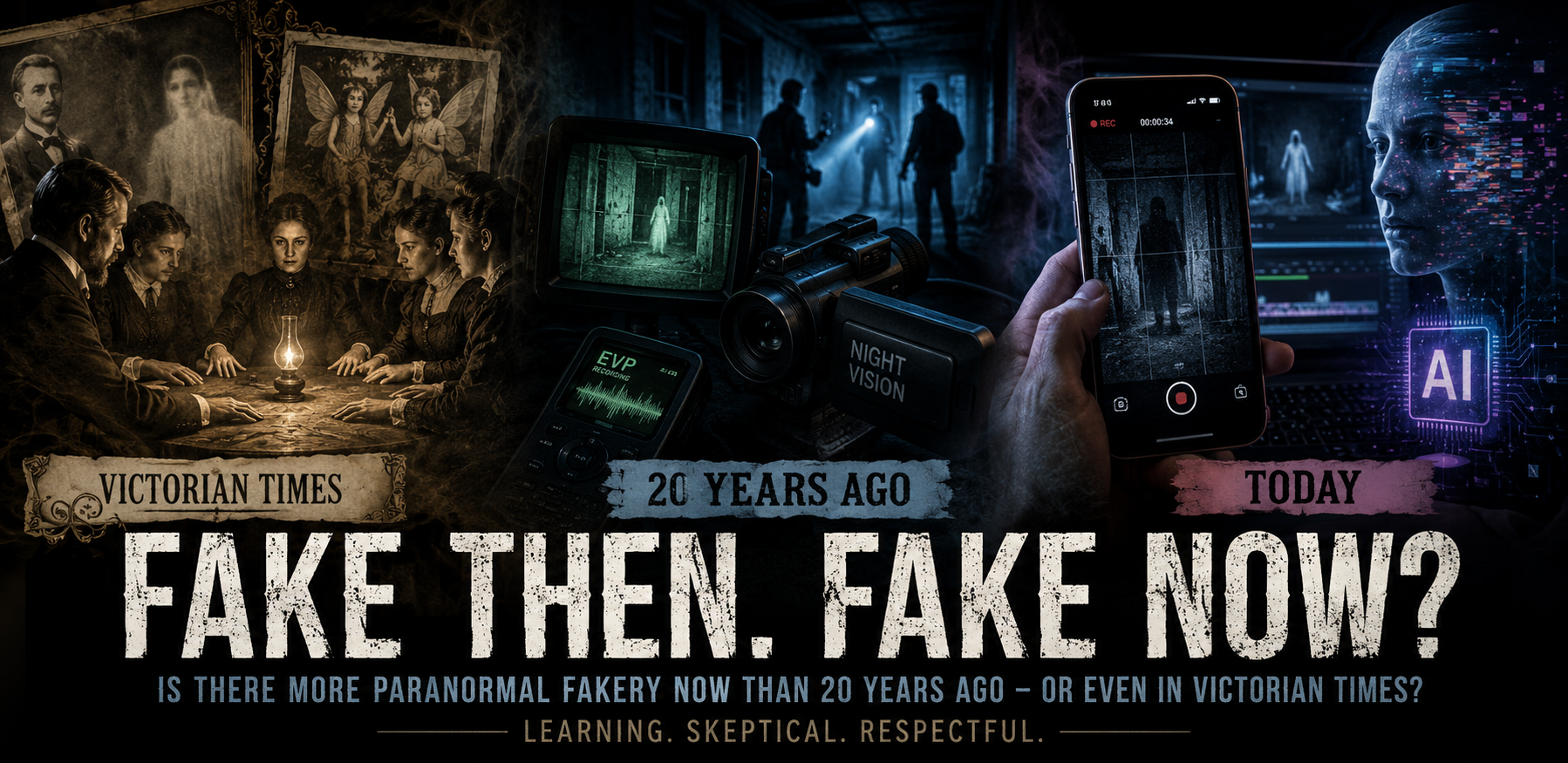
Every generation seems convinced that it lives in an age of unprecedented deception. Today we have artificial intelligence, deepfake videos, edited ghost-hunting clips on social media, and viral paranormal stories that can reach millions of people within hours. It is tempting to conclude that fakery has never been worse.
But history tells a more interesting story.
The Victorian era (1837–1901) was arguably one of the greatest periods of paranormal deception ever recorded. Twenty years ago, television was flooded with ghost-hunting programmes, many of which blurred the line between entertainment and investigation. Today, social media has transformed paranormal content once again, making it easier than ever to create convincing evidence—but also easier than ever to expose it.
So, are there really more fakes today? Or are they simply different?
As sceptics with open minds, it is worth looking at each era fairly.
The Victorian Age: When Ghosts Became Big Business

If there was ever a golden age of paranormal fraud, many historians would point towards the Victorian period.
Several factors came together perfectly:
High mortality rates, Frequent outbreaks of disease, Wars that left countless families grieving, The rapid rise of photography, A growing fascination with science and the afterlife
Many people desperately wanted proof that loved ones survived death. Unfortunately, some individuals saw an opportunity.
Spirit Photography
One of the most famous examples involved American photographer William Mumler.
He claimed his camera could capture spirits standing beside living relatives.
To modern eyes, the photographs are clearly double exposures or manipulated negatives. Yet during the 1860s, photography was still mysterious enough that many people believed the images were genuine. Mumler even photographed Mary Todd Lincoln, supposedly with the ghost of Abraham Lincoln standing behind her. Eventually, investigators demonstrated numerous ways such photographs could be faked, although Mumler avoided conviction due to insufficient evidence.
Britain experienced similar scandals.
William Hope became famous for “spirit photography” until paranormal investigator Harry Price demonstrated that photographic plates had apparently been switched during sittings, strongly suggesting deliberate fraud.
Fake Mediums
Victorian séances were often theatrical performances.
Some mediums used:
hidden assistants, concealed wires, glowing paint, fake ectoplasm made from cheesecloth or paper, musical instruments operated in darkness, secret compartments
Many audiences genuinely believed spirits were communicating with them.
Professional magicians such as Harry Houdini later spent years exposing fraudulent mediums because they recognised stage illusions being presented as genuine supernatural events.
The Cottingley Fairies
Perhaps the most famous British paranormal hoax involved two young girls who photographed cardboard fairy cut-outs.
Even Sir Arthur Conan Doyle accepted the photographs as genuine evidence.
The images fooled many intelligent people—not because they lacked intelligence, but because they genuinely wanted them to be true.
Twenty Years Ago: The Television Boom

Around twenty years ago, paranormal television exploded in popularity.
Ghost hunting moved from niche hobby to mainstream entertainment.
Programmes often featured: night vision cameras, infrared footage, EVP recordings, dramatic music, suspenseful editing, cliff-hangers before advert breaks
Most presenters never claimed outright that every piece of evidence proved ghosts.
However, television naturally rewarded exciting moments over uneventful investigations.
A five-hour investigation producing nothing interesting rarely made good television.
That doesn’t automatically mean evidence was fabricated—but editing sometimes created a stronger impression than the raw investigation might have deserved.
Meanwhile, digital photography introduced a new wave of misunderstandings.
Many famous “ghost photographs” from the early 2000s later turned out to involve: camera straps, dust illuminated by flash (“orbs”), motion blur, compression artefacts, lens flare
Unlike Victorian frauds, many of these images were probably honest mistakes rather than deliberate hoaxes.
Today: The Age of AI and Viral Content
Today’s paranormal world is completely different.
Almost everyone carries a 4K video camera, multiple editing apps, AI image generators, voice cloning software, instant access to millions of viewers
Creating convincing fake evidence has never been easier.
Neither has exposing it. Communities of photographers, visual effects artists and experienced investigators frequently analyse videos frame-by-frame within hours of publication.
Ironically, modern fakery often has a much shorter lifespan. Twenty years ago, a questionable photograph might circulate for months.
Today, it can be debunked worldwide before the day ends.
Have We Become Better Skeptics?
In many ways, yes.
The average person today understands photography and video editing far better than a Victorian audience.
People commonly ask:
- Could this be AI?
- Is there another camera angle?
- Has the original file been uploaded?
- Was this edited?
- Can someone reproduce the effect?
This level of healthy questioning simply wasn’t possible in the nineteenth century.
However, social media has also created another challenge.
Algorithms reward dramatic content.
A genuine investigation that produces nothing unusual rarely gains millions of views.
A shocking ghost video—even if fake—often does.
That creates a financial incentive for some creators to exaggerate or fabricate evidence.
Why People Still Believe
This question is more complicated than simply asking who is gullible. Throughout history, belief has often been driven by emotion rather than ignorance.
People may seek comfort after bereavement. Others have experienced something they genuinely cannot explain.
Many investigators who later exposed fraud actually began as believers. Equally, some sceptics have witnessed events they cannot easily dismiss. These experiences remind us why respectful discussion matters. Being sceptical does not mean dismissing every claim.
Being open-minded does not mean accepting every claim. The strongest investigations sit somewhere in the middle.
So… Which Era Had the Most Fakery?
Victorian Times
- Probably had the highest proportion of organised paranormal fraud.
- Fake mediums often charged significant sums.
- Many relied on the public’s limited understanding of new technologies.
- Some frauds continued for years before being exposed.
Twenty Years Ago
- Television encouraged sensational presentation.
- Digital cameras created countless accidental anomalies.
- Some investigations blurred the line between entertainment and research.
Today
- The sheer quantity of fake paranormal content is likely greater than ever because anyone can create and upload it instantly.
- AI, editing software and social media make fabrication easier.
- At the same time, independent investigators and online communities can often identify hoaxes much faster than in previous generations.
Paranormal Magazines Ending Statement.
History suggests that paranormal fakery is not a new problem—it simply evolves with technology, Victorian fraudsters mastered photographic plates and darkened séance rooms.
Television producers mastered editing and suspense, Today’s creators have AI, smartphones and global audiences, Yet one thing has remained remarkably consistent, most people interested in the paranormal are not looking to be fooled. They are searching for answers, That is why respectful scepticism remains the best approach.
We should investigate unusual claims with curiosity rather than cynicism, ask difficult questions without ridicule, and remember that exposing fraud ultimately protects genuine investigation. Every fake uncovered helps ensure that any truly unexplained evidence receives the careful attention it deserves.
After all, if the paranormal is real, then it has nothing to fear from honest scepticism. It is only deception that cannot withstand careful scrutiny.

