The Warren Legacy Under Fire: What the Evidence Shows—and What It Does Not
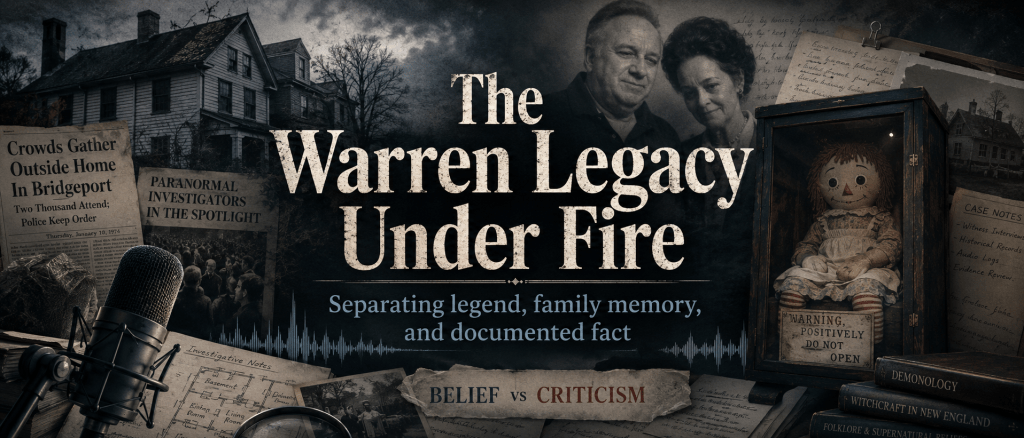
A recent video challenging Ed and Lorraine Warren’s history has prompted a public response from their grandson. Between accusations, family loyalty and decades of paranormal folklore, the truth is more complicated than either side’s strongest supporters may wish to admit.
Few names carry as much weight in paranormal culture as Ed and Lorraine Warren. To supporters, they were compassionate pioneers who entered frightening situations when families had nowhere else to turn. To critics, they were talented storytellers whose most famous cases became increasingly dramatic as books, lectures and films expanded their audience.
That long-running debate has resurfaced following a YouTube discussion featuring paranormal investigator Jason Hawes and researcher Stevie Etay of the Truth or Demons Podcast. The video examines the Warrens’ career, their celebrated cases and several objects associated with their collection.
Chris McKinnell, the Warrens’ grandson, subsequently published a personal defence of his grandparents. His statement did not portray them as flawless. Instead, he argued that they were imperfect people working in a field that had no established guidebook, and that later generations benefited from knowledge unavailable to the Warrens when they began.
The disagreement raises two separate questions that should not be confused: Were the Warrens good people who sincerely tried to help others? And were all the stories connected to their work historically accurate?
What the video argues
The video makes a broad case that stories surrounding the Warrens changed over time and that some claims attached to their cases and museum objects cannot be independently verified.
Among the subjects discussed are:
- The date and circumstances under which the Warrens began investigating paranormal claims.
- Different versions of the Annabelle story.
- The Warrens’ limited involvement in the Enfield poltergeist investigation.
- Alleged accidents and deaths associated with Annabelle.
- The origins of objects displayed as haunted or dangerous.
- The commercialization of the Warren name and collection.
- Serious allegations concerning the Warrens’ private lives.
The discussion includes references to newspaper articles, recordings, reverse-image searches and conversations with people connected to various cases. Some of those points are valuable and potentially verifiable. Others depend on personal recollections, unnamed sources or interpretations of incomplete records.
The video is best understood as a critical interview presenting research leads and arguments, rather than a finished historical investigation proving every allegation it contains.
Was NESPR founded in 1952?
The New England Society for Psychic Research identifies itself as having been founded by Ed and Lorraine Warren in 1952. That remains the organization’s official account. (warrens.net)
The video questions this timeline because its guest says she could not locate contemporary newspaper coverage showing the Warrens publicly working as paranormal investigators that early. She says the earliest material she found focused on their artwork, with clearer public references to paranormal work appearing much later.
This is a fair historical question, but it does not settle the matter.
An organization can exist informally before appearing in newspapers, directories or public records. Conversely, a date repeated by an organization many years later is not automatically independent proof that it was formally operating in its later-recognizable form at that time.
The responsible conclusion is that 1952 is the officially stated founding date, while the extent of the organization’s documented activity during its earliest years remains open to further research. The video does not prove that the date is false.
What happened in Bridgeport in 1974?
McKinnell’s statement refers to the widely publicized disturbances at a house on Lindley Street in Bridgeport, Connecticut. He argues that his grandparents did not manufacture the publicity: the family called for help, police arrived, the press followed and the situation quickly became uncontrollable.
The documented sequence substantially supports that portion of his statement.
Police reports reproduced in William J. Hall’s research describe officers being sent to the Goodin family home on November 24, 1974. Officers reported finding the interior in disarray, with broken dishes, overturned furniture and frightened occupants asking for assistance.
The story then attracted reporters, investigators and large numbers of onlookers. Accounts have placed the crowd outside the property in the hundreds.
None of this proves that a poltergeist was responsible.
Police eventually announced that the Goodins’ young daughter had been observed attempting to create at least one disturbance and had reportedly admitted to staging activity. Some witnesses nevertheless maintained that she could not explain everything they believed they had seen, including incidents said to have occurred when she was absent.
The facts establish that a frightened family contacted authorities, police documented considerable disorder and the case became a genuine media spectacle. Whether all the disturbances were fraudulent, misunderstood or paranormal remains disputed.
This distinction is important. Evidence that an incident occurred is not necessarily evidence that its supernatural explanation was correct.
The Warrens’ role in the Enfield case
One of the strongest factual criticisms in the video concerns the Enfield poltergeist, which inspired The Conjuring 2.
The central investigators were Maurice Grosse and Guy Lyon Playfair, who spent extensive periods with the Hodgson family and produced large quantities of notes and recordings. The Society for Psychical Research credits Grosse and Playfair with conducting the long-term investigation.
Playfair later stated that, apart from a casual visit, the Warrens did not investigate the case.
That does not mean the Warrens never entered the home or had no contact with people involved. It means that their role was far smaller than the central position given to them in the Hollywood version.
On this issue, the criticism is well supported: the film dramatically enlarged the Warrens’ importance to the Enfield investigation.
Hollywood adaptation, however, should not automatically be treated as evidence that the Warrens themselves authored every fictional element. Responsibility may also lie with screenwriters, studios and the demands of a film franchise. The historical record and the cinematic story must be evaluated separately.
Annabelle: documented doll, unproven explanation
The existence of the Raggedy Ann doll known as Annabelle is not in question. Neither is the fact that the Warrens displayed it and associated it with a disturbing case.
The official NESPR account says that a medium identified the presence as a seven-year-old girl named Annabelle, while the Warrens concluded that the doll was being manipulated by an inhuman or demonic force.
Those are claims, not scientifically demonstrated conclusions.
The video argues that details changed between early newspaper reports, books, television appearances and later retellings. Changing details matter, especially when names, ages, deaths, accidents or the supposed origin of an entity are presented as factual history.
At the same time, inconsistencies do not automatically reveal why a story changed. Possible explanations include faulty memory, careless retelling, dramatization, misunderstanding or deliberate invention. Determining which explanation applies requires side-by-side examination of the original sources.
The most honest conclusion is that Annabelle’s paranormal reputation has not been independently proven, and reported inconsistencies give investigators valid reasons to question the legend. That is not the same as proving that every witness intentionally fabricated every experience.
The motorcycle-death legend
One frequently repeated story claims that a young man mocked Annabelle and later died in a motorcycle crash.
The video correctly identifies a major evidentiary problem: publicly repeated versions generally fail to provide a verifiable name, exact date, police report, hospital record or clearly identified accident location.
Without those details, the story cannot responsibly be reported as established fact.
It is possible that an accident occurred and that identifying information was withheld. It is also possible that an unrelated accident became attached to the doll through repeated storytelling. Until primary documentation is produced, the appropriate classification is unverified legend—not proven history and not necessarily conclusively disproven.
Questions surrounding museum objects
The video also attempts to trace the origins of objects described as a “fire doll” and a mysterious baboon-like figure.
Reverse-image searching can be useful. It may reveal that an object closely resembles a commercial doll, Halloween prop or mass-produced collectible. In the case of an object supposedly connected to an older tragedy, evidence that the model was manufactured decades later would present a serious contradiction.
But resemblance alone is not complete authentication.
A conclusive identification would ideally include:
- Manufacturer records or markings.
- Clear photographs showing distinguishing features.
- Purchase or donation records.
- Statements from the object’s creator or original owner.
- A documented chain of custody.
- Evidence showing when the paranormal story was first attached to it.
The video raises legitimate questions that deserve answers. It does not, based on the interview alone, establish the full provenance of every disputed object.
When real deaths are incorporated into the history of a supposedly haunted artifact, the standard of evidence should be especially high. Families and victims should not become supporting characters in a paranormal attraction without a documented connection.
Is the video respectful?
The video begins from a reasonably balanced position. The host acknowledges the Warrens’ influence and says viewers should examine facts and reach their own conclusions.
As the conversation continues, however, the tone becomes less neutral. The speakers occasionally laugh about disputed stories, use dismissive language and make broad judgments about the Warrens’ honesty and legacy. The programme does not include a representative of the Warren family or NESPR responding to the specific evidence.
That does not invalidate its accurate points. Evidence remains evidence regardless of whether it is presented gently. But tone matters, particularly when discussing deceased people, grieving families and allegations that have never been tested in court.
The video would have been stronger had it more consistently separated four categories:
Documented fact, reasonable inference, unverified testimony and personal opinion.
At times, those categories are blended together.
What McKinnell’s post gets right
McKinnell’s response is considerably more restrained than many online arguments surrounding the Warrens.
He does not demand that his grandparents be considered perfect. He acknowledges that they made mistakes and argues that modern investigators have benefited from decades of additional research and experience. He also objects to turning real human beings into flawless heroes who must either remain on a pedestal or be completely destroyed.
That is a fair observation.
Historical figures should be examined honestly without being reduced to saints or villains. The Warrens can have helped frightened people, influenced the paranormal field and sincerely believed portions of their work while also making errors, exaggerating claims or using methods that would not satisfy modern standards.
Multiple things can be true simultaneously.
However, McKinnell’s post is primarily a defence of his grandparents’ intentions and character. It does not directly answer most of the video’s documentary questions. Saying that someone had a good heart cannot establish that a particular story was accurate. Likewise, identifying contradictions in a story does not prove that the person involved had a bad heart.
Character testimony and factual verification are different forms of evidence.
So who is in the wrong?
Neither side is entirely right or entirely wrong.
The video’s participants are right to examine the Warrens’ stories, challenge inconsistent accounts and demand primary documentation. No person’s fame, family status or influence should place their claims beyond examination.
They are on weaker ground when they treat missing evidence as definitive proof of fabrication, rely on hearsay, make conclusions from visual resemblance alone or use ridicule in place of careful argument.
McKinnell is right that his grandparents were human beings rather than fictional horror characters. He is also substantially correct that the Bridgeport case became a public spectacle after the family contacted authorities, rather than appearing to have begun as a publicity event created solely by the Warrens.
His defence becomes less persuasive only if positive memories or good intentions are treated as answers to specific historical contradictions.
A legacy between pioneering and mythology
The Warrens unquestionably helped bring paranormal investigation into popular culture. NESPR continues to describe their work as an effort to investigate paranormal and demonic phenomena and assist people reporting frightening experiences. (warrens.net)
Their influence does not establish the truth of every case attributed to them. Nor do inconsistencies in some cases erase every family they comforted, every event they attended or every person who sincerely believed they had been helped.
The paranormal community does not need to choose between unquestioning devotion and total condemnation.
A mature assessment of the Warren legacy should preserve original documents, identify the sources behind each claim, distinguish films from case histories and acknowledge uncertainty where evidence is missing. Supporters should not fear legitimate questions. Critics should not present speculation as proof simply because it points in a skeptical direction.
Ed and Lorraine Warren’s legacy is neither the flawless love story portrayed by Hollywood nor a case that can be dismissed with a few online discoveries.
It is a complicated piece of paranormal history—part investigation, part personal belief, part popular entertainment and, in some places, unresolved controversy.
The truth will not be protected by placing the Warrens on a pedestal. It will not be found by knocking them from it, either.
NEW ARTICLE PUBLISHED PART 2.

Posted on July 24, 2026, in Uncategorized and tagged debunked, ghost. Bookmark the permalink. Leave a comment.


Leave a comment
Comments 0