Blog Archives
Fallout Grows Over Warren Legacy Interview as Jason Hawes and Ryan Buell Trade Public Statements
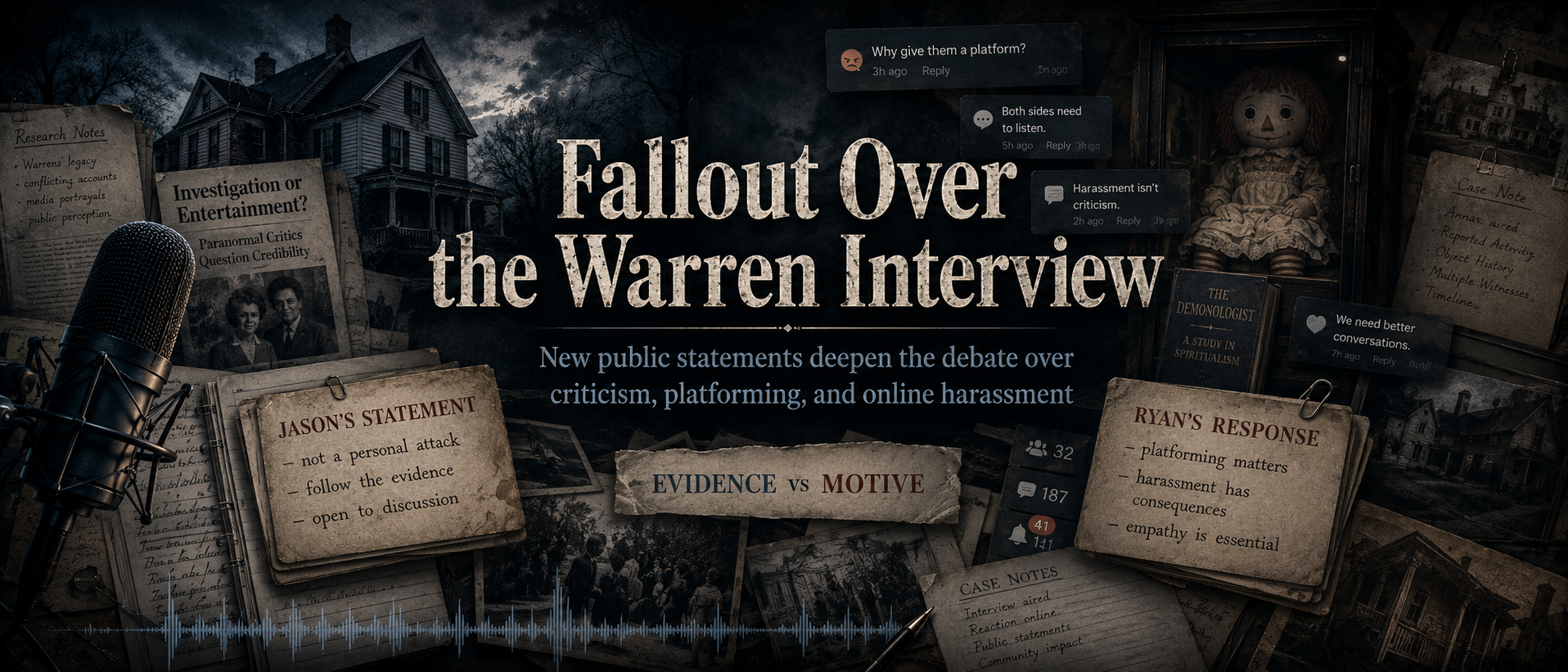
A debate that began with questions about Ed and Lorraine Warren’s historical claims has widened into a dispute over platforming, cyberbullying, editorial responsibility and the difference between criticism and harassment.
The controversy surrounding a recent discussion of Ed and Lorraine Warren’s legacy has intensified after paranormal investigators Jason Hawes and Ryan Buell issued sharply different public statements about the programme and its consequences.
The original video featured Hawes speaking with Stevie Etay of the Truth or Demons Podcast. During the lengthy conversation, the pair examined the Warrens’ history, the origins of several well-known stories and alleged inconsistencies involving cases and objects associated with the New England Society for Psychic Research, commonly known as NESPR.
The discussion included legitimate historical questions, personal recollections, disputed allegations and criticism of how the Warrens’ legacy has been presented to the public. It also touched briefly on an uncomfortable allegation involving Ed Warren’s private life.
Following criticism of the episode, Hawes defended the programme by saying it was never intended as a personal attack or smear campaign. Buell has now challenged that explanation, arguing that Hawes gave a major platform to someone Buell accuses of engaging in repeated online harassment.
The result is no longer simply a disagreement about whether old paranormal stories withstand modern scrutiny. It has become a wider argument about how paranormal researchers investigate one another, how serious accusations should be presented and what responsibility influential creators carry when promoting controversial voices.
Jason Hawes defends the purpose of the interview
In his public response, Hawes said the programme was about determining whether historical claims still hold up when compared with documented evidence.
According to Hawes, some people are willing to accept extraordinary claims without sufficient support but become uncomfortable when researchers discover records that contradict established narratives.
“This field should always be about searching out the truth, not just taking somebody’s word for it,” Hawes wrote.
That principle is difficult to dispute. Paranormal claims should not be protected from examination because they involve respected investigators, famous families or culturally important cases. Newspaper archives, police reports, recordings, photographs and contemporary witness accounts can all help determine how stories developed over time.
Hawes also addressed the personal allegation mentioned near the end of the video. He said it was raised briefly because ignoring it could have led viewers to accuse the programme of deliberately overlooking a major part of the controversy.
There is some merit to that position. When a serious allegation has already become part of the public historical discussion, complete silence may appear selective. However, acknowledging an allegation and proving it are not the same thing. Such subjects require careful attribution, context and language that makes clear what has been established and what remains disputed.
Ryan Buell questions the guest and the platform
Buell’s response does not primarily defend the historical accuracy of the Warrens’ paranormal claims. Instead, he focuses on the conduct and reputation of Hawes’s guest.
Buell accuses Etay of having an extensive history of cyberbullying and targeting people within the paranormal community, particularly NESPR and its supporters. He also alleges that she uses an alias to conceal her identity and personal history.
These are serious allegations. In the post provided, however, Buell does not include screenshots, links, dates or a detailed chronology demonstrating the conduct he describes. His claims should therefore be reported as allegations rather than established facts.
Using a professional name or online alias is not, by itself, evidence of dishonesty. Many writers, performers, researchers and creators use pseudonyms for privacy or branding. It would become relevant if someone were using an alias to impersonate others, avoid legal accountability, conceal important conflicts of interest or return after being removed from platforms. Buell’s statement does not document those circumstances.
Buell further argues that Hawes failed to challenge the guest’s motives, research methods or personal conduct. By featuring her on a large platform and repeatedly praising her work, Buell believes Hawes gave her credibility and may have emboldened people involved in hostile online behaviour.
This criticism raises a legitimate editorial question.
Inviting someone onto a programme does not automatically mean endorsing everything that person has ever said or done. Journalists, podcasters and investigators frequently interview controversial people. Nevertheless, when an interview is overwhelmingly supportive and contains little meaningful challenge, audiences may reasonably perceive the appearance as an endorsement of the guest’s work and reliability.
Was the original discussion fair and balanced?
The programme contained several defensible lines of inquiry.
The speakers discussed changing accounts of the Annabelle story, questioned whether certain legends can be linked to police or newspaper records and examined the degree of the Warrens’ involvement in cases later dramatized by Hollywood. They also raised questions about the provenance of objects promoted as haunted.
Such claims should be investigated.
However, the programme was not a formally balanced debate. No representative from NESPR, no member of the Warren family and no historian presenting a different interpretation appeared during the discussion. Hawes and his guest agreed on most major points, and several claims were accepted without rigorous questioning.
The discussion also blended different standards of evidence.
At various moments, the speakers referred to historical articles and recordings. Elsewhere, they relied on personal conversations, unnamed sources, visual comparisons, internet searches and speculation about motives. Those sources do not all carry equal evidentiary weight.
A contemporary newspaper report may establish that a person made a statement at a particular time. It does not automatically prove the statement was true. A reverse-image search may show that an object resembles a commercial product. It does not necessarily establish the history of the exact object in a museum. An inability to locate a record may make a story doubtful, but it does not always prove that the event never occurred.
The video would have been stronger had it consistently labelled each point as documented fact, reasonable inference, disputed testimony, unverified claim or personal opinion.
Criticism is not automatically harassment
Buell is correct that cyberbullying and targeted harassment are genuine problems.
Criticism can cross a line when people encourage followers to overwhelm an individual, repeatedly tag family members, publish private information, make threats, contact employers or relatives, or coordinate efforts intended to frighten and exhaust someone.
The paranormal community’s interest in public cases does not justify attacking private individuals or grieving families.
At the same time, repeated criticism of a public organisation or influential investigator does not automatically constitute harassment. Researchers are allowed to revisit claims, identify contradictions and publish critical conclusions. Even forceful or uncomfortable commentary is not necessarily bullying.
Determining whether Etay or her associates engaged in harassment would require examining the actual posts, messages, context and patterns of conduct. Buell’s characterisation alone cannot settle that question.
It is also important to separate the researcher from the research. A person may behave poorly and still identify a genuine contradiction. Conversely, someone may be respectful and sincere while promoting an inaccurate claim.
The history of Annabelle, Enfield or any other Warren case must be evaluated through evidence, not solely through opinions about the people discussing it.
Questions about editorial responsibility
Buell criticises Hawes for apparently failing to contact NESPR or members of the Warren family before releasing the interview.
If no opportunity for comment was offered, that was a missed opportunity.
A response from NESPR would not have guaranteed agreement, but it could have clarified dates, corrected errors, supplied documentation or shown viewers exactly where the two sides differ. Even a statement that NESPR declined to participate would have demonstrated an attempt to include the organisation’s position.
Hawes was under no absolute obligation to create a formal debate. His programme is not a court proceeding. However, the more serious and personal the allegations become, the stronger the case for contacting those accused before publication.
Buell goes further by warning that someone will eventually be hurt and suggesting that Hawes may share responsibility because he helped amplify the guest.
That argument currently goes beyond the available evidence.
There is no indication in the programme that Hawes instructed viewers to threaten, contact or harass anyone. Promoting a creator may increase that person’s influence, but it does not automatically make the host responsible for every future action taken by the guest, her followers or unrelated commenters.
Jason’s responsibility would depend on what he knew, what he encouraged and how he responded to credible evidence of abuse. Those facts have not been publicly established in the statements examined here.
The significance of Buell acknowledging his own past
Buell anticipates that critics may question his authority to speak about harmful conduct because of his own widely discussed history.
He openly acknowledges that he hurt people while struggling with active drug addiction and says he faced consequences and worked to change his life. He argues that this experience gives him insight into misconduct and accountability.
Acknowledging previous wrongdoing is preferable to pretending it never occurred. It does not automatically prove that Buell’s current allegations are correct, but neither does his past disqualify him from raising concerns.
The accuracy of his claims must be judged on evidence, just as the claims made in the original Warren discussion must be judged on evidence.
Where Jason’s response falls short
Hawes is justified in rejecting the idea that historical claims should become off limits simply because they involve famous or deceased investigators.
However, his description of the programme as an examination of claims against documented evidence is incomplete.
The discussion also included opinions about character, speculation concerning financial motives, private allegations, hearsay and openly dismissive comments. At points, the tone included laughter and ridicule.
That does not mean the entire programme was a smear campaign. A smear campaign generally involves knowingly spreading false or misleading information for the purpose of damaging someone. That intention has not been demonstrated.
Nevertheless, a programme can be created without malicious intent and still be one-sided, insufficiently challenged or unnecessarily personal. Intent and effect are not always identical.
Where Ryan’s response goes too far
Buell is justified in asking whether Hawes properly vetted his guest and whether NESPR should have been contacted.
He is also justified in warning that online disagreements can become harmful when followers begin treating criticism as permission to target individuals.
But Buell’s post relies heavily on accusations about Etay’s character without presenting the evidence necessary for readers to assess them. Calling someone a relentless cyberbully is a significant claim. It should be supported with examples that distinguish research, criticism and sarcasm from actual harassment.
His prediction that someone “will” be hurt also escalates the dispute. Unless there are specific threats or documented plans that have not been included publicly, the statement risks implying a certainty that has not been established.
What is actually known?
At present, several points can be stated with reasonable confidence.
Hawes hosted a strongly critical discussion of the Warrens with a guest whose work he openly praised. The programme questioned multiple established paranormal narratives and included a serious personal allegation.
Hawes says the purpose was historical scrutiny rather than personal attack.
Buell believes the guest has engaged in harmful online conduct and argues that Hawes irresponsibly amplified her. The public statement provided does not independently document those allegations.
The video was not fully balanced in the conventional journalistic sense, and it appears that no representative from NESPR or the family participated.
There is currently no evidence in the material reviewed that Hawes directly encouraged harassment.
These facts leave substantial room between the two most extreme interpretations.
A dispute now overshadowing the evidence
The original conversation began with a worthwhile question: Do the stories surrounding the Warrens withstand examination against contemporary records?
That question risks being lost as the disagreement shifts towards accusations about personalities, hidden motives and online behaviour.
NESPR and the Warren family should be able to respond to factual criticism without being harassed. Researchers should be able to examine the Warren legacy without automatically being branded enemies or trolls. Critics who make serious allegations should support them. Defenders who dispute research should answer the evidence rather than relying only on character testimony.
Hawes was not wrong to host a critical discussion. He should, however, have challenged the evidence more consistently and made a stronger effort to include a response from those being criticised.
Buell was not wrong to raise concerns about platforming and online conduct. He should support his allegations with material that readers can independently evaluate and avoid assigning responsibility for hypothetical future harm without a clearer factual basis.
The paranormal field frequently asks the public to distinguish unexplained experiences from assumption and legend. Its leading voices should apply the same discipline to disputes within their own community.
Until further evidence is produced, neither side has established that the other acted as part of a deliberate campaign. What has been established is that the discussion was one-sided, the response was highly accusatory and the original historical questions remain largely unresolved beneath the growing personal conflict.
Editor’s note: This article reports and analyses public statements supplied to the publication. Allegations of cyberbullying, harassment and private misconduct have not been independently established within the material reviewed and are presented as claims rather than proven facts.
When the Search for the Unknown Meets the Search for Clicks: A Respectful Look at the State of Paranormal Investigating FT: Ghosts On Trent
The paranormal community has always been driven by curiosity. Whether it’s exploring allegedly haunted locations, researching local history, testing new equipment, or simply trying to understand experiences that defy explanation, most investigators begin with the same goal: to search for answers.
Over the last decade, however, the paranormal world has changed dramatically. Social media platforms like YouTube, TikTok, Facebook and Instagram have introduced the subject to millions of people around the world. That has undoubtedly helped the community grow, but it has also changed the way investigations are presented and, in some cases, the motivations behind them.
A recent post by Ghosts On Trent has sparked discussion across the paranormal community. Their message suggests that genuine investigation is increasingly being overshadowed by entertainment, social media popularity and influencer culture.
It’s a thought-provoking point, but like most things in the paranormal world, the reality isn’t quite as simple as one side being right and the other being wrong.
The Main Concerns
Ghosts On Trent raise several important issues.
They question whether some investigators are becoming influencers before they become researchers. They suggest that popularity on social media can sometimes outweigh experience and credibility, and they express concern that paranormal events may be favouring creators with the largest audiences over those with years of investigative knowledge.
They also argue that chasing views, revenue and online recognition risks damaging the credibility of paranormal investigating. Whether you completely agree or not, these concerns are worthy of discussion.
Social Media Has Changed the Paranormal
There is little doubt that social media has transformed the paranormal community. Years ago, investigations were shared through local groups, forums, DVDs and word of mouth. Today, a single investigation can reach hundreds of thousands of people within hours. That’s not necessarily a bad thing.
Social media has introduced thousands of people to paranormal investigating who may never have discovered it otherwise. It has allowed small teams to reach global audiences, encouraged collaboration and opened conversations that simply weren’t possible twenty years ago.
However, social media also rewards excitement. Videos with dramatic music, emotional reactions, bold claims and eye-catching thumbnails naturally attract more attention than a quiet investigation where very little happens. Unfortunately, that creates pressure.
A completely honest investigation that ends with “we didn’t capture anything conclusive tonight” rarely performs as well as one claiming to have found undeniable evidence.
When Views Start Driving Investigations
Good investigations take time. Researching a location’s history. Learning about previous reports.
Testing equipment. Ruling out natural explanations before jumping to paranormal conclusions. None of these things make particularly exciting short videos, yet they’re often the most important parts of an investigation.
The danger is that investigators can begin feeling pressure to make every unexplained noise, shadow or equipment anomaly seem paranormal because that’s what audiences have come to expect.
That doesn’t automatically mean they’re being dishonest. Sometimes it’s simply the reality of creating content in an online world where excitement is rewarded.
Clickbait: Part of the Modern Landscape
One word that’s become almost impossible to avoid is clickbait. It’s often used as criticism, but the truth is that almost every successful creator uses eye-catching titles and thumbnails to some degree. That’s not unique to the paranormal community—it’s simply how YouTube and social media work.
Even many of the most respected paranormal channels use intriguing titles designed to make people curious enough to click. Without them, their content may never reach the audience it deserves. The important distinction isn’t whether a title is dramatic.
It’s whether the investigation delivers on that promise. There’s nothing wrong with making people curious enough to watch. Problems begin when evidence is exaggerated, speculation is presented as certainty, or ordinary events are deliberately made to appear paranormal simply for entertainment.
Perhaps that’s where the real conversation should be. Not whether creators use exciting titles—because almost everyone does—but whether the investigation itself remains honest, balanced and transparent.
Everyone Wants Their Work to Be Seen
One point that’s often overlooked is this: if someone uploads their investigations to social media, they clearly want people to watch them. That’s true whether they’re a small local team with a few hundred followers or a channel with hundreds of thousands of subscribers.
People share their work because they want it to be seen. They want discussion. They want feedback.
They want their investigations to reach an audience. In that sense, everyone is chasing views.
The difference is that for many investigators, views are simply the way their work reaches people—they’re not the reason they investigate.
There’s nothing wrong with wanting your hard work to be watched and appreciated. The problem only begins if the pursuit of views becomes more important than honesty, evidence and integrity.
The Convention Debate
Ghosts On Trent also questioned whether paranormal conventions are favouring creators with the biggest online audiences.
There is some truth to the idea that popular creators help sell tickets. Event organisers are businesses, and successful events need visitors to survive. However, that’s only part of the picture.
Many event companies actually invite a mixture of guests. Alongside well-known YouTube personalities, you’ll often find historians, authors, experienced investigators, equipment specialists and researchers who take a far more scientific or evidence-based approach.
That’s because visitors attend these events for different reasons. Some enjoy hearing exciting investigation stories. Others want to learn about historical research, investigation techniques or the science behind certain equipment.
A balanced line-up benefits everyone. It allows attendees to hear different viewpoints, compare methods and decide for themselves what resonates most.
Rather than seeing these different styles as competitors, perhaps they’re simply serving different parts of the same community.
Popularity Doesn’t Equal Credibility
It’s also important not to assume that having a large audience automatically makes someone less credible.
Many successful creators invest enormous amounts of time researching locations, improving their methods and presenting investigations responsibly, Equally, having a small audience doesn’t automatically make someone an expert.
Credibility isn’t measured by subscriber counts, It’s measured by honesty, consistency, transparency and a willingness to question your own conclusions—even when they aren’t exciting.
The Importance of Critical Thinking
Perhaps the biggest danger in paranormal investigating isn’t social media at all, It’s confirmation bias.
When investigators arrive expecting paranormal activity, it’s easy to interpret every sound, shadow or equipment response as evidence, Responsible investigators challenge themselves.
They look for ordinary explanations before extraordinary ones, Ironically, doing so often makes genuinely unexplained experiences even more compelling.
A Community That Needs Every Perspective
Perhaps the most interesting aspect of this debate is that every part of the paranormal community depends on the others more than many people realise.
Entertainment-focused channels introduce huge numbers of people to paranormal investigating. For many viewers, these creators are the gateway into the subject. Without that exposure, the paranormal community would almost certainly be much smaller.
At the same time, evidence-based investigators, sceptics and debunkers play an equally important role. They encourage critical thinking, test claims and remind the community that extraordinary claims deserve careful examination.
In many ways, it’s a catch-22, Without exciting investigations attracting large audiences, there would be far fewer claims for researchers and debunkers to analyse. Likewise, without people asking difficult questions and challenging evidence, investigative standards would likely suffer.
Whether people realise it or not, both sides help shape the paranormal community, Neither exists entirely in isolation.
Respect Matters
One thing Ghosts On Trent deserve credit for is that their post focused on wider trends rather than publicly attacking individual creators, Healthy discussion benefits the community, Respectful disagreement encourages better standards.
Personal attacks rarely solve anything, The paranormal world has always been filled with different beliefs, different methods and different opinions. That’s part of what makes it fascinating.
Is Ghosts On Trent Completely Right?
Not entirely, The concerns they raise are genuine, but the situation is more complex than simply blaming social media or content creators, Social media has undoubtedly encouraged some sensationalism.
At the same time, it has also helped grow the paranormal community, introduced new generations to investigating and given independent researchers opportunities that simply didn’t exist twenty years ago.
Like any tool, social media depends entirely on how it’s used, The real issue isn’t technology, It’s integrity.
The Balance
Perhaps the future of paranormal investigating lies somewhere in the middle, Creators should be able to produce entertaining, engaging content without exaggerating evidence.
Researchers should embrace modern platforms without abandoning good investigative methods, Audiences should recognise that not every investigation ends with dramatic proof—and that’s perfectly acceptable.
Paranormal Magazines Ending statement.
Ghosts On Trent have started an important conversation, and that’s something the paranormal community should welcome.
Whether you’re an experienced investigator, a content creator, a sceptic or simply someone fascinated by the unknown, credibility should always remain at the heart of what we do.
At the same time, we should recognise that the paranormal community is made up of many different voices. Some educate through historical research. Some entertain through immersive investigations. Some challenge claims through sceptical analysis. All have contributed, in one way or another, to making the paranormal more accessible than ever before.
Perhaps the goal shouldn’t be deciding which approach is “right,” but encouraging every creator to be honest about what they present. Views will always matter because they allow investigations to reach an audience. Selling tickets will always matter because events need to survive. Entertainment will always matter because it inspires curiosity.
But above all else, integrity should matter most.
If the paranormal community can hold on to that, then there is room for researchers, entertainers, sceptics, historians and investigators alike—each playing their own part in the continuing search for the unknown.
there will be a part 2 more focused on produced fake evidence and the damage,
visit PARANORMAL DEBUNKED to view all our articles like this.
Elizabeth The Haunted Bridal Doll Returns To The Headlines Following Fresh Media Coverage
Britain’s most talked-about haunted bridal doll is back in the spotlight after being featured by both Manchester Evening News and Yorkshire Live, introducing the controversial paranormal case to a new generation of readers.
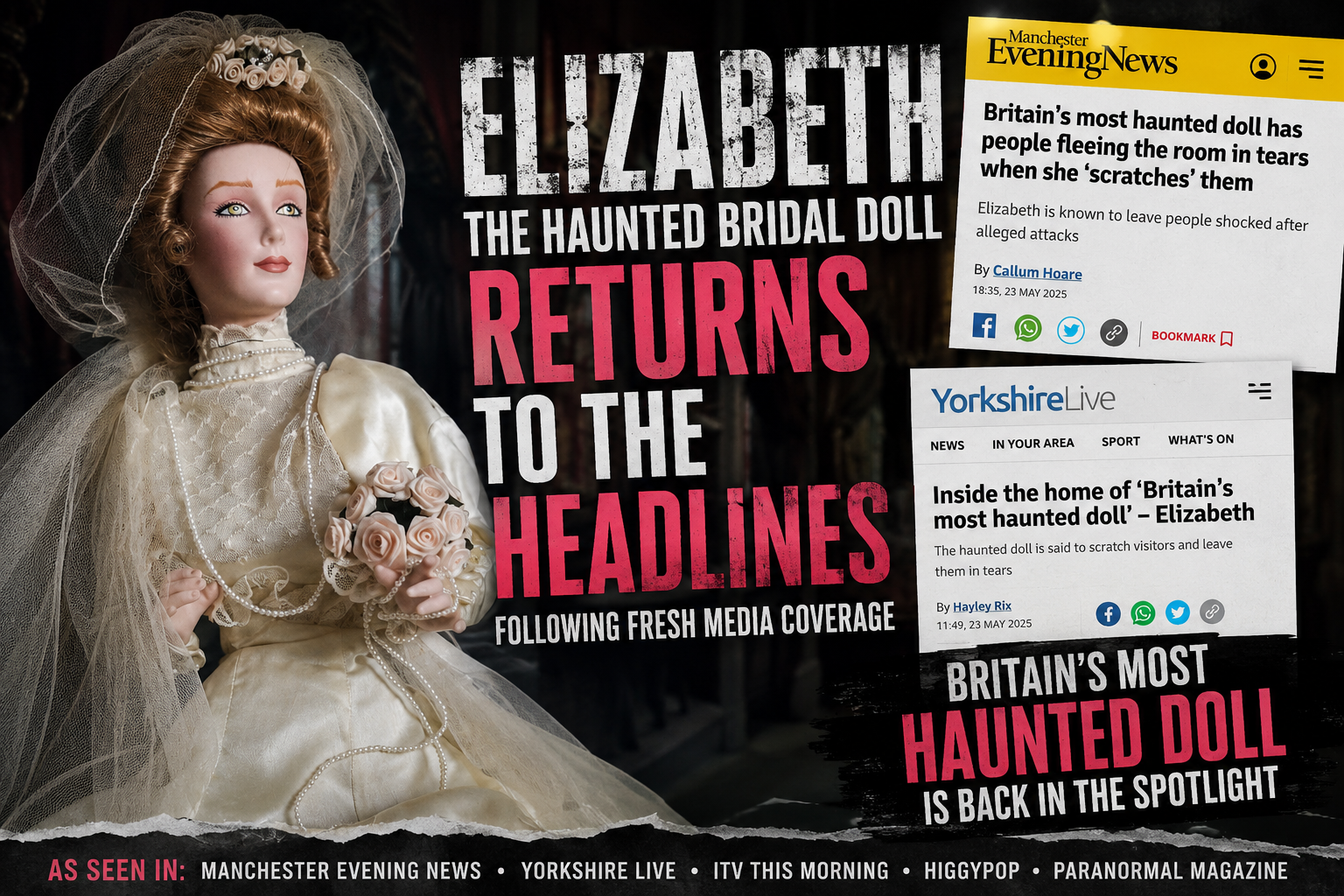
For over a decade, Elizabeth has remained one of the UK’s most discussed allegedly haunted objects, attracting investigators, sceptics, believers and curious members of the public from across the country.
Now, following fresh coverage by major regional news outlets, interest in the doll has surged once again.
The recent articles have reignited debate surrounding the infamous bridal doll, with thousands of readers sharing their opinions online and asking the same question that has followed Elizabeth for years:
Is Britain’s most haunted doll genuinely haunted, or is she simply one of the most fascinating paranormal legends of modern times?
A Story That Refuses To Go Away
Unlike many paranormal stories that briefly capture public attention before disappearing, Elizabeth has continued generating headlines, investigations and public discussion for years.
The doll first gained notoriety after reports of unexplained activity linked to previous ownership. Since then, the story has expanded through paranormal investigations, witness testimonies, television appearances and social media coverage.
Over the years, visitors and investigators have reported a variety of strange experiences while in the doll’s presence, including unexplained scratches, feelings of unease, emotional reactions and other incidents that believers argue cannot be easily explained.
While sceptics maintain that psychological factors and suggestion may play a role in such experiences, the volume of reports has helped cement Elizabeth’s reputation as one of Britain’s most controversial haunted objects.
Why Is Elizabeth Trending Again?
The latest wave of media attention appears to have introduced the story to a completely new audience.
Coverage from Manchester Evening News and Yorkshire Live has brought renewed focus to the case, with social media users sharing videos, articles and personal opinions about the doll.
Many readers encountering Elizabeth for the first time have been surprised to discover that the story stretches back more than a decade and continues to attract interest today.
The renewed attention demonstrates something unusual about the case.
Despite years passing since the earliest reports, public fascination surrounding Elizabeth shows little sign of fading.
From Paranormal Investigation To National Recognition
Elizabeth’s story has grown far beyond the boundaries of the paranormal community.
The doll has been featured in investigations, documentaries, interviews and media reports, becoming one of the most recognisable allegedly haunted objects in Britain.
What makes the case particularly unique is its longevity.
Each year seems to bring a new wave of interest, with fresh audiences discovering the story through television, online videos, newspaper features and social media discussions.
The latest media coverage is simply the newest chapter in a story that continues to evolve.
Believers Vs Sceptics
As with all paranormal cases, opinion remains divided.
Supporters of the case point to years of witness accounts and reported experiences surrounding the doll.
Critics argue that expectation, suggestion and psychological influences may explain many of the reported incidents.
Regardless of where people stand on the debate, one thing remains clear:
Elizabeth continues to generate discussion, attract media attention and capture public imagination in a way few haunted objects ever achieve.
The Story Continues
Whether viewed as a genuine paranormal mystery, a psychological phenomenon or a modern piece of British folklore, Elizabeth remains one of the country’s most talked-about haunted dolls.
The recent coverage from Manchester Evening News and Yorkshire Live has once again placed the doll firmly in the public eye, proving that more than a decade after the story first emerged, fascination with Elizabeth remains as strong as ever.
As new readers discover the case and old followers revisit the story, Britain’s most haunted bridal doll continues to make headlines.
And if recent events are anything to go by, Elizabeth’s story is far from over.
Have You Experienced Elizabeth?
Have you visited Elizabeth, attended an investigation involving the doll or experienced something you cannot explain?
Share your experience in the comments below.

Elizabeth’s Lockout: Did Britain’s Most Haunted Doll Try To Stop Visitors Entering?
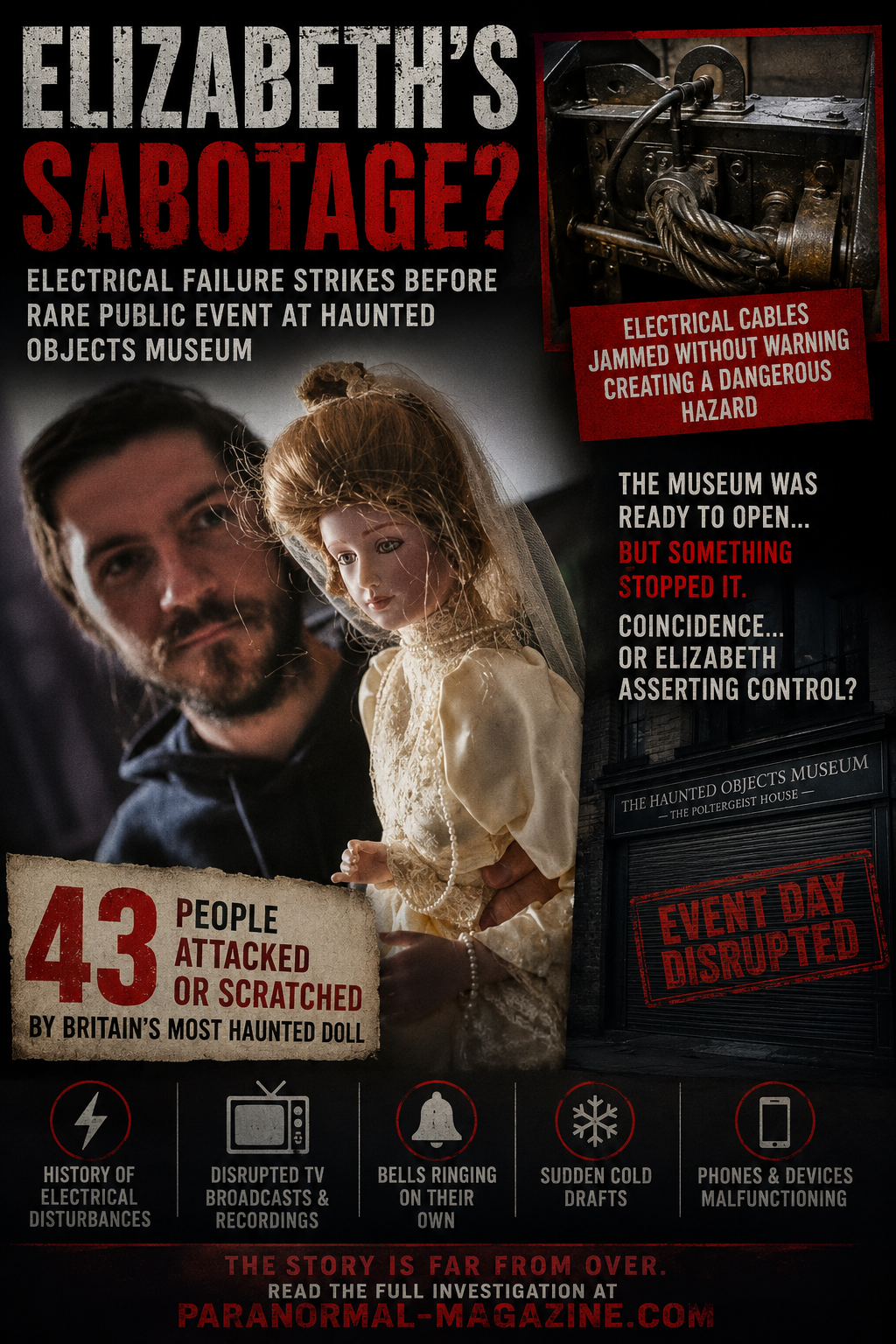
ROTHERHAM, UK — Just hours before a rare public open day at the Haunted Objects Museum, an unexpected mechanical failure left staff scrambling and visitors waiting outside.
The heavy security shutters providing access to the museum suddenly failed while preparations were underway, despite having operated normally every day in the lead-up while the building was being cleaned, painted, and prepared for the event.
When inspected, the internal cable mechanism had somehow become jammed within the housing — creating what staff described as a potentially dangerous electrical issue involving the main power system.
For paranormal investigator Lee Steer, owner of the infamous bridal doll Elizabeth, the timing felt difficult to ignore.
Strange Timing
Elizabeth — often referred to in paranormal circles as Britain’s Most Haunted Bridal Doll — has long been associated with reports of unusual electrical disturbances.
Over the years, claims connected to the doll have included:
- fire alarms activating unexpectedly
- lights flickering
- electrical faults
- camera malfunctions
- recording issues
- unexplained disturbances during investigations
While sceptics may point to coincidence or mechanical failure, the fact the shutter problem happened on the exact morning of a rare public event immediately raised eyebrows among visitors.
Was it simply bad luck?
Or another strange incident in Elizabeth’s long and controversial history?
A Rare Public Appearance
The museum’s public event was significant because daytime access to Elizabeth is unusual.
Visitors had travelled from across the UK to see the doll, with paranormal equipment set up throughout the room to document any unusual activity.
During the event itself, guests later reported:
- cold drafts
- hair being pulled
- personal items moving
- phone malfunctions
- unusual reactions to paranormal equipment
Coincidence — Or Part Of The Story?
No direct evidence links Elizabeth to the shutter malfunction.
But for followers of the case, the incident adds another curious chapter to a story that has already included national TV appearances, media attention, and years of strange claims surrounding the doll.
Whether coincidence, environmental fault, psychology, or something harder to explain…
Elizabeth continues to generate stories.
visit Elizabeth HOMEPAGE
Visit Elizabeth VIDEOS
Visit Elizabeth NEWS AND MEDIA
 Paranormal Magazine UK