Blog Archives
How Responsible Are Paranormal / debunkers / podcast Content Creators for Their Comment Sections?
In the paranormal podcast and debunking community, online arguments are nothing new. But when comment sections turn toxic, how much responsibility should fall on the person who made the content?
The paranormal community has always had its disagreements. Believers, investigators, sceptics and debunkers often have very different opinions, and that’s perfectly fine. Questioning evidence and challenging claims are part of a healthy discussion. But sometimes those discussions turn nasty, particularly in the comment sections of podcasts, YouTube videos and social media posts.
When this happens, you’ll often hear creators say, “I’m not responsible for what other people comment. Everyone has their own opinions.” And to a certain extent, they’re right. Nobody can control what another person thinks or chooses to write online.
But does that mean content creators have no responsibility at all?
The Tone Starts With the Creator
Something that often gets overlooked is how much the tone of a video or podcast can influence the people watching or listening.
Think about it. If a debunker makes a funny, light-hearted video about a piece of paranormal footage, there’s a good chance the comments will follow that same tone. People will make jokes, have a laugh and perhaps share their own thoughts about the evidence. Now imagine that same footage being discussed in an angry video. The creator is clearly frustrated, speaking aggressively and getting worked up about the people involved. It’s hardly surprising if the comments become more heated too.
Then there’s the content that relies heavily on insults, mocking people and making them look stupid. When a creator spends an entire video putting someone down, should they really be surprised when their audience starts doing the same? Of course, not everyone will react in the same way. Even the friendliest videos can attract horrible comments.
But the tone you set often influences the tone you get back.
And this isn’t just a paranormal community problem. You’ll see exactly the same thing in gaming, sports, politics and just about any other online community.
There’s a Difference Between Criticism and Personal Attacks
Debunking paranormal evidence is not toxic in itself.
There’s nothing wrong with pointing out that a supposed ghost might be dust, an insect or a camera effect. Equally, there’s nothing wrong with a paranormal investigator questioning a debunker’s explanation. That’s how conversations should work.
The problem starts when the focus shifts away from the evidence and onto attacking the person. You can disagree with someone’s footage without calling them stupid. You can question someone’s investigation without insulting their appearance, their intelligence or their character. And this works both ways. Paranormal investigators can be just as guilty of encouraging negativity towards debunkers and sceptics.
Nobody should be above criticism, but criticism doesn’t have to be cruel.
So Who Is Actually Responsible?
Ultimately, the person writing a nasty comment is responsible for what they say. That shouldn’t be forgotten. However, creators also have some responsibility for the community they encourage.
If a podcast host or debunker constantly mocks people, uses insulting language and then laughs along with abusive comments, they’re helping create an environment where that behaviour feels acceptable.
Likewise, if a creator encourages respectful disagreement, doesn’t join in with personal attacks and makes it clear that harassment isn’t welcome, that can influence the audience in a more positive direction. It doesn’t mean creators should have to police every single comment or take the blame for everything their followers do. But there’s a big difference between not being able to control your audience and having absolutely no influence over them.
Can Things Be Better?
The paranormal and debunking communities don’t need to agree on everything. In fact, they probably never will, and that’s not necessarily a bad thing.
A bit of humour, healthy debate and even the occasional heated disagreement are all part of discussing subjects people feel strongly about. But perhaps creators on both sides could think a little more about the atmosphere they’re creating.
Are they encouraging people to question the evidence, or simply encouraging them to dislike the person presenting it? Are they making jokes about a situation, or turning an individual into the joke? And when their comment sections become hostile, are they genuinely surprised, or does that hostility reflect the tone of their own content?
Final Thoughts
I don’t believe content creators should be held responsible for every comment left on their videos or podcasts. People have their own minds and should be accountable for their own words.
But I also don’t believe creators can completely distance themselves from the communities they build.
If you create content that’s funny and welcoming, you may encourage a funny and welcoming audience. If you create content built around anger and insults, you shouldn’t be surprised when some of that anger and those insults appear in your comments.
It won’t happen every time, but the influence is there. And whether you’re a paranormal investigator, a podcast host, a believer or a debunker, the same principle applies. You can’t control everything your audience says, but you can certainly influence the kind of conversation you start.
the question isn’t whether creators are responsible for every comment. It’s whether they’re willing to take responsibility for the tone they set.
Spirit Box Videos on the Recently Deceased Need to Stop
There is something about recent spirit box videos that does not sit right with me, When somebody has only just passed away, especially if their death is all over the news, it feels wrong to see channels rushing to make ITC or spirit box videos about them.
The family may still be grieving, the funeral may not have even happened yet, and strangers are already putting that person’s face in thumbnails and claiming they have made contact with them. That is where paranormal investigation starts to look more like content chasing. Spirit boxes also need to be treated with a lot more caution than they often are.
These devices scan radio frequencies, so if somebody’s name is already being mentioned on the radio, in news reports, interviews or talk shows, then hearing that name come through a spirit box is not automatically paranormal. Of course certain names, places or details might appear, They are already being talked about everywhere.
That is why a name coming through during a session on a recently deceased famous person should never be treated as solid proof that the person is communicating, Editing can also make these sessions look far more convincing than they really are.
A session might last an hour, but the viewer only sees the few moments that seem to match the questions being asked. Add subtitles telling people what they are supposed to hear and suddenly a random bit of radio sounds like a clear response. This does not mean every investigator is deliberately misleading people, but it does mean viewers should be careful.
There is also another side to this that does not get talked about enough, people who disagree with these channels and do commentary can sometimes fall into the same trap without realising.
If a creator makes a video saying that spirit box channels are exploiting a recently deceased person, but then uses a huge photograph of that same person in the thumbnail and puts their name in the title to attract clicks, there is a contradiction there, the intention may be different, but the deceased person is still being used to sell the video in a different way more then likely not fully thinking about it.
these videos does not always need the deceased person’s face plastered across the thumbnail. The focus should be on the behaviour, the method and the ethics of what is happening. a title such as “Why Recent-Death Spirit Box Videos Are a Problem” makes the point without turning the person who died into the main attraction.
Sometimes a screenshot or image may be needed for context, and there is nothing wrong with discussing a case responsibly, but there is a difference between showing something for explanation and using somebody’s death as clickbait. The same rule should apply to everyone.
ITC channels, paranormal investigators, debunkers and commentary channels should all remember that behind the story is a real person and a real family. Whether you believe spirit communication is possible or not, there should still be some respect. i understand its coming from the right place in heart for the debunkers and commetnery channels. If the ITC channel wasnt making the HIDOUS videos in the first place this wouldnt be happening.
If a person has only just died, maybe the most respectful thing is not to rush to contact them, debunk them, react to them or build content around them. Sometimes people should simply be allowed to rest.
abit of a contreversial one but interesting i would love to know your thoughts on this.
Do Paranormal YouTubers Really Need Clickbait to Get Views?
A recent statement from paranormal investigation team Ghosts On Trent, responding to criticism of some of their YouTube titles and thumbnails, got me thinking about something that goes far beyond one channel.
Their statement inspired this article, but this isn’t intended as another piece about Ghosts On Trent. The bigger question is one that affects almost everyone making paranormal content today:
Do you actually need clickbait to succeed on YouTube?
Spend ten minutes scrolling through paranormal videos and you would be forgiven for thinking the answer is yes.
There are shocked faces everywhere. Red arrows pointing towards dark corners. Figures standing in doorways that somehow look much clearer in the thumbnail than they ever do in the actual footage. Words such as DEMON, ATTACKED, TERRIFYING and POSSESSED appear with remarkable regularity.
Then there are the titles.
“We Should Never Have Gone Inside.”
“This Was Our Most Terrifying Investigation Ever.”
“Something Followed Us Home.”
“We Were NOT Alone.”
You know the sort.
It has become part of paranormal YouTube culture, and there seems to be a growing belief among creators that this is simply what you have to do if you want people to watch.
I don’t think that’s true.
You need to give people a reason to click. Of course you do. YouTube is full of videos competing for somebody’s attention.
But clickable and clickbait are not the same thing.
And if your entire channel depends on viewers believing that your investigations are genuine, repeatedly overselling what happened could eventually cause more damage than a disappointing view count, this is way ghosts on trent may be facing the critisum which ia fair.
What Do We Actually Mean By Clickbait?
This is probably where some of the disagreement starts.
Not every catchy title is clickbait.
If you investigate an old Victorian property with decades of reported paranormal activity, there is absolutely nothing wrong with calling the video:
“We Spent the Night Investigating a Victorian House With 100 Years of Ghost Stories.”
That’s a decent title.
It tells me where you’re going, what you’re doing and why I might be interested.
Compare that with:
“Paranormal Investigation #38.”
Which one are you clicking? Making something sound interesting isn’t dishonest. You should make it sound interesting.
The problem begins when the title or thumbnail promises something the video doesn’t contain. If your thumbnail shows a black figure standing behind an investigator but that figure wasn’t actually there, that’s a problem.
If the title says:
“DEMON CAUGHT ON CAMERA”
and the big moment turns out to be a faint knock from another room, you’ve oversold it.
You may have got my click. You probably haven’t earned my trust. And that distinction matters enormously in paranormal content.
The Click Isn’t Everything
There seems to be a strange idea that YouTube only cares about getting somebody to click on a video. It obviously cares whether people click. Why wouldn’t it?
But think about this from YouTube’s point of view.
Suppose I see an incredible thumbnail and click immediately.
Within 45 seconds I realise the thumbnail was wildly exaggerated, nothing is happening and the video isn’t what I expected.
So I leave. Was that really a successful recommendation? Probably not.
Now imagine another video with a less ridiculous thumbnail. I click it, become interested in the investigation and watch for 25 minutes. Which viewer behaviour would you rather have?
This is why chasing clicks at any cost is short-sighted. A title and thumbnail have one job: get the right person into the video.
Then the video has to do the rest.
Paranormal Channels Have an Extra Problem: Trust
This is where paranormal creators are different from many other YouTubers.
If you review phones, your audience doesn’t particularly need to believe that strange unexplained events happened to you last night. A paranormal investigator does.
You’re asking viewers to examine noises, movements, possible voices and strange pieces of footage where the explanation isn’t always obvious. Trust is everything.
If I already think you’re exaggerating what happened in the thumbnail, why shouldn’t I wonder whether you’re exaggerating what happened during the investigation?
That doesn’t mean somebody using a dramatic thumbnail is faking evidence. Those are two very different accusations.
But audiences make associations.
If every video is apparently the most terrifying investigation you’ve ever conducted, eventually “most terrifying” doesn’t mean very much. If every building contains a demon, sooner or later I am going to start wondering why demons seem to keep such a reliable filming schedule.
There has to be room for an investigation where very little happens. In fact, I would argue that those investigations are important.
What If Nothing Happens?
This is probably the hardest problem for genuine paranormal investigators on YouTube.
You’ve booked the location. You’ve travelled there. You’ve filmed for eight hours. You’ve paid for accommodation, fuel and equipment.
And then…
Nothing. No footsteps. No apparitions. No mysterious voices. No doors slamming. Nobody gets touched. Nobody screams. Nothing follows you home.
Now what?
Do you upload a video where nothing happened? I think you should.
The mistake is believing that the paranormal activity has to be the story. It doesn’t. The investigation can be the story.
Give Me a Question to Follow
Rather than starting with:
“Tonight we’re at another haunted location to see what happens…”
give me something specific. For example:
“Staff working here have reported footsteps crossing this upstairs corridor for more than 20 years. Tonight the building is empty apart from us, and we’re going to see whether we can work out what’s causing them.”
I’m interested already. Not because you’ve promised me a ghost. Because you’ve given me a mystery. That mystery now has an ending whether anything paranormal happens or not.
Maybe you hear the footsteps. = Maybe you don’t. Maybe you discover a heating pipe knocking inside the wall. Maybe traffic outside sounds completely different at night. Maybe you can’t explain it.
All of those are valid endings.
This is where paranormal investigation can learn a lot from documentaries.
A documentary doesn’t need the answer to be supernatural.
It just needs a good question.
A Quiet Night Doesn’t Have to Make a Boring Video
There is a difference between an uneventful investigation and an uneventful video.
If absolutely nothing happens during a 30-minute vigil, I don’t need to watch all 30 minutes.
Tell me:
“We stayed in this room for approximately half an hour. Nothing unusual happened, so we moved upstairs.”
That’s enough. Editing does not automatically make paranormal footage dishonest.
Cutting dead time isn’t faking evidence. What matters is that, when something significant does happen, you give viewers enough context to judge it properly.
Show the original moment. Let us hear the audio. Explain where everyone was.
Try to reproduce it. Look for ordinary explanations. Then move on.
I’d much rather watch a tightly edited 35-minute investigation where the team genuinely found very little than a two-hour upload containing endless silent vigils simply because somebody believes uncut automatically means authentic.
History Can Carry a Paranormal Video
If the ghosts aren’t performing, tell me about the building.
One of the strangest things about some paranormal videos is that teams gain access to genuinely fascinating historic locations and then barely tell us anything about them.
Who lived there? What happened there? Where did the ghost stories actually come from?
When was the first reported sighting? Have different witnesses described the same thing?
Changes to the building that might explain why certain noises occur?
That is interesting.
And it makes the paranormal side stronger because now we understand what is supposedly being investigated.
Some locations have far better real histories than ghost stories.
Use them.
One Good Claim Is Better Than Twenty Random Experiments
Another thing that can make paranormal videos drag is the lack of any clear purpose.
“We’re going to use every piece of equipment we’ve brought and see what happens” isn’t much of a story.
Take one claim and investigate it properly.
Perhaps people repeatedly report a woman humming on a staircase.
Great. Put recorders on different floors. Work out whether voices carry from outside.
Check whether nearby rooms produce similar acoustics. Speak to witnesses. Try to reproduce the sound.
Now there is something for the audience to follow. Or perhaps staff say a particular door opens by itself.
Monitor the door. Check airflow. Check the hinges. Check whether changes in pressure affect it.
Film it continuously.
If it moves, investigate why. If it doesn’t, that’s still useful information. You don’t need twenty gadgets flashing in the dark when one properly thought-out experiment can carry the episode.
You Don’t Need a Fake Ghost in the Thumbnail
There’s also an assumption that a paranormal thumbnail has to look like a horror film poster.
It doesn’t.
A genuinely creepy building can make a fantastic thumbnail on its own. An empty corridor can be interesting if that corridor is central to the story.
An investigator standing at the bottom of a staircase can work. An actual frame from the investigation can work. A historic photograph can sometimes work. You could even use something very simple.
A photograph of the location with the words:
“HAUNTED?”
There’s a question immediately.
What matters is that the thumbnail represents the video you’re actually about to show me.
And there may even be an advantage to being restrained. When every other paranormal thumbnail contains glowing eyes, a screaming face and three red arrows, a simple atmospheric photograph can actually stand out.
Don’t Confuse Honest With Boring
This is important. I’m not suggesting paranormal creators deliberately make terrible titles. You shouldn’t upload:
“We Went Somewhere and Not Much Happened.”
That’s honest, but it’s also terrible marketing. You have to find the interesting part of the truth.
Instead of:
“Nothing Happened at This Haunted House.”
you could use:
“We Spent Eight Hours in This Famous Haunted House — Here’s What We Actually Found.”
Instead of:
“Quiet Investigation at Old Hotel.”
try:
“Is Room 6 Really Haunted? We Spent the Night Finding Out.”
Neither promises paranormal evidence. Both create curiosity.
That’s the sweet spot.
Stop Giving Away the Answer
Another mistake paranormal creators make is telling us exactly what we’re supposed to believe before we’ve even watched the evidence.
“Ghost voice says my name!” Well, now you’ve already told me what I’m meant to hear.
Instead, let me listen first. Play the recording without subtitles.
Ask viewers what they hear. Then explain what the investigators thought it sounded like.
The same goes for visual evidence. Show the clip.
Replay it.
Show the normal-speed version before the zoomed and slowed-down version. Let the audience investigate with you.
That involvement can be far more engaging than simply announcing:
“That’s definitely paranormal.”
If Nothing Happens, Make That the Story
Imagine going to a location advertised as extremely haunted and recording absolutely nothing unusual.
Don’t hide it. Lean into it.
“Everyone told us this was one of the most active locations in the area. We spent the entire night here and found almost nothing. So we decided to look more closely at where the stories came from.”
That’s interesting. Now investigate the reputation itself. How old are the haunting claims?
Are they all coming from one source?Did the ghost stories appear after the building became a paranormal venue? Do historical records match the stories told on ghost hunts?
Have independent witnesses genuinely reported similar things?
Suddenly your failed ghost hunt has turned into a completely different investigation.And possibly a better one.
A Normal Explanation Can Be a Great Ending
Paranormal investigators shouldn’t be disappointed when they debunk something. That’s investigating.
Suppose you’re called to a property because the owner hears a mysterious knocking every night.
You spend hours investigating and eventually discover that changing temperature causes an old pipe behind the wall to move.
No ghost.But that is still a successful investigation. You had a mystery.You tested it. You found an explanation.
That is satisfying television.
And if your audience knows you genuinely try to find normal explanations, they’ll pay far more attention when you eventually encounter something you can’t explain.
Build Trust Before You Need It
This may be the biggest argument against constantly exaggerating paranormal videos.
Trust builds slowly.
If I watch ten investigations from your channel and you’ve been prepared to say:
“Nothing happened.” “We debunked this.” “We think that was probably somebody outside.” “This recording isn’t clear enough to call evidence.” “We simply don’t know.”
Then on investigation number eleven you say:
“We have tried everything we can think of and we still cannot explain this.”
I’m going to pay attention. You’ve earned that moment. Compare that with a channel where every thumbnail has contained a demon for the previous six months. Which unexplained clip carries more weight?
So, Do You Need Clickbait to Win?
No..
Most importantly, you need to find the most interesting truthful thing about the investigation and build the video around it.
Don’t ask:
“How can we make this look terrifying?”
Ask:
“What was actually interesting about tonight?”
Maybe you captured something strange. Maybe you disproved one of the location’s best-known ghost stories. That’s interesting too. Maybe you uncovered fascinating history.
Use it. Maybe you tested six claims and every one of them failed. Tell us.
Maybe the building everybody calls haunted wasn’t particularly spooky at all. That’s still a story.
And maybe, after reviewing everything, the only responsible conclusion is:
Nothing happened.
That’s fine. Paranormal investigation isn’t supposed to guarantee ghosts.
It is supposed to investigate claims of the paranormal. If you go into every location already knowing the video needs a ghost before you’ve even started filming, are you really investigating?
Or are you producing a show that requires a particular ending? There is nothing wrong with paranormal entertainment. There is an audience for it and always will be.
But if your channel presents itself as genuine paranormal investigation, there should always be the possibility that you walk away with nothing. And strangely enough, being willing to show those nights might be one of the best ways to convince an audience that, when something genuinely strange does happen, it’s worth watching.
You don’t need to fake the scare. You don’t need to fake the thumbnail. And you don’t need to promise a demon every week.
Tell people an interesting story, investigate it properly and be prepared for the answer to be “nothing paranormal happened.”
That may not sound as dramatic.
But in the long run, it could be far more valuable.
view more articles in our DEBUNKED SECTION
Wentworth’s Shadow Figures — Has Lee Steer Found a Possible Explanation?
For years, people visiting Wentworth have reported seeing dark figures moving around the graveyard. Some describe them as black shapes darting between the graves, appearing for a second and then disappearing.
Lee Steer (I) recently posted a Facebook reel showing something that could help explain at least some of those sightings.
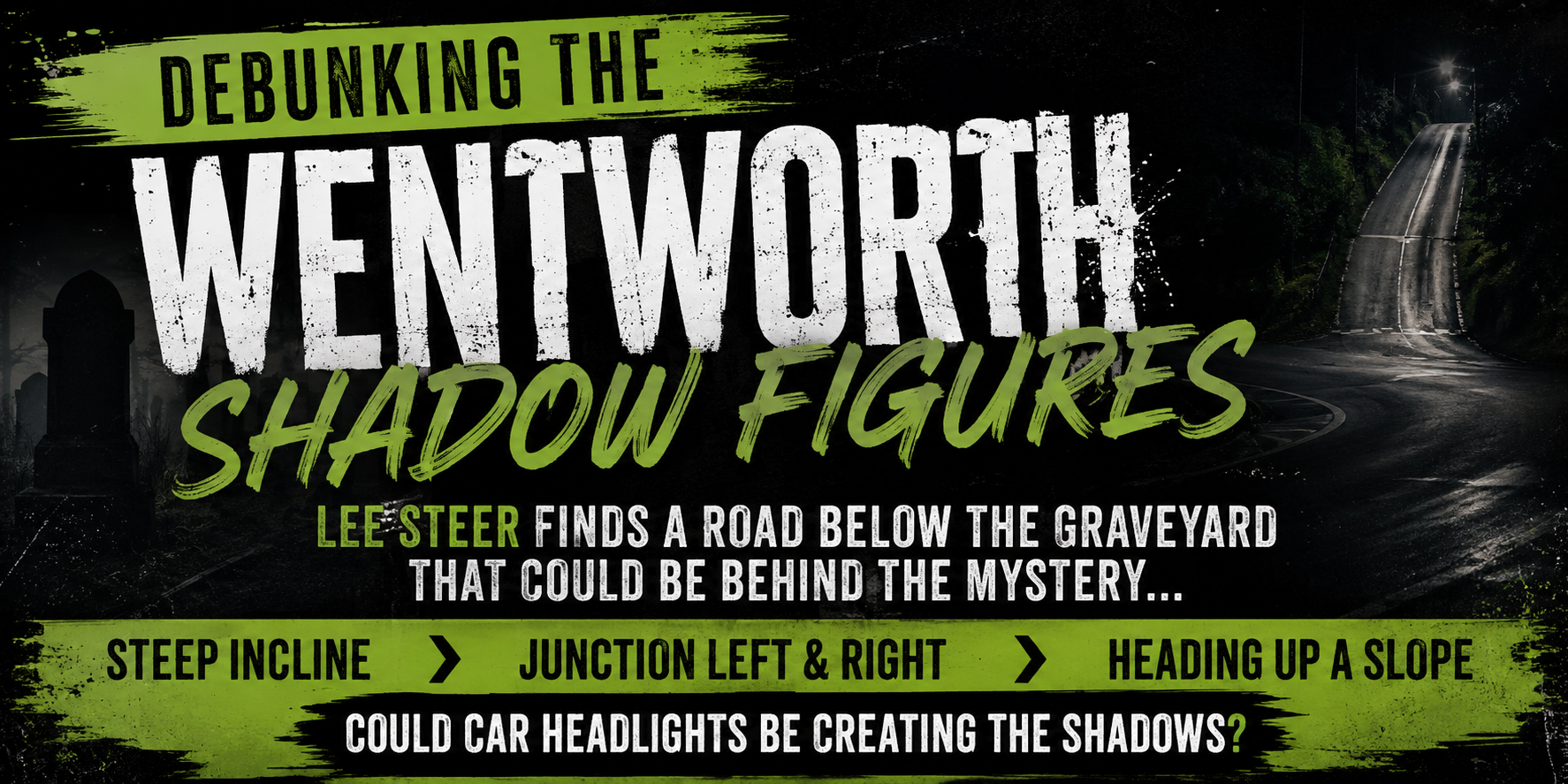
At the bottom of the graveyard is a road with a very steep incline. At the lower part of the road there is also a junction, where vehicles can turn left or right, while the road ahead continues uphill on a gentler slope.
That might not sound very paranormal, but at night it could be important.
Could Car Headlights Create the Shadows?
If a car approaches from below the graveyard, its headlights will shine upwards across the surrounding area.
The graveyard is full of objects that can block that light — gravestones, trees, walls, railings and vegetation. As the car moves, the angle of the headlights changes.
If the vehicle then turns left or right at the junction, those lights sweep across the area. Anything blocking them can cast a moving shadow. And those shadows can move much faster than the object creating them.
Anyone who has shone a torch across a wall has seen the same effect. Move the torch slightly and a shadow can shoot several feet across the surface. Now imagine that happening in a dark graveyard.
A shadow suddenly appears beside one gravestone, races across several others and disappears. From the right position, that could easily look like a dark figure running through the cemetery.
The Steep Road Makes It More Interesting
The incline Lee showed could make the effect even stronger. As a vehicle climbs, its headlights are changing height and angle in relation to the graveyard. A shadow could grow, shrink or change shape as the car moves.
Then, when the vehicle reaches the junction and turns, the shadow could suddenly move sideways.
That might also explain why some witnesses describe figures that seem unusually tall, distorted or almost as though they are changing shape. The object casting the shadow might never move at all, It is the light source that is moving.
Does This Mean Wentworth Is Debunked?
Not necessarily. Finding a possible explanation isn’t the same as proving every reported sighting has been caused by headlights.
But the observation gives investigators something that can actually be tested. The best thing to do would be to place cameras in the graveyard and another camera overlooking the road.
Then compare what happens when vehicles approach, climb the hill and turn at the junction. Do shadows appear in the areas where people have reported seeing figures?
Do they move in the same direction? Do they disappear in the same places? If the same type of black figure can be recreated repeatedly when cars use that road, it would be strong evidence that at least some of the Wentworth sightings have a perfectly natural explanation. And if investigators cannot recreate them, then the mystery remains.
This Is What Debunking Should Be
There is sometimes a strange attitude in the paranormal community that finding a normal explanation somehow ruins a location.
It doesn’t. Good investigating should be about trying to work out what really happened. If headlights are creating the Wentworth shadow figures, that is worth knowing.
If they explain some sightings but not others, that is worth knowing too. And if investigators recreate the exact conditions and still cannot explain certain reports, those cases become more interesting.
my Facebook post may have highlighted something people have overlooked because everyone was concentrating on what was happening inside the graveyard.
Sometimes the explanation for a paranormal experience isn’t where the witness is looking.
At Wentworth, it might be coming from the road below.

