Blog Archives
Why Beardo Gets Scared Accepting GTI’s Invitation Could Matter to the Paranormal Community
The online arguments have happened. The evidence has been questioned. Now Beardo Gets Scared has accepted Ghost Trip Investigation’s invitation to investigate alongside them. If handled properly, what happens next could be far more important than another YouTube disagreement.
There are plenty of arguments in the paranormal world.
One investigator captures something they cannot explain. A sceptic examines the footage and offers another explanation. Viewers choose sides, comment sections explode, response videos appear and, before long, the original question — what actually happened? — can become buried beneath personalities, loyalties and algorithms.
The developing situation between Beardo Gets Scared and Ghost Trip Investigation (GTI) has the potential to be different.
GTI, the UK paranormal team led by Dan Spragg and Adam Oakley, publicly invited Beardo to accompany them on an investigation, describing it as a genuine opportunity to investigate together in a transparent, open and honest way. Beardo subsequently publicly accepted the invitation.
That acceptance matters.
Because instead of continuing the discussion exclusively through edited videos, livestreams and social-media posts, two very different approaches to paranormal content now have an opportunity to meet in the place where these questions should ultimately be tested:
inside an investigation.
Why Beardo Saying “Yes” Is Important
Beardo Gets Scared has built his platform around examining paranormal evidence critically.
His own website describes an approach based around investigating claims, analysing footage using his knowledge of video editing, challenging weak evidence and attempting to separate genuine mysteries from misidentification or fakery. Importantly, his stated position is not simply that everything paranormal must be false, but that the evidence should be followed wherever it leads.
That distinction is important.
A useful sceptic should not enter a paranormal investigation determined to prove that nothing can happen.
Equally, a paranormal investigator should not enter determined that every unexplained noise, light or equipment response must be supernatural.
The interesting territory exists somewhere between those positions.
GTI describes its own philosophy as being centred around live exploration, audience involvement and allowing viewers to witness investigations and decide for themselves what they believe happened.
Putting those philosophies together could create something genuinely useful.
Beardo gets the opportunity to see GTI’s investigation process from beginning to end rather than analysing selected footage after publication.
GTI gets the opportunity to demonstrate its methods directly in front of someone who has been critical of paranormal evidence.
And the audience gets something even more valuable:
context.
This Should Not Be Beardo Versus GTI
The biggest mistake everyone involved could make would be treating this investigation as a boxing match.
It should not be about Beardo trying to catch GTI doing something wrong.
It should not be about GTI trying to manufacture an experience dramatic enough to convert him to their way of thinking.
And it certainly should not become several hours of people attempting to win an internet argument.
The paranormal community has enough tribalism already.
This investigation has the chance to demonstrate something considerably healthier: that people can fundamentally disagree about evidence while still being willing to stand in the same building, use the same equipment, watch the same rooms and examine the same incidents together.
Being challenged should not automatically be considered an attack.
Neither should scepticism.
If somebody claims that an event is paranormal, questions should be expected. If somebody offers a normal explanation, that explanation should also be questioned.
That is how investigations become stronger.
So What Should Actually Happen on the Investigation?
If this collaboration is going to mean something, transparency cannot simply be a slogan attached to the promotional material. It needs to be built into the investigation itself.
Before anything begins, GTI should explain exactly how they normally investigate. Beardo should explain what controls or additional observations he believes are necessary.
Then everybody should agree on the conditions.
There should be continuous cameras covering important areas wherever practically possible. Equipment should be inspected and demonstrated before use. Environmental factors should be noted. People entering and leaving investigation areas should be accounted for.
Most importantly, everybody should be allowed to observe.
If something strange happens, the first reaction should not immediately be:
“Ghost.”
It should be:
“What just happened?”
Then investigate it. That process does not destroy paranormal investigation. It improves it.
Because if ordinary explanations are properly tested and eliminated and something still cannot be explained, the remaining evidence becomes considerably more interesting.
Let Beardo Be Beardo — And Let GTI Be GTI
Another mistake would be forcing either side to abandon its identity.
GTI should conduct the investigation in the manner its audience recognises.
Beardo should be allowed to question what he sees.
If he believes an equipment response has a conventional explanation, he should say so.
If GTI disagrees, they should explain why.
And if Beardo witnesses something he genuinely cannot account for?
He should say that too.
There is an enormous difference between saying “I cannot explain that” and saying “therefore it was paranormal.”
That small distinction is one the wider paranormal community could benefit from hearing more often.
Unexplained should be allowed to remain unexplained.
Sometimes that is the most interesting answer available.
The Raw Footage Could Be More Important Than the Investigation
What happens after the lights come back on may ultimately determine whether this experiment succeeds.
Both sides will presumably produce content about the experience. That is perfectly reasonable.
But edited videos should not become the only record of what happened.
Where practical, the original footage surrounding significant incidents should be preserved and made available for examination. If an event becomes controversial, viewers should be able to see what occurred immediately before and immediately afterwards rather than only a dramatic ten-second clip.
Beardo should also be willing to show moments that challenge his expectations.
GTI should be willing to show moments where apparently paranormal activity turns out to have an ordinary explanation.
That symmetry matters. Transparency cannot mean releasing everything that supports your position while quietly forgetting everything that does not.
Bigger Than One YouTube Collaboration
GTI has grown a substantial online paranormal community, while Beardo Gets Scared has built an audience around questioning paranormal footage and claims.
That is exactly why this meeting has significance.
Paranormal entertainment increasingly exists in an environment where dramatic claims generate attention, sceptical response videos generate attention, and arguments between communities can generate even more.
But underneath all of that remains the question that brought most people into the paranormal world in the first place:
Is something genuinely unexplained happening?
The best way of exploring that question is not by surrounding ourselves exclusively with people who already agree with us.
Believers need sceptics. Sceptics need investigators willing to open their doors.
Investigators need people who will challenge methodology. And debunkers occasionally need to leave the editing desk, enter the allegedly haunted building and experience the unpredictable reality of field investigation for themselves.
That is why Beardo accepting GTI’s invitation is potentially important. Not because somebody is going to be proven right. Not because somebody is going to be proven wrong.
But because two sides of a frequently divided paranormal community have an opportunity to investigate the same place, at the same time, under the same conditions.
Now the challenge is to make the investigation worthy of the conversation surrounding it. Keep it civil.
Keep the cameras rolling. Keep questioning everything.
And afterwards, show us what happened — including the parts that do not fit anybody’s preferred conclusion.
Because if the paranormal community genuinely wants to understand the unexplained, that is what transparency should look like.
Paranormal magazine will be watching with interest.
From Grainy Orbs to Cinematic Hauntings: How YouTube Reinvented the Ghost Investigation

In YouTube’s earliest years, paranormal videos were brief, blurry and supposedly accidental. Two decades later, ghost hunting has become a sophisticated entertainment industry built around feature-length investigations, specialist equipment, global fandoms and million-pound creator businesses. But has the evidence improved along with the production values?
When YouTube’s first 19-second video, Me at the Zoo, appeared in April 2005, it demonstrated the platform’s original appeal: ordinary people could record something, upload it and potentially show it to the world.
That same promise was irresistible to paranormal enthusiasts. A strange shape on a security camera, an unexplained voice on a recording or a shadow moving through an empty hallway no longer had to remain a local story. It could be uploaded, replayed, slowed down, brightened, debated and shared internationally.
YouTube did not invent the filmed ghost investigation. It inherited many of its conventions from television programmes such as Most Haunted, Ghost Hunters and Ghost Adventures: night-vision cameras, whispered commentary, electronic meters, dramatic histories and investigators challenging unseen entities to reveal themselves. What YouTube changed was who could participate.
A television network was no longer required. A haunted location, a camera and a willingness to enter a dark building could be enough.
Twenty-one years after YouTube’s launch, the platform’s paranormal genre is almost unrecognisable. Grainy clips have become feature-length documentaries. Amateur teams have become media companies. Comment sections have become mass evidence-review sessions. Ghost hunts have even moved into cinemas, merchandise businesses, subscription clubs and visitor attractions.
The evolution has been creatively impressive. Whether it has produced stronger evidence for ghosts is a more complicated question.
The first era: “Ghost caught on camera”
Early paranormal YouTube was dominated by the isolated evidence clip.
Titles usually promised something extraordinary: REAL GHOST CAUGHT ON CCTV, DEMON IN ABANDONED HOSPITAL or GHOST GIRL APPEARS BEHIND MAN. The videos were often short, context-free and heavily compressed. Many had passed through several websites or computers before reaching YouTube, making their original source difficult to establish.
This poor image quality was part of their power. Digital noise, reflections, compression artefacts and motion blur created ambiguous shapes that viewers could interpret in different ways. A few pixels might resemble a face. Dust illuminated close to a camera could become a glowing “orb”. A person in the distance could become transparent after being recorded through glass or processed repeatedly.
The audience was asked to perform a simple task: watch closely and decide whether the footage was real.
That made early ghost videos highly participatory. Viewers replayed individual frames, posted timestamps and argued over whether they had seen a spirit, an insect, a reflection or an actor. The comment section functioned as an informal public laboratory, although one without agreed procedures, access to original files or reliable information about how the footage had been produced.
The most compelling clips were often not those with the clearest evidence. They were those containing just enough ambiguity to sustain disagreement.
This remains one of the central rules of paranormal media: a completely clear image can be exposed as a person, prop or visual effect, while a vague image can remain mysterious indefinitely.
Monetisation changed the hunt
A major change arrived when uploading videos became a possible career.
YouTube introduced its Partner Program in 2007, allowing selected creators to receive a share of advertising revenue. The programme rewarded those who uploaded original material consistently and developed significant audiences.
That did not automatically make paranormal creators dishonest. Producing regular investigations involves genuine costs: transport, accommodation, insurance, location fees, cameras, batteries, sound equipment and editing time. Monetisation allowed committed teams to travel farther, purchase better equipment and produce more ambitious work.
It also created an unavoidable conflict.
A scientifically useful investigation may produce nothing. A commercially successful ghost-hunting channel must regularly produce videos that people consider worth clicking and watching.
The creator therefore enters a difficult position. A quiet night with no unusual events may be the most honest result, but “We Investigated a Building and Nothing Happened” is unlikely to perform as strongly as “The Demon Followed Us Home”.
This does not prove that evidence is fabricated. It means that the economic structure rewards dramatic interpretation. Ordinary noises become possible footsteps. Equipment malfunctions become “intelligent responses”. A frightened reaction becomes a thumbnail. Uncertainty may survive inside the episode, but certainty tends to dominate the title.
The pressure is not necessarily a deliberate command from YouTube. The platform says its recommendation system considers a mixture of signals, including watch time, satisfaction surveys, sharing, likes and dislikes, while demoting content classified as harmful or misleading in sensitive information categories.
Paranormal entertainment, however, occupies an awkward middle ground. A dramatic claim about a ghost is generally not treated in the same way as dangerous medical misinformation. Creators therefore compete largely through storytelling, personality, suspense and audience retention.
From the viral clip to the paranormal episode
In 2011, YouTube began integrating live-streaming capabilities directly into the platform. In 2012, it placed greater emphasis on watch time and longer viewing sessions rather than rewarding clicks alone.
These developments helped transform ghost content.
Instead of uploading one unexplained moment, investigators could construct a complete narrative:
- Introduce the location and its history.
- Interview witnesses.
- Explore the building in daylight.
- Establish alleged paranormal “hotspots”.
- Begin the night investigation.
- Escalate from quiet observation to equipment sessions.
- End with the strongest apparent evidence.
This was much closer to television, but YouTube allowed episodes to be longer, looser and more personal. Creators could spend 40 minutes, an hour or sometimes several hours inside one location. They could also upload deleted scenes, evidence reviews and behind-the-scenes footage.
The investigator’s personality became as important as the haunting. Audiences were no longer simply watching a building. They were spending time with a familiar group of people.
That relationship became the genre’s greatest asset. A viewer might doubt a particular recording while still trusting the creators’ sincerity. Fear, friendship, humour and vulnerability created emotional credibility even when the physical evidence remained inconclusive.
The ghost-hunting technology arms race
As paranormal channels grew, their equipment bags expanded.
Early investigations often relied on digital cameras, audio recorders and basic electromagnetic-field meters. Modern episodes may include thermal cameras, motion sensors, REM pods, laser grids, vibration detectors, radio-sweep “spirit boxes”, environmental data loggers and devices that convert sensor readings into words.
The equipment creates an appearance of scientific procedure. Screens display numbers. Lights respond. Graphs change. Devices produce voices. Investigators conduct what they call experiments.
The difficulty is that an instrument can be scientific without its paranormal interpretation being scientifically justified.
EMF meters
An electromagnetic-field meter measures electromagnetic fields. These may be produced by wiring, electrical appliances, radio transmitters, mobile phones and other ordinary sources.
Ghost hunters frequently interpret an unexplained rise as evidence that a spirit is present or drawing energy from the environment. However, no accepted mechanism has established that a deceased human consciousness should create an electromagnetic field, or that a particular reading distinguishes a ghost from conventional interference.
A spike is evidence that the meter detected something within its operating range. Determining the source requires controlled testing, not merely asking the spike whether it is a ghost.
Electronic voice phenomena
Electronic voice phenomena, or EVP, are apparent voices discovered in recordings made during investigations. Some are clear enough to attract attention without prompting. Many are extremely faint and are presented with subtitles telling the audience what to hear.
This is important because human perception is strongly influenced by expectation.
Research into auditory pareidolia shows how people can perceive meaningful words in ambiguous or random sound. In one study discussed in PLOS One, participants exposed to paranormal suggestions were more likely to report voices in unclear audio. Previous experiments cited by the researchers found that 36 per cent of participants reported hearing voices in random noise after first watching information about EVP. The same paper found remarkably little agreement between listeners and the words paranormal investigators had assigned to EVP clips.
This does not establish that every EVP has an ordinary explanation. It does demonstrate why subtitles, repeated listening, noise reduction and leading questions can unintentionally create apparent messages.
A stronger test would allow multiple independent listeners to describe the recording without being shown subtitles, questions or location history. Their answers could then be compared. If one listener hears “leave this house”, another hears “Steven’s out” and a third hears only static, the evidential value is weak.
Spirit boxes and the Estes Method
A spirit box rapidly scans radio frequencies, producing static and fragments of broadcasts. Investigators believe spirits may select or manipulate these fragments to answer questions.
The Estes Method attempts to reduce some forms of cueing. One participant listens through headphones, sometimes while blindfolded, and repeats words heard from the scanning radio. Another participant asks questions that the listener supposedly cannot hear.
It is a more interesting procedure than an ordinary group spirit-box session because it separates the questioner from the listener. It does not, however, remove the central problem: the device deliberately generates fragments of human speech.
Given enough questions, words and time, occasional matches are likely. Investigators may also remember impressive responses while forgetting the many irrelevant ones. This is a form of selection bias. A genuine test would record every question, every spoken fragment, the timing between them and predefined rules for deciding what counts as a match.
SLS and Kinect figures
Structured-light or SLS cameras are used to map human-shaped figures into an environment. Paranormal investigators sometimes interpret a stick figure appearing in an empty room as an invisible entity.
Many of these systems originated from Microsoft’s Kinect technology, which was designed to identify human bodies for gaming. The software actively attempts to construct a skeleton from depth information. Furniture, railings, shadows and irregular surfaces can therefore be misidentified as body parts.
In other words, the device may display a human-like figure because it is designed to search for one, not because it has detected a spirit. Experts examining the technology have described its false skeletal figures as a predictable consequence of the system’s body-recognition process.
The more visually impressive the stick figure appears, the easier it is to forget that viewers are watching a software interpretation rather than a photograph of an entity.
The BuzzFeed Unsolved turning point
One of the most significant changes in paranormal YouTube arrived with BuzzFeed Unsolved: Supernatural.
Launched in 2016, the series paired Ryan Bergara, an enthusiastic believer, with Shane Madej, an openly sceptical co-host. Rather than hiding disagreement, the programme made disagreement its central format.
Ryan interpreted locations through folklore, witness testimony and personal experience. Shane challenged assumptions, mocked demons and regularly remained unimpressed by supposed evidence. Their chemistry allowed viewers to occupy either position without being excluded.
By 2019, BuzzFeed reported that the wider Unsolved franchise had accumulated hundreds of millions of views and billions of minutes of watch time. The programme ended its original run in 2021 after almost six years, with each final investigation accompanied by a question-and-answer “postmortem”.
Its influence was deeper than its viewing figures.
Unsolved demonstrated that scepticism did not have to destroy paranormal entertainment. It could improve it. Shane’s refusal to accept every noise as evidence gave the series tension and credibility. Ryan’s willingness to enter frightening situations prevented the scepticism from becoming distant or sneering.
The viewer was not told what to believe. The viewer was invited into an ongoing argument.
That believer–sceptic structure remains one of the healthiest models available to paranormal media. It respects extraordinary experiences without automatically treating every interpretation as factual.
Ryan and Shane later continued their paranormal work independently through Watcher’s Ghost Files, illustrating another major development: creators were no longer dependent on large digital publishers. Successful personalities could establish their own production companies, retain their audiences and build television-scale programmes directly on YouTube.
The influencer investigation
While BuzzFeed Unsolved refined the believer–sceptic documentary, other creators fused ghost hunting with exploration, challenges and influencer culture.
Sam Golbach and Colby Brock are among the clearest examples. Their work evolved from stunts and abandoned-building exploration into large-scale paranormal investigations. Academic analysis has placed channels like theirs within a form of “virtual dark tourism”, allowing viewers to experience prisons, hospitals, historic houses and sites associated with death or tragedy from home.
Their investigations increasingly resemble event films. Episodes use cinematic drone footage, elaborate sound design, multiple cameras, invited mediums, celebrity guests and recurring Halloween seasons. Locations become franchises, with investigations spread across several videos or an entire week.
The business surrounding the videos has also expanded. Sam and Colby have developed clothing, memberships, live experiences and theatrical releases. Reporting on their company showed how paranormal content can support a diversified creator business stretching far beyond advertising revenue.
This represents an extraordinary change from the anonymous ghost clip.
The modern paranormal creator may be presenter, investigator, filmmaker, brand owner, tourism operator and executive producer at the same time.
It also intensifies the problem of evidence.
When an investigation employs guests, dramatic music, fast editing and a major production crew, the audience cannot easily determine what happened continuously, what occurred off camera or how much material was discarded. Even completely sincere creators are producing an edited story rather than a controlled scientific record.
The question is no longer simply, “Could this clip be fake?”
It is also, “Can a commercial entertainment production ever provide enough information to test its own conclusion?”
The audience becomes part of the investigation
YouTube’s greatest innovation may not be its cameras or equipment. It is the audience.
Viewers freeze frames, isolate sounds and identify background movements missed by the production team. They submit personal stories, recommend locations, fund investigations and sometimes travel to places featured in videos.
Some series invite audience members to submit their own alleged evidence before an investigation. Livestream viewers can report noises or shapes in real time. After release, sceptical channels produce detailed breakdowns, recreating effects and testing equipment.
This participation can improve accountability. A misleading edit may be noticed. A hidden crew member may be spotted in a reflection. A supposedly mysterious sound may be identified as plumbing, wildlife or radio interference.
Participation can also amplify weak evidence. Once one viewer circles a dark patch and labels it a face, thousands of others may begin to see the same face. Repetition transforms a suggestion into a community belief.
Research published in 2024 examined 50 highly viewed YouTube videos about hauntings and UFOs. Most presented paranormal claims, while scientific sources appeared in almost none of the haunting videos. A survey conducted as part of the study found an association between YouTube use and belief in hauntings, even after accounting for several other variables. The research does not prove that YouTube directly causes belief, but it suggests the platform can help reinforce paranormal interpretations.
The genre therefore does more than entertain existing believers. It helps establish what paranormal investigation looks like, what counts as evidence and which explanations viewers consider plausible.
The pandemic, gaming and the paranormal revival
Interest in ghost content grew again during and after the COVID-19 pandemic.
Periods of isolation, uncertainty, bereavement and heightened awareness of mortality created fertile ground for supernatural storytelling. People spent more time at home, consumed more online entertainment and sometimes became newly attentive to unfamiliar noises in their surroundings.
The multiplayer game Phasmophobia, released in 2020, introduced a younger audience to a gamified version of paranormal investigation. Players use recognisable ghost-hunting equipment, collect evidence and identify different entities. Streamers and YouTubers helped turn the game into a cultural phenomenon, while some players moved from virtual investigations towards real-world paranormal groups.
British ghost-hunting communities have reported a broader rise in “have-a-go” investigators, commercial ghost nights and paranormal tourism, supported by YouTube and TikTok exposure.
The exchange now works in both directions. Television inspired early YouTube ghost hunters. YouTube inspired games and independent creators. Games introduced new investigators to YouTube. Successful YouTubers then moved into television-scale productions and cinemas.
Ghost hunting has become a connected entertainment ecosystem.
The Shorts era: fear in under a minute
The arrival of YouTube Shorts added another layer.
YouTube began testing Shorts creation tools in 2020. The format was designed for rapid, mobile viewing and easy discovery.
For paranormal creators, Shorts function as trailers, highlights and evidence clips. A two-hour investigation can be condensed into 30 seconds containing a scream, a moving object and a device apparently saying somebody’s name.
This is effective promotion, but it removes context.
Viewers may not see the ten minutes of silence before the event, the investigators walking near the equipment or the later attempt to recreate the sound. The most dramatic interpretation reaches millions of viewers without the qualifications contained in the full episode.
Short-form paranormal media risks returning the genre to its earliest form: an isolated, unexplained clip detached from the conditions under which it was recorded.
Only now the image is sharper, the editing faster and the distribution algorithm far more powerful.
Has the evidence actually improved?
Technically, yes.
Modern creators have access to better low-light cameras, clearer audio, multiple viewpoints, precise timestamps and enormous storage capacity. Raw footage can be preserved. Environmental conditions can be measured. Investigations can be livestreamed. Independent analysts can examine material immediately.
In principle, this should make paranormal claims easier to test.
Yet improved technology does not automatically produce improved methodology.
A 2020 review of environmental research into allegedly haunted locations found a relatively small and methodologically inconsistent body of literature. Studies examining factors such as lighting, temperature, air quality, infrasound and electromagnetic fields produced outcomes that were mostly null, weak or inconsistent. The authors called for more precise measurement, proper control conditions and cooperation between researchers with differing beliefs.
Those recommendations highlight the gap between an investigation and an experiment.
An investigation asks, “What happened here tonight?”
An experiment asks, “Under clearly defined conditions, does this effect occur more frequently than chance, error or ordinary environmental activity would predict?”
Most YouTube ghost hunts are excellent at the first question. Very few are designed to answer the second.
What a genuinely rigorous YouTube ghost investigation would involve
A more credible investigation would not need to abandon atmosphere, storytelling or curiosity. It would need stronger controls.
Investigators could begin by recording environmental baselines before discussing the building’s ghost stories. Electrical sources, radio signals, airflow, loose windows, plumbing, wildlife and building movement could be documented in daylight.
Equipment should be tested openly. Viewers should be shown what causes a K2 meter, motion sensor or REM pod to activate under normal conditions. Devices should be kept away from phones, radios and camera transmitters unless interference is part of the test.
Audio should be reviewed by independent listeners who do not know the questions being asked. EVP subtitles should appear only after viewers have first heard the untreated recording. Original audio files should be provided when privacy and location agreements allow.
Every response from a spirit-box session should be logged, including irrelevant words and failed answers. Criteria for a successful response should be established before the session rather than invented afterwards.
Multiple fixed cameras should cover investigators and equipment simultaneously. Continuous timestamps would make it harder for editing to create a misleading sequence.
Negative results should be included. If a device remains silent for three hours, that information is essential for assessing the significance of its one activation.
Most importantly, an apparently successful result should be repeated. A response that occurs once may be interesting. A response that occurs reliably under controlled conditions would be far more important.
These practices would not prove that ghosts do not exist. They would help distinguish genuinely unexplained events from the enormous number of ways people, buildings and electronic devices can produce strange results.
The coming problem: AI ghosts
The next stage of paranormal YouTube will face a challenge greater than fishing line, hidden speakers or selective editing.
Realistic synthetic video and audio can now create people, voices and events that never existed. A convincing apparition no longer requires advanced visual-effects training. An alleged EVP can be generated with a cloned voice. Security-camera footage can be altered while retaining the imperfect appearance audiences associate with authenticity.
YouTube introduced disclosure requirements for realistic altered or synthetic content in 2024, including footage that could mislead viewers about real people, places or events.
Policies alone will not solve the problem. Paranormal creators who care about credibility may need to preserve original files, publish metadata, document chains of custody and use cameras capable of generating verifiable authenticity information.
Ironically, the future of ghost hunting may depend less on obtaining more mysterious footage and more on proving that the footage has not been manipulated.
Scepticism is not the enemy of wonder
Paranormal YouTube is sometimes judged by two equally unhelpful extremes.
One side assumes that every unexplained event is supernatural. The other assumes that every investigator is fraudulent and every witness foolish.
Neither approach reflects reality.
People can sincerely misinterpret ordinary events. Equipment can behave unpredictably. Memories can change. Fear can influence perception. Editors can unintentionally exaggerate a sequence. Investigators can become emotionally invested in a theory without consciously deceiving anyone.
There are also deliberate hoaxes. The history of paranormal media contains actors, props, manipulated photographs and staged events. But exposing individual hoaxes does not explain every unusual experience, just as failing to explain an experience does not establish that a ghost caused it.
Healthy scepticism means withholding a conclusion until the evidence supports it. It asks whether a normal explanation has been properly tested. It distinguishes “unexplained” from “supernatural”. It remains willing to change position when better information appears.
Most importantly, scepticism need not strip ghost hunting of its value.
Paranormal investigations preserve local folklore, introduce audiences to neglected historic buildings and create communities around mystery, mortality and storytelling. They can be funny, frightening and emotionally meaningful even when they fail to demonstrate an afterlife.
The strongest creators understand that uncertainty is not a weakness. It is the reason viewers continue watching.
From “broadcast yourself” to building haunted worlds
YouTube began as a place for brief, personal uploads. Its paranormal genre followed the same journey as the platform itself.
It moved from isolated clips to regular channels, from amateur recordings to professional productions, from advertising revenue to complete creator businesses. Ghost hunters became hosts, filmmakers and entrepreneurs. Viewers became fans, investigators, critics and customers.
The production quality has improved beyond anything early uploaders could have imagined. The central question, however, remains unchanged:
What exactly are we looking at?
After two decades, YouTube has not settled the existence of ghosts. What it has done is transform the search for them into one of the internet’s most adaptable forms of storytelling.
The future of the genre will depend on whether creators continue escalating the spectacle or recognise that the greatest unexplained event would not need dramatic music, a shocked thumbnail or a glowing gadget.
It would need evidence strong enough to survive believers, sceptics and the pause button.
Is There More Paranormal Fakery Today Than 20 Years Ago… or Even in Victorian Times? MUST READ!
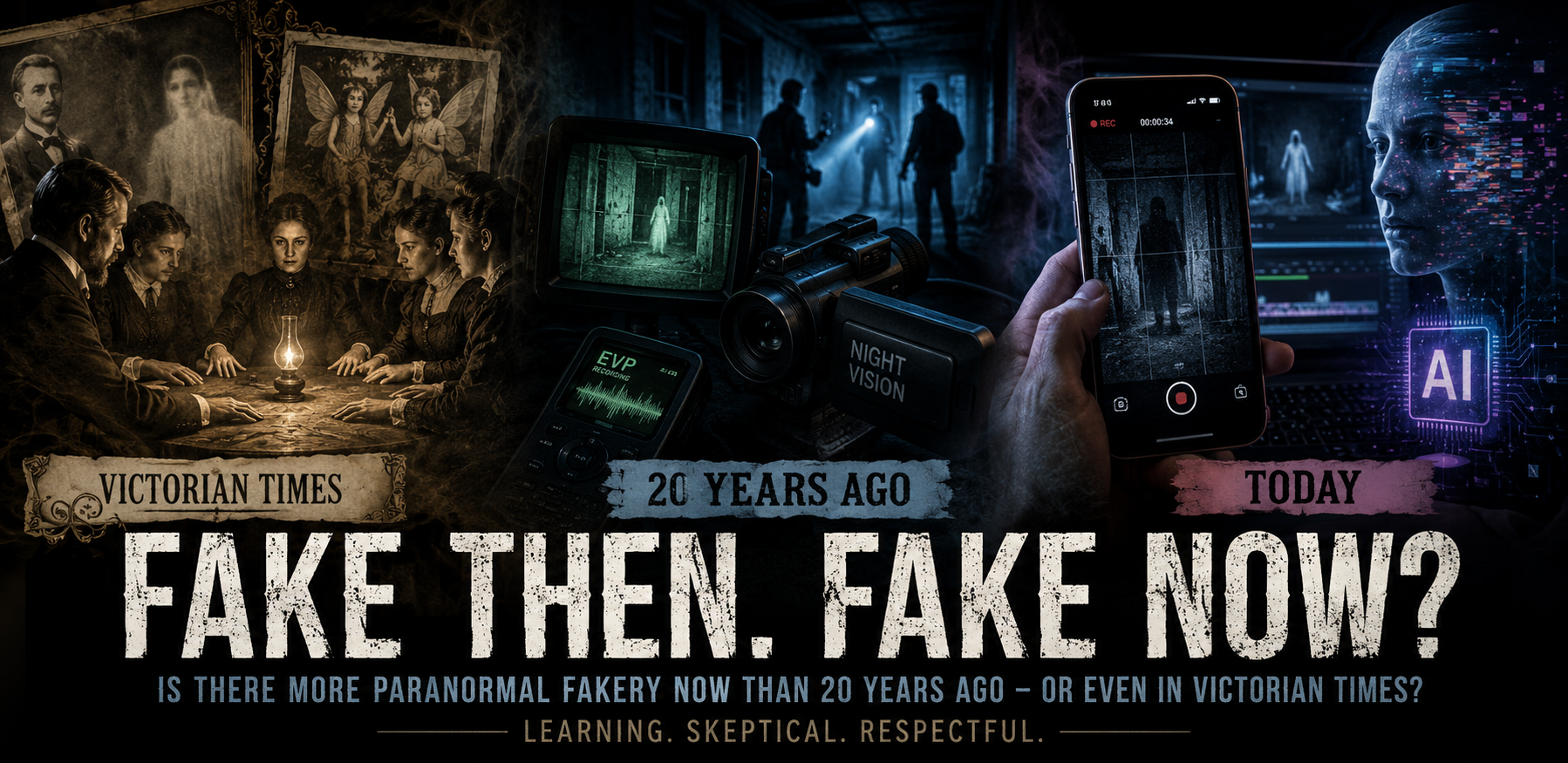
Every generation seems convinced that it lives in an age of unprecedented deception. Today we have artificial intelligence, deepfake videos, edited ghost-hunting clips on social media, and viral paranormal stories that can reach millions of people within hours. It is tempting to conclude that fakery has never been worse.
But history tells a more interesting story.
The Victorian era (1837–1901) was arguably one of the greatest periods of paranormal deception ever recorded. Twenty years ago, television was flooded with ghost-hunting programmes, many of which blurred the line between entertainment and investigation. Today, social media has transformed paranormal content once again, making it easier than ever to create convincing evidence—but also easier than ever to expose it.
So, are there really more fakes today? Or are they simply different?
As sceptics with open minds, it is worth looking at each era fairly.
The Victorian Age: When Ghosts Became Big Business

If there was ever a golden age of paranormal fraud, many historians would point towards the Victorian period.
Several factors came together perfectly:
High mortality rates, Frequent outbreaks of disease, Wars that left countless families grieving, The rapid rise of photography, A growing fascination with science and the afterlife
Many people desperately wanted proof that loved ones survived death. Unfortunately, some individuals saw an opportunity.
Spirit Photography
One of the most famous examples involved American photographer William Mumler.
He claimed his camera could capture spirits standing beside living relatives.
To modern eyes, the photographs are clearly double exposures or manipulated negatives. Yet during the 1860s, photography was still mysterious enough that many people believed the images were genuine. Mumler even photographed Mary Todd Lincoln, supposedly with the ghost of Abraham Lincoln standing behind her. Eventually, investigators demonstrated numerous ways such photographs could be faked, although Mumler avoided conviction due to insufficient evidence.
Britain experienced similar scandals.
William Hope became famous for “spirit photography” until paranormal investigator Harry Price demonstrated that photographic plates had apparently been switched during sittings, strongly suggesting deliberate fraud.
Fake Mediums
Victorian séances were often theatrical performances.
Some mediums used:
hidden assistants, concealed wires, glowing paint, fake ectoplasm made from cheesecloth or paper, musical instruments operated in darkness, secret compartments
Many audiences genuinely believed spirits were communicating with them.
Professional magicians such as Harry Houdini later spent years exposing fraudulent mediums because they recognised stage illusions being presented as genuine supernatural events.
The Cottingley Fairies
Perhaps the most famous British paranormal hoax involved two young girls who photographed cardboard fairy cut-outs.
Even Sir Arthur Conan Doyle accepted the photographs as genuine evidence.
The images fooled many intelligent people—not because they lacked intelligence, but because they genuinely wanted them to be true.
Twenty Years Ago: The Television Boom

Around twenty years ago, paranormal television exploded in popularity.
Ghost hunting moved from niche hobby to mainstream entertainment.
Programmes often featured: night vision cameras, infrared footage, EVP recordings, dramatic music, suspenseful editing, cliff-hangers before advert breaks
Most presenters never claimed outright that every piece of evidence proved ghosts.
However, television naturally rewarded exciting moments over uneventful investigations.
A five-hour investigation producing nothing interesting rarely made good television.
That doesn’t automatically mean evidence was fabricated—but editing sometimes created a stronger impression than the raw investigation might have deserved.
Meanwhile, digital photography introduced a new wave of misunderstandings.
Many famous “ghost photographs” from the early 2000s later turned out to involve: camera straps, dust illuminated by flash (“orbs”), motion blur, compression artefacts, lens flare
Unlike Victorian frauds, many of these images were probably honest mistakes rather than deliberate hoaxes.
Today: The Age of AI and Viral Content
Today’s paranormal world is completely different.
Almost everyone carries a 4K video camera, multiple editing apps, AI image generators, voice cloning software, instant access to millions of viewers
Creating convincing fake evidence has never been easier.
Neither has exposing it. Communities of photographers, visual effects artists and experienced investigators frequently analyse videos frame-by-frame within hours of publication.
Ironically, modern fakery often has a much shorter lifespan. Twenty years ago, a questionable photograph might circulate for months.
Today, it can be debunked worldwide before the day ends.
Have We Become Better Skeptics?
In many ways, yes.
The average person today understands photography and video editing far better than a Victorian audience.
People commonly ask:
- Could this be AI?
- Is there another camera angle?
- Has the original file been uploaded?
- Was this edited?
- Can someone reproduce the effect?
This level of healthy questioning simply wasn’t possible in the nineteenth century.
However, social media has also created another challenge.
Algorithms reward dramatic content.
A genuine investigation that produces nothing unusual rarely gains millions of views.
A shocking ghost video—even if fake—often does.
That creates a financial incentive for some creators to exaggerate or fabricate evidence.
Why People Still Believe
This question is more complicated than simply asking who is gullible. Throughout history, belief has often been driven by emotion rather than ignorance.
People may seek comfort after bereavement. Others have experienced something they genuinely cannot explain.
Many investigators who later exposed fraud actually began as believers. Equally, some sceptics have witnessed events they cannot easily dismiss. These experiences remind us why respectful discussion matters. Being sceptical does not mean dismissing every claim.
Being open-minded does not mean accepting every claim. The strongest investigations sit somewhere in the middle.
So… Which Era Had the Most Fakery?
Victorian Times
- Probably had the highest proportion of organised paranormal fraud.
- Fake mediums often charged significant sums.
- Many relied on the public’s limited understanding of new technologies.
- Some frauds continued for years before being exposed.
Twenty Years Ago
- Television encouraged sensational presentation.
- Digital cameras created countless accidental anomalies.
- Some investigations blurred the line between entertainment and research.
Today
- The sheer quantity of fake paranormal content is likely greater than ever because anyone can create and upload it instantly.
- AI, editing software and social media make fabrication easier.
- At the same time, independent investigators and online communities can often identify hoaxes much faster than in previous generations.
Paranormal Magazines Ending Statement.
History suggests that paranormal fakery is not a new problem—it simply evolves with technology, Victorian fraudsters mastered photographic plates and darkened séance rooms.
Television producers mastered editing and suspense, Today’s creators have AI, smartphones and global audiences, Yet one thing has remained remarkably consistent, most people interested in the paranormal are not looking to be fooled. They are searching for answers, That is why respectful scepticism remains the best approach.
We should investigate unusual claims with curiosity rather than cynicism, ask difficult questions without ridicule, and remember that exposing fraud ultimately protects genuine investigation. Every fake uncovered helps ensure that any truly unexplained evidence receives the careful attention it deserves.
After all, if the paranormal is real, then it has nothing to fear from honest scepticism. It is only deception that cannot withstand careful scrutiny.
When the Search for the Unknown Meets the Search for Clicks: A Respectful Look at the State of Paranormal Investigating FT: Ghosts On Trent
The paranormal community has always been driven by curiosity. Whether it’s exploring allegedly haunted locations, researching local history, testing new equipment, or simply trying to understand experiences that defy explanation, most investigators begin with the same goal: to search for answers.
Over the last decade, however, the paranormal world has changed dramatically. Social media platforms like YouTube, TikTok, Facebook and Instagram have introduced the subject to millions of people around the world. That has undoubtedly helped the community grow, but it has also changed the way investigations are presented and, in some cases, the motivations behind them.
A recent post by Ghosts On Trent has sparked discussion across the paranormal community. Their message suggests that genuine investigation is increasingly being overshadowed by entertainment, social media popularity and influencer culture.
It’s a thought-provoking point, but like most things in the paranormal world, the reality isn’t quite as simple as one side being right and the other being wrong.
The Main Concerns
Ghosts On Trent raise several important issues.
They question whether some investigators are becoming influencers before they become researchers. They suggest that popularity on social media can sometimes outweigh experience and credibility, and they express concern that paranormal events may be favouring creators with the largest audiences over those with years of investigative knowledge.
They also argue that chasing views, revenue and online recognition risks damaging the credibility of paranormal investigating. Whether you completely agree or not, these concerns are worthy of discussion.
Social Media Has Changed the Paranormal
There is little doubt that social media has transformed the paranormal community. Years ago, investigations were shared through local groups, forums, DVDs and word of mouth. Today, a single investigation can reach hundreds of thousands of people within hours. That’s not necessarily a bad thing.
Social media has introduced thousands of people to paranormal investigating who may never have discovered it otherwise. It has allowed small teams to reach global audiences, encouraged collaboration and opened conversations that simply weren’t possible twenty years ago.
However, social media also rewards excitement. Videos with dramatic music, emotional reactions, bold claims and eye-catching thumbnails naturally attract more attention than a quiet investigation where very little happens. Unfortunately, that creates pressure.
A completely honest investigation that ends with “we didn’t capture anything conclusive tonight” rarely performs as well as one claiming to have found undeniable evidence.
When Views Start Driving Investigations
Good investigations take time. Researching a location’s history. Learning about previous reports.
Testing equipment. Ruling out natural explanations before jumping to paranormal conclusions. None of these things make particularly exciting short videos, yet they’re often the most important parts of an investigation.
The danger is that investigators can begin feeling pressure to make every unexplained noise, shadow or equipment anomaly seem paranormal because that’s what audiences have come to expect.
That doesn’t automatically mean they’re being dishonest. Sometimes it’s simply the reality of creating content in an online world where excitement is rewarded.
Clickbait: Part of the Modern Landscape
One word that’s become almost impossible to avoid is clickbait. It’s often used as criticism, but the truth is that almost every successful creator uses eye-catching titles and thumbnails to some degree. That’s not unique to the paranormal community—it’s simply how YouTube and social media work.
Even many of the most respected paranormal channels use intriguing titles designed to make people curious enough to click. Without them, their content may never reach the audience it deserves. The important distinction isn’t whether a title is dramatic.
It’s whether the investigation delivers on that promise. There’s nothing wrong with making people curious enough to watch. Problems begin when evidence is exaggerated, speculation is presented as certainty, or ordinary events are deliberately made to appear paranormal simply for entertainment.
Perhaps that’s where the real conversation should be. Not whether creators use exciting titles—because almost everyone does—but whether the investigation itself remains honest, balanced and transparent.
Everyone Wants Their Work to Be Seen
One point that’s often overlooked is this: if someone uploads their investigations to social media, they clearly want people to watch them. That’s true whether they’re a small local team with a few hundred followers or a channel with hundreds of thousands of subscribers.
People share their work because they want it to be seen. They want discussion. They want feedback.
They want their investigations to reach an audience. In that sense, everyone is chasing views.
The difference is that for many investigators, views are simply the way their work reaches people—they’re not the reason they investigate.
There’s nothing wrong with wanting your hard work to be watched and appreciated. The problem only begins if the pursuit of views becomes more important than honesty, evidence and integrity.
The Convention Debate
Ghosts On Trent also questioned whether paranormal conventions are favouring creators with the biggest online audiences.
There is some truth to the idea that popular creators help sell tickets. Event organisers are businesses, and successful events need visitors to survive. However, that’s only part of the picture.
Many event companies actually invite a mixture of guests. Alongside well-known YouTube personalities, you’ll often find historians, authors, experienced investigators, equipment specialists and researchers who take a far more scientific or evidence-based approach.
That’s because visitors attend these events for different reasons. Some enjoy hearing exciting investigation stories. Others want to learn about historical research, investigation techniques or the science behind certain equipment.
A balanced line-up benefits everyone. It allows attendees to hear different viewpoints, compare methods and decide for themselves what resonates most.
Rather than seeing these different styles as competitors, perhaps they’re simply serving different parts of the same community.
Popularity Doesn’t Equal Credibility
It’s also important not to assume that having a large audience automatically makes someone less credible.
Many successful creators invest enormous amounts of time researching locations, improving their methods and presenting investigations responsibly, Equally, having a small audience doesn’t automatically make someone an expert.
Credibility isn’t measured by subscriber counts, It’s measured by honesty, consistency, transparency and a willingness to question your own conclusions—even when they aren’t exciting.
The Importance of Critical Thinking
Perhaps the biggest danger in paranormal investigating isn’t social media at all, It’s confirmation bias.
When investigators arrive expecting paranormal activity, it’s easy to interpret every sound, shadow or equipment response as evidence, Responsible investigators challenge themselves.
They look for ordinary explanations before extraordinary ones, Ironically, doing so often makes genuinely unexplained experiences even more compelling.
A Community That Needs Every Perspective
Perhaps the most interesting aspect of this debate is that every part of the paranormal community depends on the others more than many people realise.
Entertainment-focused channels introduce huge numbers of people to paranormal investigating. For many viewers, these creators are the gateway into the subject. Without that exposure, the paranormal community would almost certainly be much smaller.
At the same time, evidence-based investigators, sceptics and debunkers play an equally important role. They encourage critical thinking, test claims and remind the community that extraordinary claims deserve careful examination.
In many ways, it’s a catch-22, Without exciting investigations attracting large audiences, there would be far fewer claims for researchers and debunkers to analyse. Likewise, without people asking difficult questions and challenging evidence, investigative standards would likely suffer.
Whether people realise it or not, both sides help shape the paranormal community, Neither exists entirely in isolation.
Respect Matters
One thing Ghosts On Trent deserve credit for is that their post focused on wider trends rather than publicly attacking individual creators, Healthy discussion benefits the community, Respectful disagreement encourages better standards.
Personal attacks rarely solve anything, The paranormal world has always been filled with different beliefs, different methods and different opinions. That’s part of what makes it fascinating.
Is Ghosts On Trent Completely Right?
Not entirely, The concerns they raise are genuine, but the situation is more complex than simply blaming social media or content creators, Social media has undoubtedly encouraged some sensationalism.
At the same time, it has also helped grow the paranormal community, introduced new generations to investigating and given independent researchers opportunities that simply didn’t exist twenty years ago.
Like any tool, social media depends entirely on how it’s used, The real issue isn’t technology, It’s integrity.
The Balance
Perhaps the future of paranormal investigating lies somewhere in the middle, Creators should be able to produce entertaining, engaging content without exaggerating evidence.
Researchers should embrace modern platforms without abandoning good investigative methods, Audiences should recognise that not every investigation ends with dramatic proof—and that’s perfectly acceptable.
Paranormal Magazines Ending statement.
Ghosts On Trent have started an important conversation, and that’s something the paranormal community should welcome.
Whether you’re an experienced investigator, a content creator, a sceptic or simply someone fascinated by the unknown, credibility should always remain at the heart of what we do.
At the same time, we should recognise that the paranormal community is made up of many different voices. Some educate through historical research. Some entertain through immersive investigations. Some challenge claims through sceptical analysis. All have contributed, in one way or another, to making the paranormal more accessible than ever before.
Perhaps the goal shouldn’t be deciding which approach is “right,” but encouraging every creator to be honest about what they present. Views will always matter because they allow investigations to reach an audience. Selling tickets will always matter because events need to survive. Entertainment will always matter because it inspires curiosity.
But above all else, integrity should matter most.
If the paranormal community can hold on to that, then there is room for researchers, entertainers, sceptics, historians and investigators alike—each playing their own part in the continuing search for the unknown.
there will be a part 2 more focused on produced fake evidence and the damage,
visit PARANORMAL DEBUNKED to view all our articles like this.

