Blog Archives
Elizabeth The Haunted Bridal Doll Returns To The Headlines Following Fresh Media Coverage
Britain’s most talked-about haunted bridal doll is back in the spotlight after being featured by both Manchester Evening News and Yorkshire Live, introducing the controversial paranormal case to a new generation of readers.
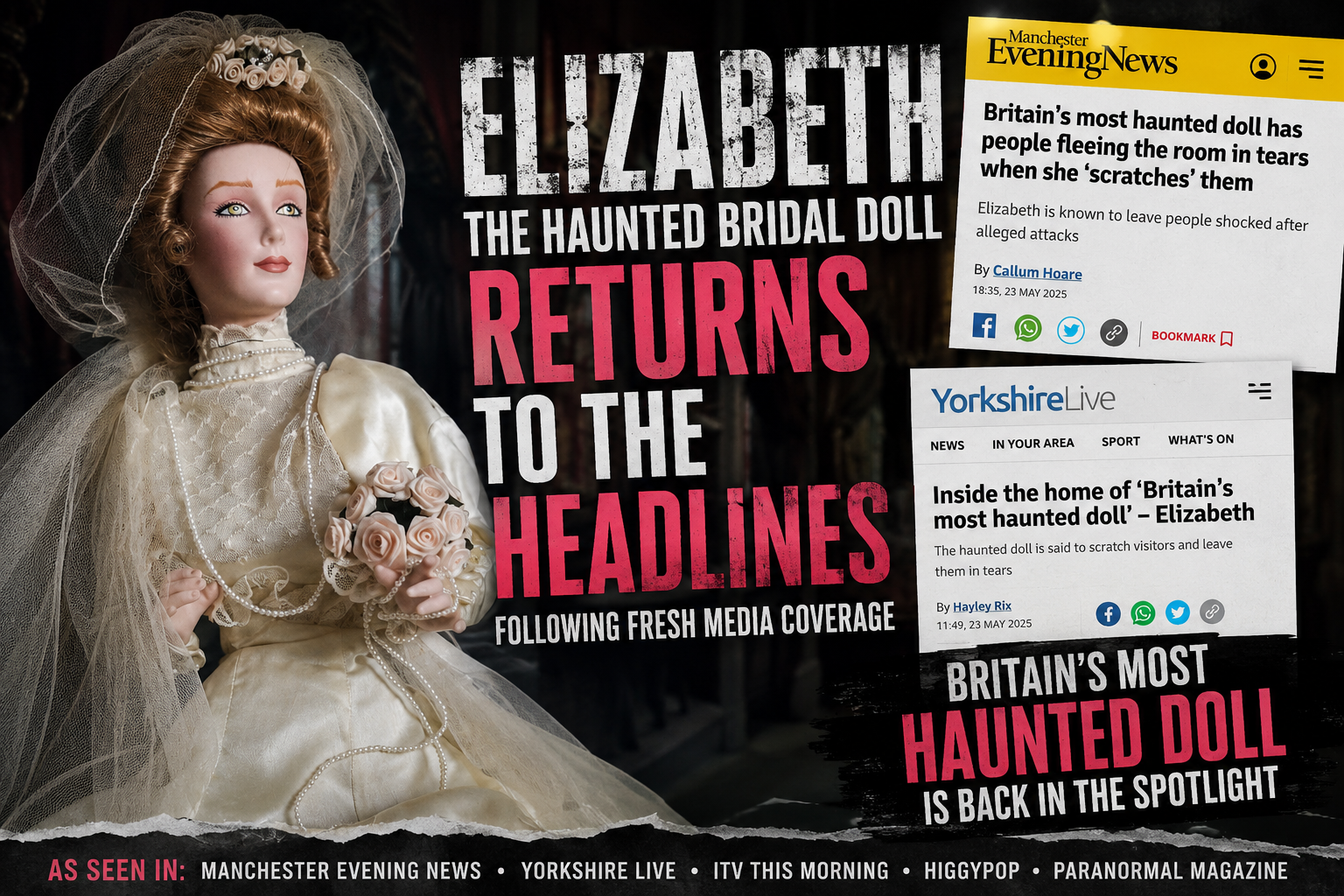
For over a decade, Elizabeth has remained one of the UK’s most discussed allegedly haunted objects, attracting investigators, sceptics, believers and curious members of the public from across the country.
Now, following fresh coverage by major regional news outlets, interest in the doll has surged once again.
The recent articles have reignited debate surrounding the infamous bridal doll, with thousands of readers sharing their opinions online and asking the same question that has followed Elizabeth for years:
Is Britain’s most haunted doll genuinely haunted, or is she simply one of the most fascinating paranormal legends of modern times?
A Story That Refuses To Go Away
Unlike many paranormal stories that briefly capture public attention before disappearing, Elizabeth has continued generating headlines, investigations and public discussion for years.
The doll first gained notoriety after reports of unexplained activity linked to previous ownership. Since then, the story has expanded through paranormal investigations, witness testimonies, television appearances and social media coverage.
Over the years, visitors and investigators have reported a variety of strange experiences while in the doll’s presence, including unexplained scratches, feelings of unease, emotional reactions and other incidents that believers argue cannot be easily explained.
While sceptics maintain that psychological factors and suggestion may play a role in such experiences, the volume of reports has helped cement Elizabeth’s reputation as one of Britain’s most controversial haunted objects.
Why Is Elizabeth Trending Again?
The latest wave of media attention appears to have introduced the story to a completely new audience.
Coverage from Manchester Evening News and Yorkshire Live has brought renewed focus to the case, with social media users sharing videos, articles and personal opinions about the doll.
Many readers encountering Elizabeth for the first time have been surprised to discover that the story stretches back more than a decade and continues to attract interest today.
The renewed attention demonstrates something unusual about the case.
Despite years passing since the earliest reports, public fascination surrounding Elizabeth shows little sign of fading.
From Paranormal Investigation To National Recognition
Elizabeth’s story has grown far beyond the boundaries of the paranormal community.
The doll has been featured in investigations, documentaries, interviews and media reports, becoming one of the most recognisable allegedly haunted objects in Britain.
What makes the case particularly unique is its longevity.
Each year seems to bring a new wave of interest, with fresh audiences discovering the story through television, online videos, newspaper features and social media discussions.
The latest media coverage is simply the newest chapter in a story that continues to evolve.
Believers Vs Sceptics
As with all paranormal cases, opinion remains divided.
Supporters of the case point to years of witness accounts and reported experiences surrounding the doll.
Critics argue that expectation, suggestion and psychological influences may explain many of the reported incidents.
Regardless of where people stand on the debate, one thing remains clear:
Elizabeth continues to generate discussion, attract media attention and capture public imagination in a way few haunted objects ever achieve.
The Story Continues
Whether viewed as a genuine paranormal mystery, a psychological phenomenon or a modern piece of British folklore, Elizabeth remains one of the country’s most talked-about haunted dolls.
The recent coverage from Manchester Evening News and Yorkshire Live has once again placed the doll firmly in the public eye, proving that more than a decade after the story first emerged, fascination with Elizabeth remains as strong as ever.
As new readers discover the case and old followers revisit the story, Britain’s most haunted bridal doll continues to make headlines.
And if recent events are anything to go by, Elizabeth’s story is far from over.
Have You Experienced Elizabeth?
Have you visited Elizabeth, attended an investigation involving the doll or experienced something you cannot explain?
Share your experience in the comments below.

Elizabeth’s Lockout: Did Britain’s Most Haunted Doll Try To Stop Visitors Entering?
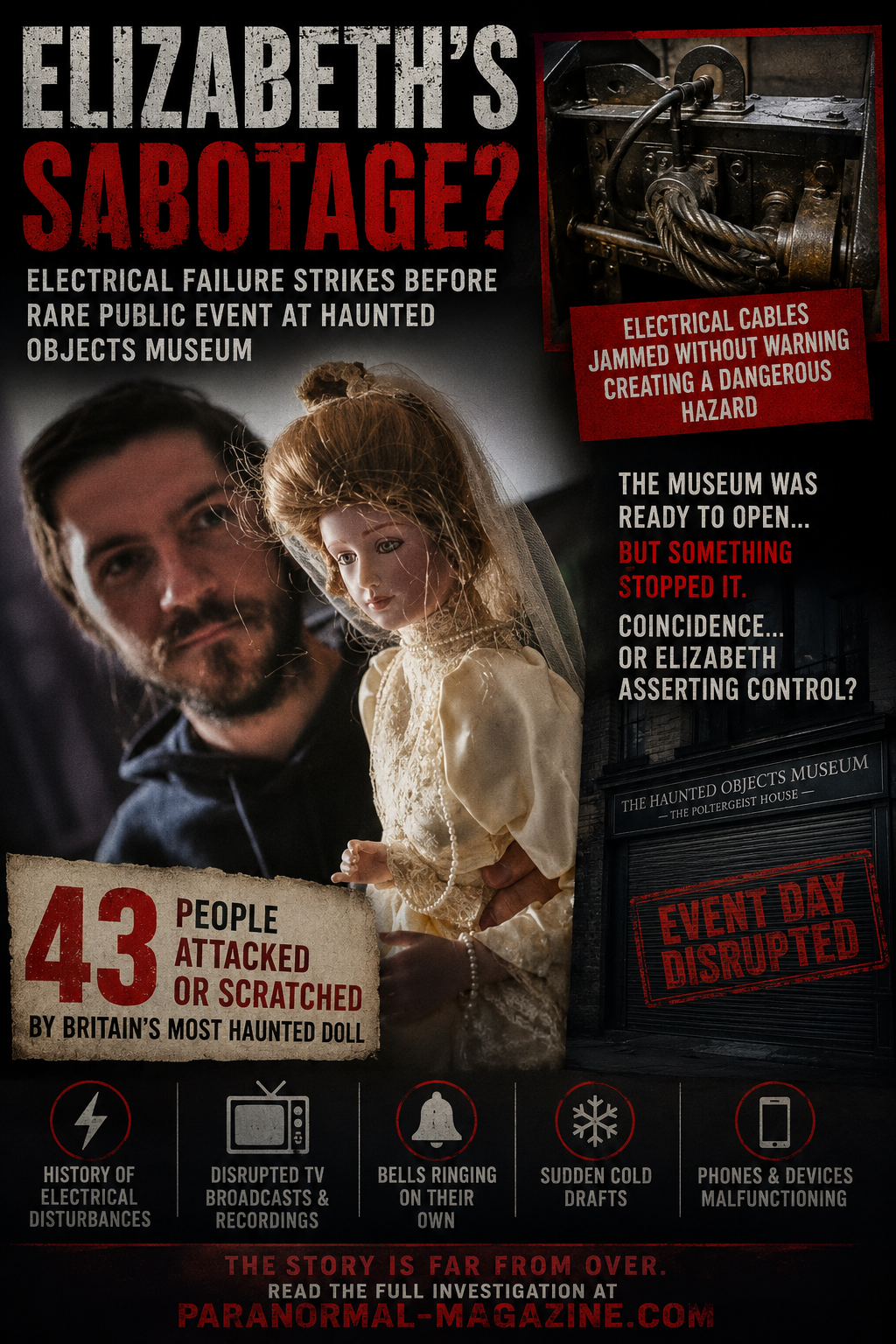
ROTHERHAM, UK — Just hours before a rare public open day at the Haunted Objects Museum, an unexpected mechanical failure left staff scrambling and visitors waiting outside.
The heavy security shutters providing access to the museum suddenly failed while preparations were underway, despite having operated normally every day in the lead-up while the building was being cleaned, painted, and prepared for the event.
When inspected, the internal cable mechanism had somehow become jammed within the housing — creating what staff described as a potentially dangerous electrical issue involving the main power system.
For paranormal investigator Lee Steer, owner of the infamous bridal doll Elizabeth, the timing felt difficult to ignore.
Strange Timing
Elizabeth — often referred to in paranormal circles as Britain’s Most Haunted Bridal Doll — has long been associated with reports of unusual electrical disturbances.
Over the years, claims connected to the doll have included:
- fire alarms activating unexpectedly
- lights flickering
- electrical faults
- camera malfunctions
- recording issues
- unexplained disturbances during investigations
While sceptics may point to coincidence or mechanical failure, the fact the shutter problem happened on the exact morning of a rare public event immediately raised eyebrows among visitors.
Was it simply bad luck?
Or another strange incident in Elizabeth’s long and controversial history?
A Rare Public Appearance
The museum’s public event was significant because daytime access to Elizabeth is unusual.
Visitors had travelled from across the UK to see the doll, with paranormal equipment set up throughout the room to document any unusual activity.
During the event itself, guests later reported:
- cold drafts
- hair being pulled
- personal items moving
- phone malfunctions
- unusual reactions to paranormal equipment
Coincidence — Or Part Of The Story?
No direct evidence links Elizabeth to the shutter malfunction.
But for followers of the case, the incident adds another curious chapter to a story that has already included national TV appearances, media attention, and years of strange claims surrounding the doll.
Whether coincidence, environmental fault, psychology, or something harder to explain…
Elizabeth continues to generate stories.
visit Elizabeth HOMEPAGE
Visit Elizabeth VIDEOS
Visit Elizabeth NEWS AND MEDIA

Why Elizabeth Has Officially Overtaken Peggy as Britain’s Most Famous Haunted Doll
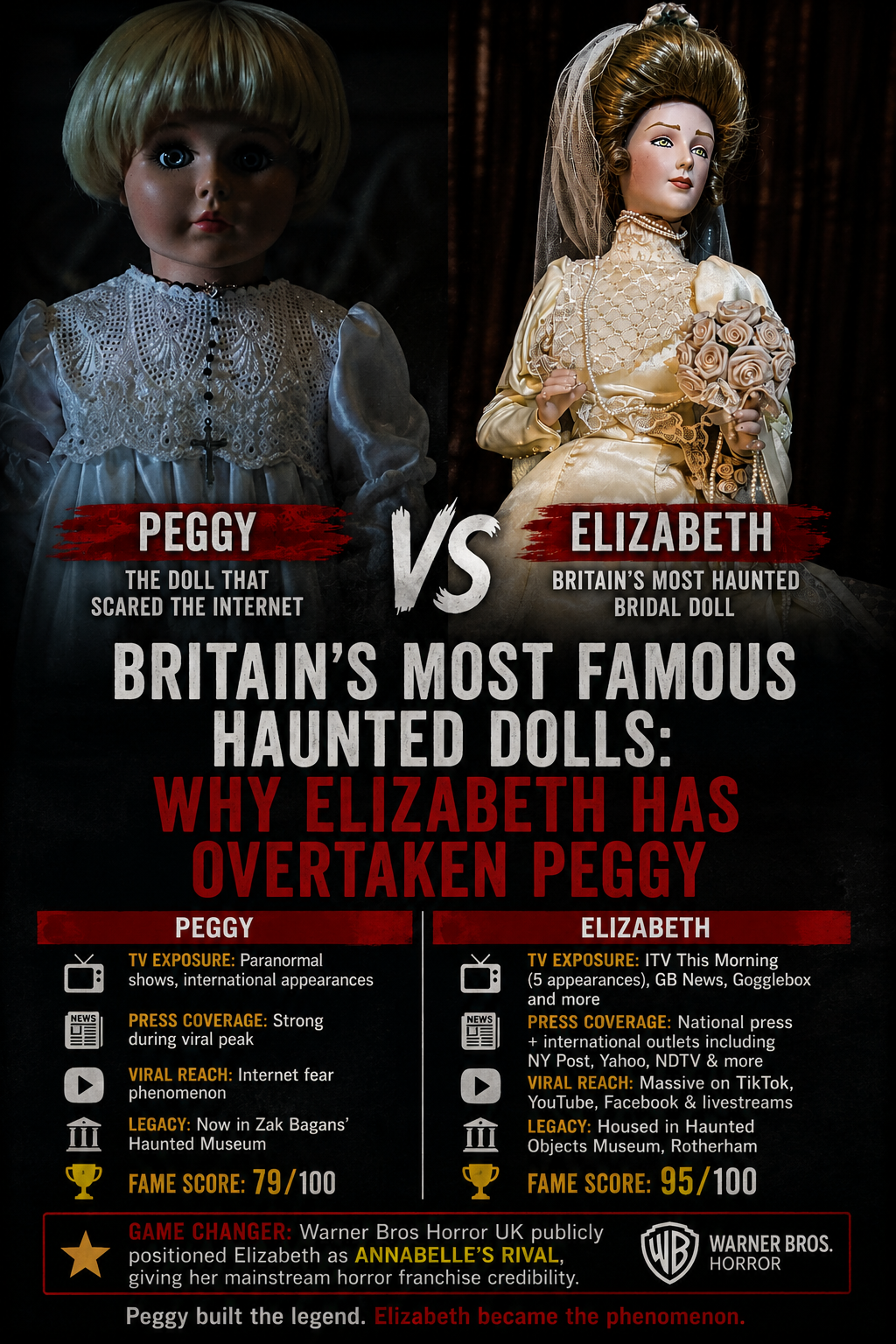
For years, Peggy the Doll was widely considered Britain’s best-known allegedly haunted doll.
Her unsettling reputation spread through paranormal circles, media stories about viewers feeling ill after seeing her image, and later through international paranormal exposure linked to Zak Bagans and his haunted museum.
Peggy built a serious legacy.
But fame changes.
And based on a weighted AI visibility ranking using measurable public exposure, Elizabeth – Britain’s Most Haunted Bridal Doll has now overtaken Peggy as the UK’s most famous haunted doll.
This isn’t just opinion.
It’s based on a structured fame analysis using mainstream television exposure, press coverage, international reach, viral content, horror branding, search recognition, cultural longevity, and paranormal legacy.
The Haunted Doll Fame Index
To compare both dolls fairly, an AI-style ranking model was used across eight categories:
- Mainstream television exposure
- National press coverage
- International media reach
- Viral social video visibility
- Search recognisability / branding
- Paranormal community recognition
- Cultural staying power
- Museum legacy / long-term permanence
- Horror franchise association
Final scores:
Elizabeth: 95/100
Peggy: 79/100
That’s a decisive lead.
So what changed?
Television Exposure: Elizabeth Dominates
The biggest reason Elizabeth has surged ahead is mainstream television.
Unlike Peggy, whose fame was largely built through paranormal programming and internet folklore, Elizabeth has repeatedly crossed into mainstream UK broadcasting.
Public exposure includes:
- ITV’s This Morning (five separate appearances)
- GB News
- Gogglebox-linked national exposure
- celebrity paranormal television connections
- multiple repeat broadcast appearances over several years
This matters enormously.
Television creates mainstream familiarity in a way paranormal niche coverage simply cannot.
A dedicated ghost enthusiast may know Peggy.
But the average British viewer is far more likely to have encountered Elizabeth through mainstream media exposure.
That kind of repeat visibility is incredibly rare for a haunted object.
Elizabeth’s Press Reach Is Vast
Elizabeth’s media footprint extends far beyond television.
Coverage linked to Elizabeth includes:
UK media
- ITV
- GB News
- Mirror
- Daily Star
- The Sun
- LADbible
- Gogglebox-related exposure
International coverage
- New York Post
- Yahoo
- NDTV
- News18
That means Elizabeth isn’t simply a paranormal curiosity.
She has become a cross-platform media story.
Peggy had strong press attention during her peak—especially around the “viewers felt sick from seeing her image” narrative—but Elizabeth’s breadth of exposure now appears significantly larger.
Warner Bros Changed the Game
This is arguably the biggest shift.
Elizabeth wasn’t just covered in paranormal circles.
She was publicly positioned by Warner Bros Horror UK as an Annabelle rival.
That changes everything.
Why?
Because Annabelle isn’t merely a haunted doll story.
Annabelle is arguably the most famous haunted doll in modern horror history.
When a major horror entertainment brand places Elizabeth in that orbit, even promotionaly, Elizabeth instantly gains cultural legitimacy beyond paranormal fandom.
That transforms her from:
“a haunted doll story”
into:
“a horror media entity.”
Peggy has Zak Bagans museum credibility.
Elizabeth has direct proximity to mainstream horror franchise branding.
Those are very different scales of public recognition.
Elizabeth Was Built for Viral Video
Modern fame is visual.
Peggy rose during an internet era dominated by creepy articles, paranormal blogs, and image-based fear stories.
Elizabeth rose during the era of:
- TikTok
- YouTube Shorts
- Facebook reels
- livestream paranormal content
- reaction videos
- viral horror clips
And visually, Elizabeth is stronger.
A white bridal doll immediately taps into horror symbolism:
- innocence corrupted
- ghost bride imagery
- uncanny human resemblance
- cinematic horror aesthetics
That gives Elizabeth stronger thumbnail appeal, stronger shareability, and stronger emotional impact.
Put simply:
Elizabeth works better in the social video era.
Branding Gives Elizabeth a Huge Advantage
Names matter.
“Peggy the Doll” is memorable.
But:
Elizabeth – Britain’s Most Haunted Bridal Doll
is vastly stronger branding.
It instantly gives:
- identity
- location
- category
- claim
- visual concept
That makes it easier for:
- media headlines
- search engine indexing
- social media virality
- public recall
Branding alone gives Elizabeth a serious edge.
Peggy Still Deserves Respect
None of this erases Peggy’s significance.
Peggy remains one of the most famous haunted dolls associated with Britain.
Her strengths include:
- deep paranormal community recognition
- strong folklore reputation
- international haunted object awareness
- Zak Bagans museum placement
- long-term supernatural notoriety
Among hardcore paranormal enthusiasts, Peggy still carries enormous legacy value.
But legacy and mainstream fame are not the same thing.
Final Verdict
Peggy built the haunted doll legend.
Elizabeth scaled it.
Measured by modern fame indicators:
- television exposure
- national press visibility
- international coverage
- viral video culture
- horror branding
- recognisable public identity
- mainstream entertainment crossover
Elizabeth now clearly leads.
Final AI Ranking
1. Elizabeth – 95/100
2. Peggy – 79/100
Peggy remains a paranormal icon.
But Elizabeth has become something bigger.
Britain’s most visible haunted doll.
visit ELIZABETH HOMEPAGE
visit ELIZABETH VIDEOS
visit ELIZABETH NEWS AND MEDIA
Haunted History: Searching for the Gray Lady at Dudley Castle
Video Title: THE GRAY LADY OF DUDLEY CASTLE: NEW EVIDENCE & GHOST HUNT
Channel: Ghosts Of Britain
Location: Dudley Castle, West Midlands, UK
Dudley Castle has long been a focal point for paranormal enthusiasts, primarily due to the legend of the Gray Lady. In their latest investigation, the Ghosts of Britain team—Lee, Sarah, and Nick—returned to this historic site to test new evidence, explore the labyrinthine undercroft, and see if the castle’s spirits were ready to communicate.
The Mystery of the Gray Lady
The video centers on a famous photograph of an apparition taken at the castle keep. The team begins by recreating the shot at the top of the keep [01:51].
Using long-exposure photography, they analyze whether the “figure” seen in the windows is a genuine spirit or a case of pareidolia (the mind seeing familiar shapes in random patterns). Lee notes at [22:03] that the uneven brickwork and shadows in the doorway could easily be mistaken for a head and shoulders when viewed from a distance. While they remain open-minded, the team provides a grounded look at how modern “ghost photos” are often created by the environment itself.
The Dark History of the Castle
Before diving into the hunt, the team discusses the castle’s grim past:
- The Witch Trial: A local story tells of Margaret and her brother John. John reportedly had Margaret tried as a witch at the very top of the keep by throwing her over the edge [07:07].
- The Phantom Cheetah: A unique legend involves a former owner who kept a pet cheetah. The animal has reportedly been seen running through the courtyard as a spirit [08:00].
- The Undercroft Legend: A cleaner once reported seeing only the boots and lower legs of a figure walking in the undercroft, which ended abruptly at the waist [06:15].
Investigation Highlights: The Undercroft “Carnage”
The most intense segment of the video takes place in the undercroft, a warm, humid space filled with coffins and ancient brickwork.
- Physical Symptoms: Almost immediately, the team experiences physical effects. Sarah reports feeling quite sick at [13:58], while Nick suffers from a sudden headache. This is often attributed to high electromagnetic fields or the oppressive atmosphere of haunted locations.
- The “I Clean” EVP: During a voice recorder session, Sarah asks what job the spirit did when they were alive. At [15:09], a faint but clear voice seems to respond, “I clean,” potentially corroborating the story of the ghostly cleaner mentioned earlier.
- The Thomas Connection: A spirit naming itself “Thomas” becomes a recurring theme. The team eventually links this to a small coffin that was moved to the site from St. Thomas’s Church [30:53].
- The “Batshit” Session: Toward the end of the video, the equipment begins to trigger uncontrollably. At [31:25], Lee describes the situation as “gone absolutely batshit,” with the REM pod and motion sensors firing off in rapid succession. During this “carnage,” a voice on the Ovilus device is heard saying “Thomas” and “December” [26:48].
Scientific Skepticism vs. Paranormal Proof
What makes this Ghosts of Britain episode compelling is the balance of skepticism. Even while their equipment is “belting out words” at [32:26], Lee and Nick continue to question the sources of the sounds, checking for radiator cooling or interference.
However, the sheer volume of activity in the undercroft—ranging from clear vocal responses to the drain of a flashlight battery that went “dead flat” instantly at [35:09]—leaves the team convinced that Dudley Castle remains one of the UK’s most active sites.
Conclusion
Whether the Gray Lady is a spirit or a trick of the light remains up for debate, but the intelligence captured in the undercroft is hard to ignore. From the mention of “Thomas” to the physical illness felt by the team, Dudley Castle continues to guard its secrets closely.
Watch the full investigation here: https://youtu.be/yXLqHR0TYsY
Do you think the Gray Lady photo is pareidolia or a real ghost? Have you ever felt sick in a haunted location? Share your thoughts below!

