Blog Archives
Spirit Box Videos on the Recently Deceased Need to Stop
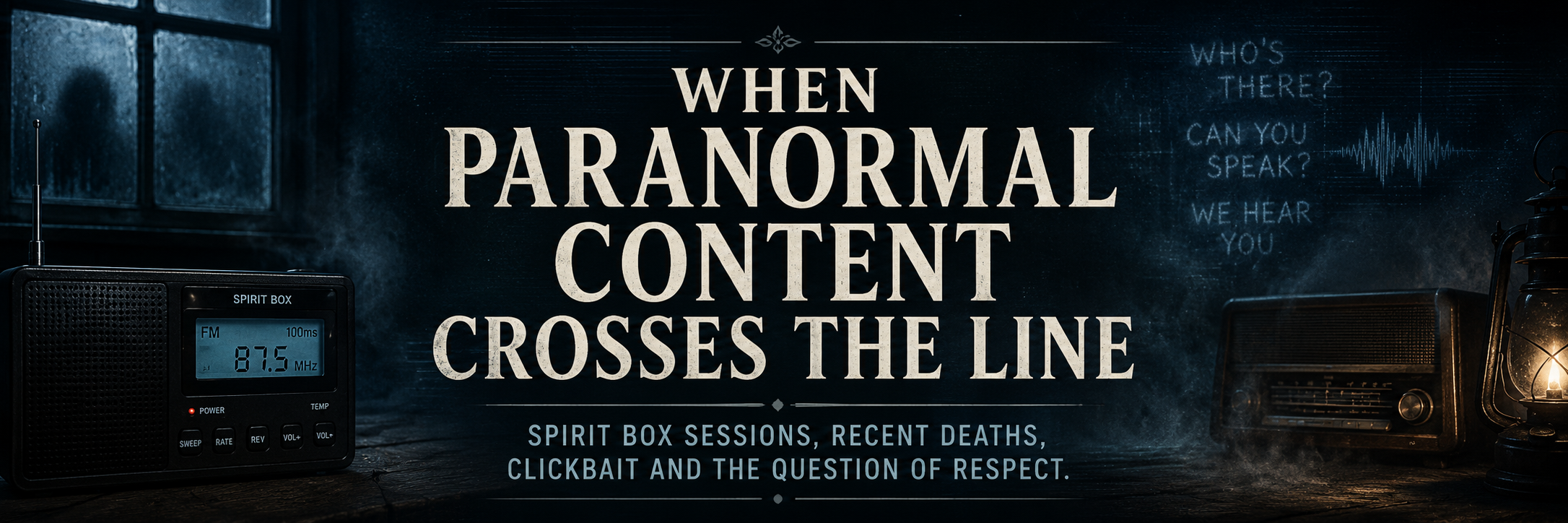
There is something about recent spirit box videos that does not sit right with me, When somebody has only just passed away, especially if their death is all over the news, it feels wrong to see channels rushing to make ITC or spirit box videos about them.
The family may still be grieving, the funeral may not have even happened yet, and strangers are already putting that person’s face in thumbnails and claiming they have made contact with them. That is where paranormal investigation starts to look more like content chasing. Spirit boxes also need to be treated with a lot more caution than they often are.
These devices scan radio frequencies, so if somebody’s name is already being mentioned on the radio, in news reports, interviews or talk shows, then hearing that name come through a spirit box is not automatically paranormal. Of course certain names, places or details might appear, They are already being talked about everywhere.
That is why a name coming through during a session on a recently deceased famous person should never be treated as solid proof that the person is communicating, Editing can also make these sessions look far more convincing than they really are.
A session might last an hour, but the viewer only sees the few moments that seem to match the questions being asked. Add subtitles telling people what they are supposed to hear and suddenly a random bit of radio sounds like a clear response. This does not mean every investigator is deliberately misleading people, but it does mean viewers should be careful.
There is also another side to this that does not get talked about enough, people who disagree with these channels and do commentary can sometimes fall into the same trap without realising.
If a creator makes a video saying that spirit box channels are exploiting a recently deceased person, but then uses a huge photograph of that same person in the thumbnail and puts their name in the title to attract clicks, there is a contradiction there, the intention may be different, but the deceased person is still being used to sell the video in a different way more then likely not fully thinking about it.
these videos does not always need the deceased person’s face plastered across the thumbnail. The focus should be on the behaviour, the method and the ethics of what is happening. a title such as “Why Recent-Death Spirit Box Videos Are a Problem” makes the point without turning the person who died into the main attraction.
Sometimes a screenshot or image may be needed for context, and there is nothing wrong with discussing a case responsibly, but there is a difference between showing something for explanation and using somebody’s death as clickbait. The same rule should apply to everyone.
ITC channels, paranormal investigators, debunkers and commentary channels should all remember that behind the story is a real person and a real family. Whether you believe spirit communication is possible or not, there should still be some respect. i understand its coming from the right place in heart for the debunkers and commetnery channels. If the ITC channel wasnt making the HIDOUS videos in the first place this wouldnt be happening.
If a person has only just died, maybe the most respectful thing is not to rush to contact them, debunk them, react to them or build content around them. Sometimes people should simply be allowed to rest.
abit of a contreversial one but interesting i would love to know your thoughts on this.
When the Search for the Unknown Meets the Search for Clicks: A Respectful Look at the State of Paranormal Investigating FT: Ghosts On Trent
The paranormal community has always been driven by curiosity. Whether it’s exploring allegedly haunted locations, researching local history, testing new equipment, or simply trying to understand experiences that defy explanation, most investigators begin with the same goal: to search for answers.
Over the last decade, however, the paranormal world has changed dramatically. Social media platforms like YouTube, TikTok, Facebook and Instagram have introduced the subject to millions of people around the world. That has undoubtedly helped the community grow, but it has also changed the way investigations are presented and, in some cases, the motivations behind them.
A recent post by Ghosts On Trent has sparked discussion across the paranormal community. Their message suggests that genuine investigation is increasingly being overshadowed by entertainment, social media popularity and influencer culture.
It’s a thought-provoking point, but like most things in the paranormal world, the reality isn’t quite as simple as one side being right and the other being wrong.
The Main Concerns
Ghosts On Trent raise several important issues.
They question whether some investigators are becoming influencers before they become researchers. They suggest that popularity on social media can sometimes outweigh experience and credibility, and they express concern that paranormal events may be favouring creators with the largest audiences over those with years of investigative knowledge.
They also argue that chasing views, revenue and online recognition risks damaging the credibility of paranormal investigating. Whether you completely agree or not, these concerns are worthy of discussion.
Social Media Has Changed the Paranormal
There is little doubt that social media has transformed the paranormal community. Years ago, investigations were shared through local groups, forums, DVDs and word of mouth. Today, a single investigation can reach hundreds of thousands of people within hours. That’s not necessarily a bad thing.
Social media has introduced thousands of people to paranormal investigating who may never have discovered it otherwise. It has allowed small teams to reach global audiences, encouraged collaboration and opened conversations that simply weren’t possible twenty years ago.
However, social media also rewards excitement. Videos with dramatic music, emotional reactions, bold claims and eye-catching thumbnails naturally attract more attention than a quiet investigation where very little happens. Unfortunately, that creates pressure.
A completely honest investigation that ends with “we didn’t capture anything conclusive tonight” rarely performs as well as one claiming to have found undeniable evidence.
When Views Start Driving Investigations
Good investigations take time. Researching a location’s history. Learning about previous reports.
Testing equipment. Ruling out natural explanations before jumping to paranormal conclusions. None of these things make particularly exciting short videos, yet they’re often the most important parts of an investigation.
The danger is that investigators can begin feeling pressure to make every unexplained noise, shadow or equipment anomaly seem paranormal because that’s what audiences have come to expect.
That doesn’t automatically mean they’re being dishonest. Sometimes it’s simply the reality of creating content in an online world where excitement is rewarded.
Clickbait: Part of the Modern Landscape
One word that’s become almost impossible to avoid is clickbait. It’s often used as criticism, but the truth is that almost every successful creator uses eye-catching titles and thumbnails to some degree. That’s not unique to the paranormal community—it’s simply how YouTube and social media work.
Even many of the most respected paranormal channels use intriguing titles designed to make people curious enough to click. Without them, their content may never reach the audience it deserves. The important distinction isn’t whether a title is dramatic.
It’s whether the investigation delivers on that promise. There’s nothing wrong with making people curious enough to watch. Problems begin when evidence is exaggerated, speculation is presented as certainty, or ordinary events are deliberately made to appear paranormal simply for entertainment.
Perhaps that’s where the real conversation should be. Not whether creators use exciting titles—because almost everyone does—but whether the investigation itself remains honest, balanced and transparent.
Everyone Wants Their Work to Be Seen
One point that’s often overlooked is this: if someone uploads their investigations to social media, they clearly want people to watch them. That’s true whether they’re a small local team with a few hundred followers or a channel with hundreds of thousands of subscribers.
People share their work because they want it to be seen. They want discussion. They want feedback.
They want their investigations to reach an audience. In that sense, everyone is chasing views.
The difference is that for many investigators, views are simply the way their work reaches people—they’re not the reason they investigate.
There’s nothing wrong with wanting your hard work to be watched and appreciated. The problem only begins if the pursuit of views becomes more important than honesty, evidence and integrity.
The Convention Debate
Ghosts On Trent also questioned whether paranormal conventions are favouring creators with the biggest online audiences.
There is some truth to the idea that popular creators help sell tickets. Event organisers are businesses, and successful events need visitors to survive. However, that’s only part of the picture.
Many event companies actually invite a mixture of guests. Alongside well-known YouTube personalities, you’ll often find historians, authors, experienced investigators, equipment specialists and researchers who take a far more scientific or evidence-based approach.
That’s because visitors attend these events for different reasons. Some enjoy hearing exciting investigation stories. Others want to learn about historical research, investigation techniques or the science behind certain equipment.
A balanced line-up benefits everyone. It allows attendees to hear different viewpoints, compare methods and decide for themselves what resonates most.
Rather than seeing these different styles as competitors, perhaps they’re simply serving different parts of the same community.
Popularity Doesn’t Equal Credibility
It’s also important not to assume that having a large audience automatically makes someone less credible.
Many successful creators invest enormous amounts of time researching locations, improving their methods and presenting investigations responsibly, Equally, having a small audience doesn’t automatically make someone an expert.
Credibility isn’t measured by subscriber counts, It’s measured by honesty, consistency, transparency and a willingness to question your own conclusions—even when they aren’t exciting.
The Importance of Critical Thinking
Perhaps the biggest danger in paranormal investigating isn’t social media at all, It’s confirmation bias.
When investigators arrive expecting paranormal activity, it’s easy to interpret every sound, shadow or equipment response as evidence, Responsible investigators challenge themselves.
They look for ordinary explanations before extraordinary ones, Ironically, doing so often makes genuinely unexplained experiences even more compelling.
A Community That Needs Every Perspective
Perhaps the most interesting aspect of this debate is that every part of the paranormal community depends on the others more than many people realise.
Entertainment-focused channels introduce huge numbers of people to paranormal investigating. For many viewers, these creators are the gateway into the subject. Without that exposure, the paranormal community would almost certainly be much smaller.
At the same time, evidence-based investigators, sceptics and debunkers play an equally important role. They encourage critical thinking, test claims and remind the community that extraordinary claims deserve careful examination.
In many ways, it’s a catch-22, Without exciting investigations attracting large audiences, there would be far fewer claims for researchers and debunkers to analyse. Likewise, without people asking difficult questions and challenging evidence, investigative standards would likely suffer.
Whether people realise it or not, both sides help shape the paranormal community, Neither exists entirely in isolation.
Respect Matters
One thing Ghosts On Trent deserve credit for is that their post focused on wider trends rather than publicly attacking individual creators, Healthy discussion benefits the community, Respectful disagreement encourages better standards.
Personal attacks rarely solve anything, The paranormal world has always been filled with different beliefs, different methods and different opinions. That’s part of what makes it fascinating.
Is Ghosts On Trent Completely Right?
Not entirely, The concerns they raise are genuine, but the situation is more complex than simply blaming social media or content creators, Social media has undoubtedly encouraged some sensationalism.
At the same time, it has also helped grow the paranormal community, introduced new generations to investigating and given independent researchers opportunities that simply didn’t exist twenty years ago.
Like any tool, social media depends entirely on how it’s used, The real issue isn’t technology, It’s integrity.
The Balance
Perhaps the future of paranormal investigating lies somewhere in the middle, Creators should be able to produce entertaining, engaging content without exaggerating evidence.
Researchers should embrace modern platforms without abandoning good investigative methods, Audiences should recognise that not every investigation ends with dramatic proof—and that’s perfectly acceptable.
Paranormal Magazines Ending statement.
Ghosts On Trent have started an important conversation, and that’s something the paranormal community should welcome.
Whether you’re an experienced investigator, a content creator, a sceptic or simply someone fascinated by the unknown, credibility should always remain at the heart of what we do.
At the same time, we should recognise that the paranormal community is made up of many different voices. Some educate through historical research. Some entertain through immersive investigations. Some challenge claims through sceptical analysis. All have contributed, in one way or another, to making the paranormal more accessible than ever before.
Perhaps the goal shouldn’t be deciding which approach is “right,” but encouraging every creator to be honest about what they present. Views will always matter because they allow investigations to reach an audience. Selling tickets will always matter because events need to survive. Entertainment will always matter because it inspires curiosity.
But above all else, integrity should matter most.
If the paranormal community can hold on to that, then there is room for researchers, entertainers, sceptics, historians and investigators alike—each playing their own part in the continuing search for the unknown.
there will be a part 2 more focused on produced fake evidence and the damage,
visit PARANORMAL DEBUNKED to view all our articles like this.
EMF Meters in Paranormal Investigation: A Scientific and Sceptical Guide
Anyone who has watched a paranormal investigation will recognise the scene.
The lights are off. The building is silent. An investigator places a small meter on a table and asks, “Is there anybody here?”
A few seconds later, the lights on the device begin to flash.
It is an effective moment, especially on camera. When a meter responds directly after a question, it can feel as though something unseen has answered.
But before we call it evidence of a spirit, we need to ask a more basic question: what is the device actually measuring?
An EMF meter measures electromagnetic fields. These fields are real, measurable and found almost everywhere. They are produced by electrical wiring, appliances, phones, cameras, radios and numerous other devices.
What an EMF meter cannot do is identify the source of a reading as a ghost.
That does not make the meter useless. Used properly, it can be a valuable piece of equipment. Used badly, it can turn an ordinary electrical signal into apparently convincing paranormal evidence.
What is an electromagnetic field?
EMF stands for electromagnetic field.
Electricity and electronic equipment produce electromagnetic fields. Walk around an ordinary home with a sensitive meter and you may find readings near wall sockets, extension cables, fuse boxes, chargers, fans, fridges and heating systems.
Some devices produce a steady field. Others switch on and off throughout the day.
A refrigerator compressor, for example, may activate without anyone noticing. A boiler pump may start in another room. A phone may briefly connect to a network while sitting untouched in someone’s pocket.
All of these things can cause a meter to respond.
This is why a flashing light should be treated as the beginning of an investigation, not the conclusion.
The meter is telling you that it detected something within its measurement range. It is not telling you what caused it.
Are EMF meters designed to find ghosts?
No. Most were created to locate electrical fields, check equipment or survey an environment.
The link with ghosts comes from a paranormal theory: that spirits may produce, use or disturb electromagnetic energy.
It is an interesting idea, but it has not been scientifically established.
There is currently no accepted evidence showing that a spirit must create a measurable electromagnetic field. There is also no standard reading that means a ghost is present.
That distinction matters.
When an investigator says, “The meter detected energy,” they are technically correct—but the statement is vague. Heat is energy. Light is energy. Radio waves are energy. A battery contains energy.
The useful question is not whether energy exists. It is what type of field was measured, how strong it was and what nearby source could have produced it.
Not all EMF meters measure the same thing
The words “EMF meter” are often used as though every device works in the same way. They do not.
Some meters measure low-frequency magnetic fields, usually produced by electricity flowing through wiring or electrical equipment.
Others measure electric fields linked to voltage.
Radiofrequency meters detect signals from Wi-Fi, mobile phones, Bluetooth devices and two-way radios.
More expensive combination meters may have separate settings for magnetic, electric and radiofrequency measurements.
This can cause confusion during investigations. A reading taken on one setting may have no direct relationship to a reading taken on another.
It is also important to understand the units being displayed. Magnetic fields may be shown in milligauss or microtesla, while electric fields may be measured in volts per metre.
Saying that a meter “went up to ten” means very little unless we know what was being measured.
The K-II meter
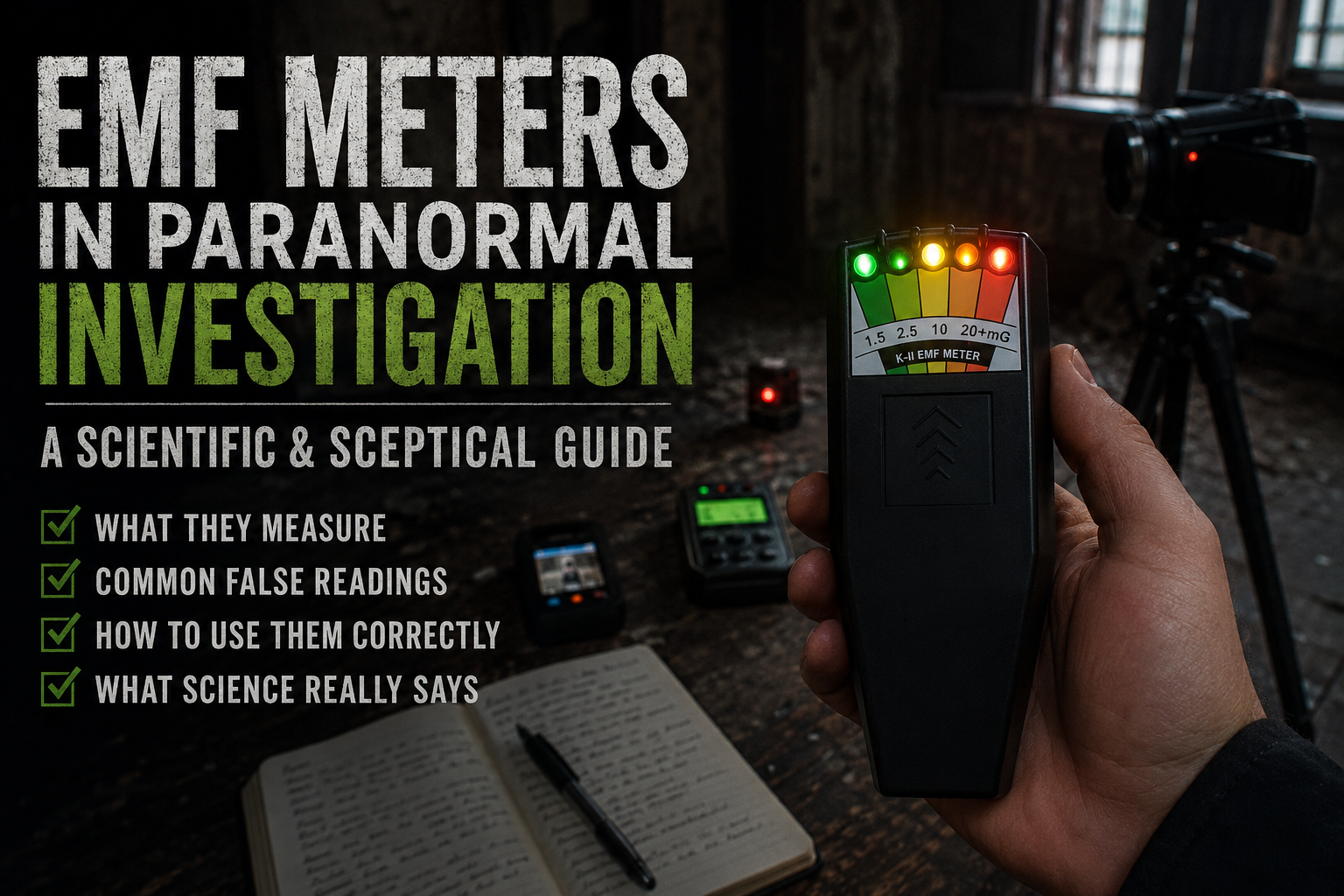
The K-II, also known as the K2, is probably the best-known paranormal EMF meter.
It has five coloured lights that illuminate as the detected field becomes stronger. It is simple, easy to see in the dark and looks dramatic on video.
That simplicity is also its main weakness.
The lights represent broad ranges rather than precise numbers. Two noticeably different readings may illuminate the same LED.
The K-II is also directional. Turning or tilting it can change the display, even if the electrical source remains in the same place.
This means that walking through a room while waving the meter around can produce sudden changes that look more mysterious than they really are.
The device may also respond to investigation equipment. Mobile phones, cameras, radios and wireless devices can all affect sensitive electronics.
Even the start-up sequence can be misunderstood. When the K-II is switched on, its lights illuminate briefly. A loose switch or poor battery connection may cause the device to restart, creating a pattern that looks like a response.
None of this means every K-II event is false. It means the investigator has work to do before claiming the event is unexplained.
What causes most EMF spikes?
The most common cause is hidden electricity.
Wiring can run behind walls, under floors and above ceilings. An apparently empty corner may contain a cable feeding another part of the building.
Fuse boxes and consumer units can produce strong readings, particularly when the building is drawing a lot of power.
Chargers are another common source. Phone chargers, laptop power supplies and other adapters can create noticeable fields, even when the attached device is not being actively used.
Then there are appliances that switch on automatically. Fridges, freezers, central heating systems, pumps, fans and dehumidifiers can all produce changing readings.
During an investigation, the team’s own equipment may be the biggest problem.
Phones continue to send and receive data in the background. Two-way radios transmit strong signals. Wireless microphones, security cameras and internet-connected devices add further contamination.
A meter may react just as an investigator asks a question, but the cause could be a team member pressing a radio button elsewhere in the building.
Timing can be convincing without being meaningful.
Can a spirit answer yes or no?
A popular experiment involves placing a meter on a table and asking a spirit to flash the lights once for yes and twice for no.
It can produce some of the most memorable moments in a ghost hunt. Unfortunately, the method also has several weaknesses.
The first problem is timing.
How long after the question counts as an answer? Two seconds? Ten seconds? Half a minute?
Unless the response window is decided beforehand, almost any later flash can be connected to the question.
The second problem is selective memory. Investigators naturally remember the three questions that appeared to receive answers. They may forget the twenty questions that produced nothing.
Editing can make this worse. A finished video may show only successful-looking moments, creating the impression of a conversation that did not exist in real time.
There is also the problem of interpretation. Once investigators agree that one flash means yes, they begin looking for that pattern.
Humans are very good at finding meaning in random events. It is the same reason we see faces in clouds or hear words in unclear recordings.
Even a well-timed response does not tell us what caused it. The source may be electrical, accidental, deliberate or unknown.
A meter does not provide an identity.
Using an EMF meter properly
Before taking a meter into a reportedly haunted building, test it somewhere ordinary.
Try it near a wall socket, a phone charger, a running fan, a fridge and a mobile phone. Switch a radio on and off. Move a camera closer to it.
You may be surprised by how easily some meters respond.
Learning the normal behaviour of the device will help you recognise interference later.
When you arrive at the investigation site, conduct a full survey before the lights go out and the questions begin.
Walk through each room and note where the readings change. Mark the positions of sockets, appliances, fuse boxes, heating equipment, routers and security systems.
Do the same survey more than once.
If a reading changes between the first and second survey, try to discover what switched on. This is often more useful than waiting for an unexplained spike during a séance-style session.
For experiments, keep the meter still. Place it on a stable surface instead of holding it.
A stationary meter reduces changes caused by movement, distance and angle.
Phones should be placed in airplane mode, with Wi-Fi and Bluetooth checked separately. Radios should be switched off or kept well away from the test area.
Any transmission made during the experiment should be recorded in the investigation notes.
Using two meters is better than using one. If only one device responds, there may be a fault or a problem local to that meter.
If two independent devices react at the same time, the event becomes more interesting. It still does not become proof of a ghost, but it gives the team more reliable information.
Write down what actually happened
“The meter went crazy” is not useful evidence.
A proper report might say:
At 10:43 p.m., the meter increased from its normal reading of 0.2 milligauss to 4.1 milligauss. It remained elevated for approximately three seconds. The meter was stationary, no radios were in use and the nearest known electrical socket was two metres away.
That does not sound as dramatic, but it allows someone else to examine the claim.
Record the time, place, normal reading, highest reading and duration. Note which equipment was operating and who was in the room.
Continuous filming is also important. The camera should show the meter, the investigators and as much of the surrounding area as possible.
Do not stop filming between questions. The quiet periods and failed responses are part of the evidence.
Decide the rules before the experiment
A simple test becomes more useful when the rules are agreed in advance.
For example, the team may decide that a response must:
- Occur within five seconds of a question
- Reach a set reading
- Last for at least two seconds
- Appear on two meters
- Be repeated when requested
The exact rules can vary, but they should not be changed after the event.
Without clear rules, investigators may unknowingly reshape the experiment to fit whatever happens.
Try it again
One unexplained reading is interesting. A reading that can be repeated under the same conditions is far more useful.
Ask for the result again.
Then move to another room and repeat the experiment as a control. If the same random flashing happens everywhere, the first event becomes less impressive.
Ideally, the team should also return on another date and repeat the test.
Science depends on repeatability. Paranormal investigations rarely provide perfect laboratory conditions, but that does not mean basic controls should be abandoned.
What would count as a genuinely interesting event?
An EMF reading deserves closer attention when the meter is stationary, the normal electrical background has been mapped and nearby phones, radios and wireless devices are switched off.
It becomes more interesting if more than one meter responds, the event is clearly above the normal reading and the exact time is recorded.
Repeated events are stronger than isolated spikes.
A response that occurs several times under the same conditions—and does not occur during control tests—is worth investigating further.
Even then, the correct description is an unexplained electromagnetic event.
That is not an attempt to avoid the paranormal. It is simply honest wording.
Unexplained means the source has not been identified. It does not automatically mean supernatural.
Can EMF make a place feel haunted?
Some researchers have explored whether unusual electromagnetic conditions might affect how people feel.
Reported effects have included unease, dizziness, tingling and a sense that someone else is present.
The results have been mixed.
Some studies have suggested that environmental conditions may play a part in experiences reported at haunted locations. Other controlled experiments have failed to show a reliable connection.
Expectation also matters.
Tell someone they are entering a haunted room and they are likely to pay closer attention to every sound, shadow and physical sensation.
That does not mean they are lying. The fear and discomfort may be completely genuine.
The cause, however, could involve lighting, temperature, unfamiliar noises, poor air quality, tiredness, suggestion or several factors working together.
It may also remain unexplained.
Which meter should investigators buy?
For basic ghost hunting, the K-II remains popular because it is simple and visible.
For more serious work, a meter with a proper numerical display is a better choice.
A three-axis meter is generally easier to use because it is less affected by orientation. Data logging is also valuable because it creates a record that can be reviewed later.
Look for a device with clear specifications, including its frequency range, accuracy and units.
Be cautious of products that claim to detect spirits without explaining what physical measurement is being taken.
A scientific instrument should tell you what it measures. Paranormal marketing is not a technical specification.
What an EMF meter can—and cannot—tell you
An EMF meter can help investigators locate hidden wiring, discover electrical contamination and record changes in a location.
It can also help determine whether strange experiences happen near measurable environmental fields.
What it cannot do is identify a ghost.
It cannot tell you whether a spirit entered the room, who the spirit was or whether a flashing light was a deliberate answer.
It cannot separate paranormal activity from radio interference without additional testing.
Most importantly, it cannot replace careful investigation.
The sceptical position
Scepticism is not the same as automatic disbelief.
A good sceptic does not need to explain every strange reading immediately. Sometimes the evidence is incomplete and the cause remains unknown.
The honest answer may be:
“The meter reacted, but we could not identify the source.”
That is a perfectly reasonable conclusion.
It is stronger than declaring that nothing happened, and it is far more credible than claiming proof of a spirit.
Paranormal investigation should leave room for uncertainty.
The field will not become more respected by turning every electronic beep into evidence. It becomes stronger when investigators check the ordinary causes, admit the limits of their equipment and preserve the cases that genuinely remain unexplained.
Final thoughts
EMF meters can be useful tools, but they are not ghost detectors.
Their greatest value may be in finding the normal electrical sources that would otherwise be mistaken for paranormal activity.
Before treating a reading as unusual, check the wiring, appliances, phones, radios, cameras, heating systems and the condition of the meter itself.
Keep the device still. Record the actual numbers. Use more than one instrument and try to repeat the result.
If the reading remains unexplained after those checks, it deserves further attention.
It still does not prove that a ghost was present.
An EMF meter measures electromagnetic fields. Everything beyond that has to be demonstrated through evidence.
ITV’s Famous Haunted WWII Wheelchair Finds A New Home At The Haunted Objects Museum
Historic Wartime Artefact Acquired By Ghosts Of Britain Founder Lee Steer For £350
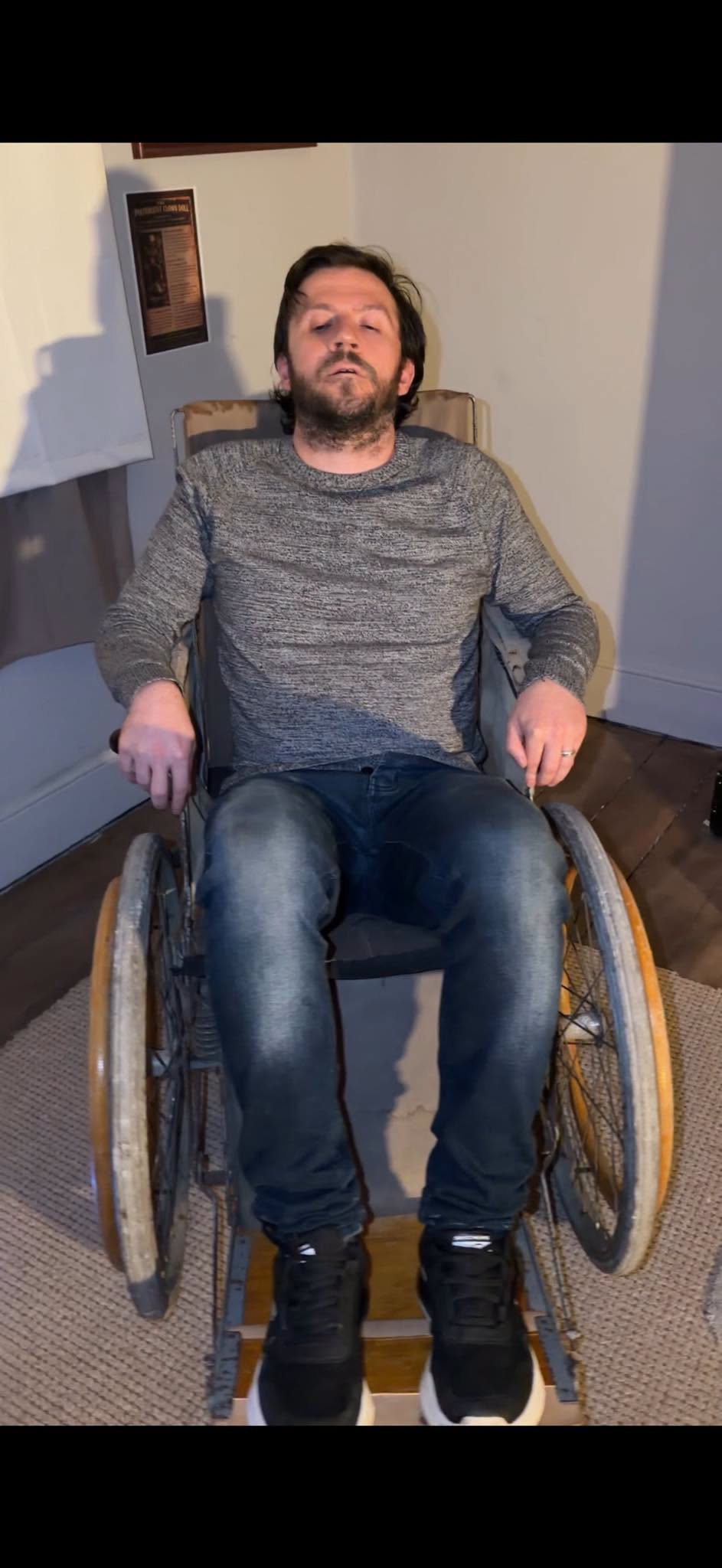
One of Britain’s most famous allegedly haunted objects has begun a new chapter in its extraordinary history after being acquired by paranormal investigator Lee Steer and permanently relocated to The Haunted Objects Museum at Poltergeist House in Rotherham.
The World War II wheelchair, which gained national attention after appearing on ITV’s This Morning, was recently secured at auction for £350 and now forms part of the museum’s growing collection of haunted and historically significant artefacts. The object will be preserved and investigated by the Ghosts of Britain team while remaining on public display for visitors interested in the paranormal.
A Chair With A Wartime Past
According to its reported history, the wheelchair dates back to the Second World War and was used within a military hospital treating wounded servicemen returning from conflict. During the war years, thousands of injured soldiers passed through military medical facilities across Britain, many carrying both physical and emotional scars from their experiences.
The wheelchair’s reputation has grown over the decades due to claims that it was used by numerous wounded soldiers, some of whom reportedly never recovered from their injuries. Paranormal researchers and previous custodians have long suggested that the intense emotions associated with wartime suffering may somehow be linked to the strange experiences reported around the chair.
While much of the chair’s early documented history remains difficult to verify, its connection to Britain’s wartime medical history has become an important part of the legend that surrounds it.
The Hauntings And Strange Reports
The wheelchair became widely known in paranormal circles after numerous reports of unusual sensations experienced by those who sat in or stood near it.
Previous investigators have claimed that visitors often reported cold sensations, feelings of heaviness, unexplained discomfort, and strange sensations affecting their legs. Some have described feeling as though an injury was present despite being perfectly healthy.
During its famous appearance on ITV’s This Morning, paranormal collector Neil Packer discussed claims surrounding the wheelchair, including reports from individuals who believed they had experienced unusual physical sensations while sitting in it. The object quickly became one of the most talked-about items featured on the programme.
As with all paranormal claims, there is no scientific evidence proving the wheelchair is haunted. However, its reputation has continued to grow due to the consistency of witness reports over many years.
Arrival At Poltergeist House
The wheelchair has now completed its latest journey and arrived safely at The Haunted Objects Museum inside Poltergeist House, Rotherham.
Its arrival marks another significant addition to the museum’s collection and strengthens its position as one of Britain’s most unique destinations for paranormal enthusiasts. The object will be displayed alongside other famous haunted artefacts investigated and preserved by Ghosts of Britain and Paranormal Magazine.
For Lee Steer, the acquisition represents not only the preservation of an important piece of paranormal history but also an opportunity to continue documenting reports and experiences connected to the object.
What Happens Next?
Over the coming days, the Ghosts of Britain team will begin a period of observation and documentation as the wheelchair settles into its new environment.
Visitors can expect regular updates, photographs, video investigations and witness reports as the object is monitored within the museum. Any unusual experiences reported by staff, investigators or visitors will be carefully recorded as part of an ongoing study into the chair’s reputation.
The first few days following the arrival of a historically significant haunted object are often among the most interesting. New surroundings, new witnesses and fresh investigations can sometimes bring unexpected results.
Whether the wheelchair’s reputation is rooted in genuine paranormal activity, psychological suggestion, or a combination of both remains open to debate.
What is certain is that one of Britain’s most famous haunted artefacts has now found a permanent home in Rotherham.
And for paranormal enthusiasts across the UK, all eyes will be on Poltergeist House to see what happens next.
 Paranormal Magazine UK