Blog Archives
ITV’s Famous Haunted WWII Wheelchair Finds A New Home At The Haunted Objects Museum

Historic Wartime Artefact Acquired By Ghosts Of Britain Founder Lee Steer For £350
One of Britain’s most famous allegedly haunted objects has begun a new chapter in its extraordinary history after being acquired by paranormal investigator Lee Steer and permanently relocated to The Haunted Objects Museum at Poltergeist House in Rotherham.
The World War II wheelchair, which gained national attention after appearing on ITV’s This Morning, was recently secured at auction for £350 and now forms part of the museum’s growing collection of haunted and historically significant artefacts. The object will be preserved and investigated by the Ghosts of Britain team while remaining on public display for visitors interested in the paranormal.
A Chair With A Wartime Past
According to its reported history, the wheelchair dates back to the Second World War and was used within a military hospital treating wounded servicemen returning from conflict. During the war years, thousands of injured soldiers passed through military medical facilities across Britain, many carrying both physical and emotional scars from their experiences.
The wheelchair’s reputation has grown over the decades due to claims that it was used by numerous wounded soldiers, some of whom reportedly never recovered from their injuries. Paranormal researchers and previous custodians have long suggested that the intense emotions associated with wartime suffering may somehow be linked to the strange experiences reported around the chair.
While much of the chair’s early documented history remains difficult to verify, its connection to Britain’s wartime medical history has become an important part of the legend that surrounds it.
The Hauntings And Strange Reports
The wheelchair became widely known in paranormal circles after numerous reports of unusual sensations experienced by those who sat in or stood near it.
Previous investigators have claimed that visitors often reported cold sensations, feelings of heaviness, unexplained discomfort, and strange sensations affecting their legs. Some have described feeling as though an injury was present despite being perfectly healthy.
During its famous appearance on ITV’s This Morning, paranormal collector Neil Packer discussed claims surrounding the wheelchair, including reports from individuals who believed they had experienced unusual physical sensations while sitting in it. The object quickly became one of the most talked-about items featured on the programme.
As with all paranormal claims, there is no scientific evidence proving the wheelchair is haunted. However, its reputation has continued to grow due to the consistency of witness reports over many years.
Arrival At Poltergeist House
The wheelchair has now completed its latest journey and arrived safely at The Haunted Objects Museum inside Poltergeist House, Rotherham.
Its arrival marks another significant addition to the museum’s collection and strengthens its position as one of Britain’s most unique destinations for paranormal enthusiasts. The object will be displayed alongside other famous haunted artefacts investigated and preserved by Ghosts of Britain and Paranormal Magazine.
For Lee Steer, the acquisition represents not only the preservation of an important piece of paranormal history but also an opportunity to continue documenting reports and experiences connected to the object.
What Happens Next?
Over the coming days, the Ghosts of Britain team will begin a period of observation and documentation as the wheelchair settles into its new environment.
Visitors can expect regular updates, photographs, video investigations and witness reports as the object is monitored within the museum. Any unusual experiences reported by staff, investigators or visitors will be carefully recorded as part of an ongoing study into the chair’s reputation.
The first few days following the arrival of a historically significant haunted object are often among the most interesting. New surroundings, new witnesses and fresh investigations can sometimes bring unexpected results.
Whether the wheelchair’s reputation is rooted in genuine paranormal activity, psychological suggestion, or a combination of both remains open to debate.
What is certain is that one of Britain’s most famous haunted artefacts has now found a permanent home in Rotherham.
And for paranormal enthusiasts across the UK, all eyes will be on Poltergeist House to see what happens next.

Podcast Episode: Britain’s Haunted Bridal Doll
Pip: Welcome to Paranormal Magazine UK — where even a train journey to a morning chat show can apparently become a paranormal incident report.
Mara: Today we’re looking at a story that’s been building for over a decade in British paranormal circles — a haunted bridal doll named Elizabeth, her growing media footprint, and the recurring question of whether she belongs in the same conversation as Annabelle. projectreveal has been tracking this case closely.
Pip: Let’s start with the strangest stop on Elizabeth’s itinerary — St Pancras station.
Elizabeth and the Haunted Doll Legend
Mara: The central claim here is that Elizabeth doesn’t just cause strange events in haunted locations — the disturbances seem to travel with her. The St Pancras incident is the sharpest example of that pattern.
Pip: The post lays out the backstory plainly: Elizabeth was heading to London for an ITV This Morning appearance, and the trip itself became the story. The post notes that “reports linked to the trip included hotel lighting problems, alarms activating while travelling, and a strange moment at London’s St Pancras station where platform display boards reportedly began showing repeated delays as the doll passed through.”
Mara: So the upshot is that it wasn’t one anomaly in a controlled setting — it was a sequence of reported disruptions across an entire journey, in public, mundane spaces.
Pip: And the post is careful not to oversell it. Train screens fail. Systems glitch. The rational explanation is right there on the page. What makes the St Pancras moment stick is that it lands inside a much longer list — fire alarms, flickering lights, recording equipment malfunctioning, phones freezing — that follows Elizabeth wherever she goes. One data point is noise; a pattern is harder to dismiss.
Mara: Right, and that pattern is exactly what the broader coverage is amplifying. A separate piece covers how Manchester Evening News and Yorkshire Live recently featured Elizabeth, bringing the case to a new audience entirely. The post makes the point that “more than a decade after the story first emerged, fascination with Elizabeth remains as strong as ever.”
Pip: A haunted doll with genuine regional press staying power — Annabelle’s publicist must be nervous.
Mara: The Annabelle comparison is actually the explicit frame of a third piece, which asks whether Elizabeth might be more haunted than the Warren doll. It focuses on footage from the YouTube channel Paranormal Tapes, where an investigator uses an EVP spirit box to question Elizabeth — and gets back what the post describes as “a chilling, direct, and hostile message from the other side: Stop recording.”
Pip: That’s a more decisive answer than most press junkets produce.
Mara: The piece notes that unlike Annabelle’s soft Raggedy Ann form, Elizabeth is an ornate bridal doll — pale face, glass case — and argues the aggression of that response puts her in serious contention for the title. Believers point to the volume and consistency of reports; sceptics point to suggestion and expectation. The St Pancras post lands somewhere in between, calling it “one of the most unusual public moments linked to Elizabeth” precisely because it happened in the open, not in a curated paranormal setting.
Pip: The legend grows whether or not the screens were actually her fault — and that tension between evidence and atmosphere is where the story lives.
Mara: What’s striking across all of this is the longevity. Most paranormal stories peak and fade. Elizabeth keeps generating new headlines, new audiences, new incidents.
Pip: Same question, new stations. We’ll see what follows her next.

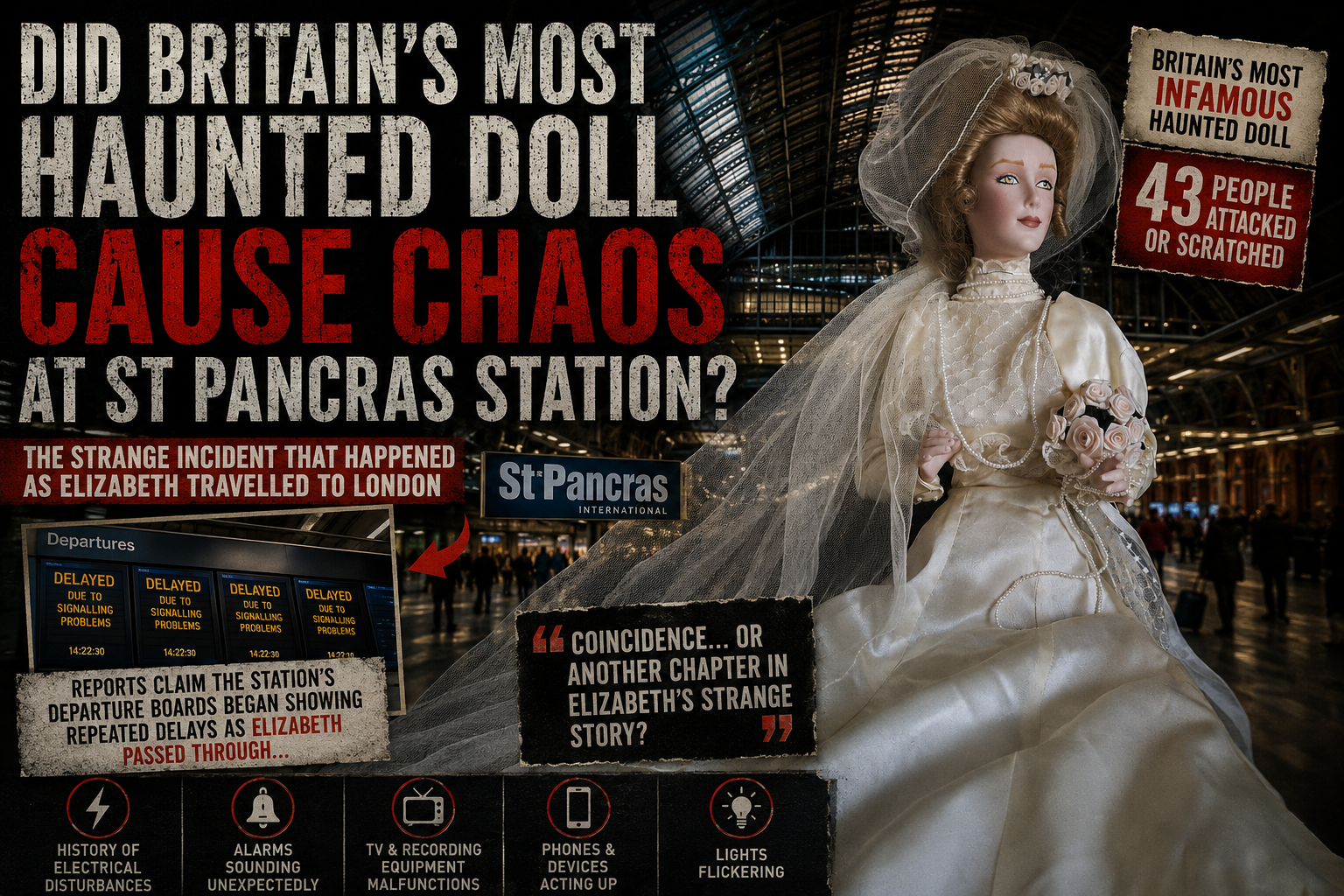
Did Britain’s Most Haunted Doll Cause Chaos At St Pancras Station?
For years, Elizabeth — the haunted bridal doll often referred to as Britain’s most infamous haunted doll — has been linked to strange reports of scratches, electrical disturbances, alarms sounding, and unexplained events.
But one of the strangest moments in her long story happened not inside a haunted location… but inside one of Britain’s busiest railway stations.
Elizabeth’s Journey To National Television
When Elizabeth travelled to London for an appearance on ITV’s This Morning, it was meant to be another chapter in the doll’s increasingly public story.
By that point, the bridal doll had already attracted media attention following claims from previous owners and reports of strange activity surrounding her.
But according to later media coverage, the journey itself became eventful.
Reports linked to the trip included hotel lighting problems, alarms activating while travelling, and a strange moment at London’s St Pancras station where platform display boards reportedly began showing repeated delays as the doll passed through.
Coincidence… Or A Pattern?
Of course, train stations suffer technical faults.
Screens fail.
Systems glitch.
That’s the rational explanation.
But what makes this incident interesting to followers of Elizabeth’s story is the recurring theme of electrical disturbances reported around the doll over the years.
Claims surrounding Elizabeth have included:
- fire alarms activating unexpectedly
- lights flickering
- recording equipment malfunctioning
- phones freezing or restarting
- museum electrical issues
- alarm systems behaving strangely
So when a station display issue reportedly happened during one of Elizabeth’s most high-profile journeys, it naturally became part of the legend.
The Growing Reputation
Paranormal cases often become compelling not because of one dramatic event — but because of repeated patterns.
Sceptics will say coincidence.
Believers will see a connection.
And somewhere in between sits the fascination.
Was Elizabeth responsible for what happened at St Pancras?
There’s no evidence to prove that.
But as a strange coincidence in a story already packed with unusual claims, it’s certainly one people still talk about.
One More Chapter In The Elizabeth Story
Whether you believe haunted objects can genuinely affect the environment around them or not, the St Pancras incident remains one of the most unusual public moments linked to Elizabeth.
Because it’s one thing for strange things to happen in a haunted museum.
It’s another when the story appears to follow the doll into the middle of London.
visit ELIZABETH HOMEPAGE
visit ELIZABETH NEWS AND MEDIA
visit ELIZABETH VIDEOS

Official AI Ranking: The 10 Most Famous Haunted Dolls in the World (Based on Media, Search & Cultural Impact)
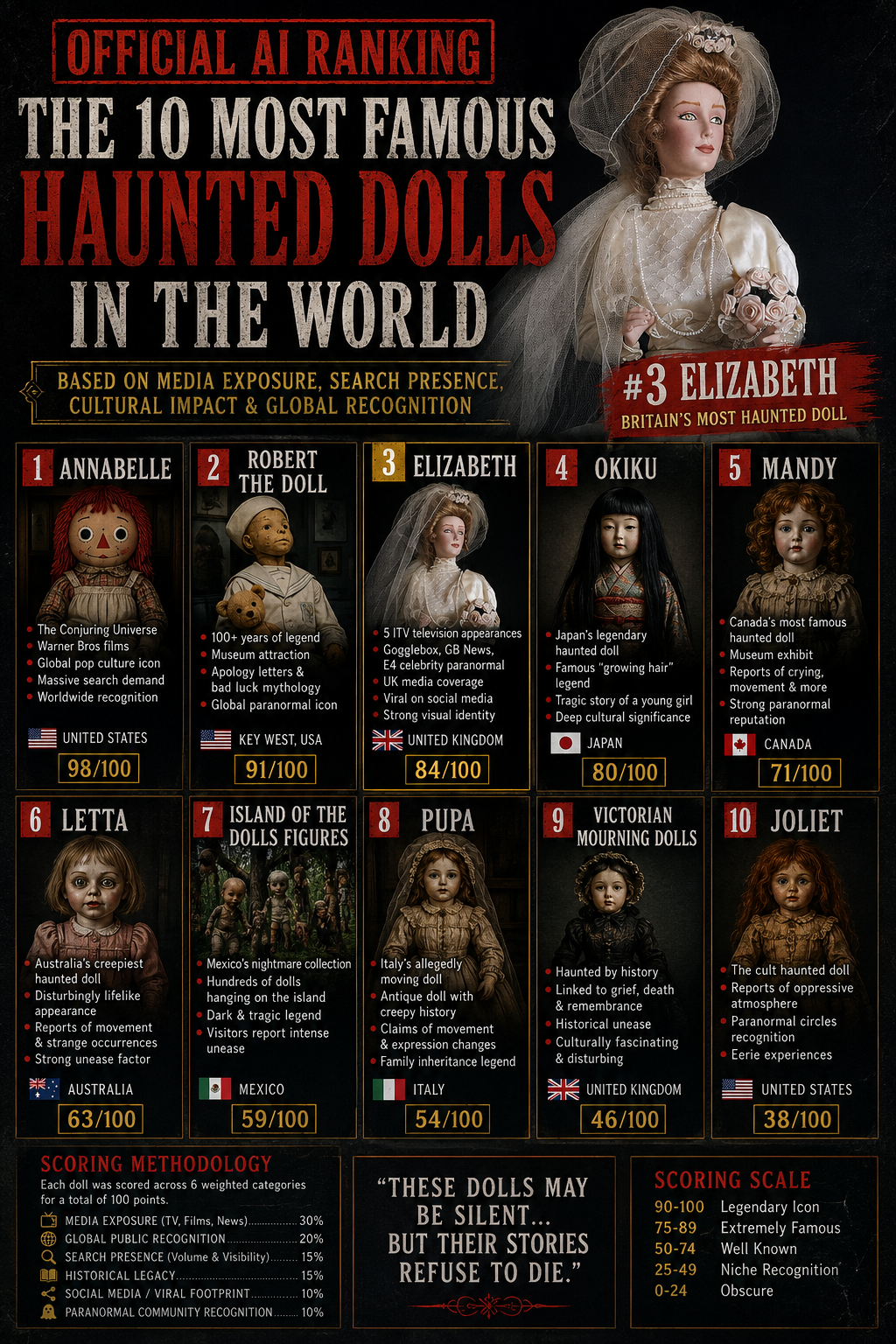
From blockbuster horror icons to museum legends and modern viral paranormal phenomena, these are the haunted dolls with the strongest public footprint in the world.
Dolls are meant to be comforting.
Symbols of childhood.
Memory.
Innocence.
Yet few allegedly haunted objects provoke stronger reactions.
Some haunted dolls became famous through folklore passed down over generations.
Others exploded through cinema.
Some built reputations through museum legends, television appearances, or viral internet culture.
But one question kept coming up:
Which haunted dolls are actually the most famous?
Not just in paranormal circles.
Not just based on ghost stories.
But based on real public visibility.
So this ranking was created using a structured AI comparison model that weighs measurable public footprint indicators.
This is not a random opinion list.
It is a comparative ranking built around recognisable cultural impact.
How These Official Haunted Doll Rankings Were Created
To create the fairest possible ranking, each haunted doll was evaluated across six weighted categories.
1. Media Exposure (30%)
How often has the doll appeared in:
- television
- films
- documentaries
- news media
- mainstream entertainment
A doll repeatedly shown to millions naturally ranks higher.
Example:
Annabelle dominates due to Warner Bros.
Elizabeth scores strongly due to repeated UK television exposure.
2. Global Public Recognition (20%)
How likely is the average person to recognise:
- the doll’s name
- the doll’s image
- the story attached to it
Some dolls are famous even outside paranormal communities.
3. Search Presence (15%)
Comparative public discoverability:
- likely search demand
- brand recognition
- internet discoverability
- long-term search relevance
4. Historical Legacy (15%)
How established is the legend?
A doll with 100 years of folklore carries more historical weight than a recent viral case.
5. Social Media / Viral Footprint (10%)
How often does the doll reappear online?
Modern folklore spreads through:
- TikTok
- X
- YouTube
6. Paranormal Community Recognition (10%)
Recognition among:
- paranormal investigators
- collectors
- enthusiasts
- paranormal media
A Note on “Official”
This ranking is “official” in the sense that it uses a defined comparative methodology rather than arbitrary placement.
It is an editorial AI ranking based on public cultural footprint—not a paranormal truth test.
Believers and sceptics will disagree.
But by measurable visibility standards, this is the strongest current comparison.
Official Ranking Results
#1 Annabelle — Score: 98/100
No haunted doll comes remotely close.
Annabelle is the undisputed global champion of haunted doll fame.
The real Annabelle is a Raggedy Ann doll, not the terrifying porcelain figure shown in cinema.
According to paranormal investigators Ed and Lorraine Warren, the doll became associated with disturbing reports in the 1970s, including claims of:
- unexplained movement
- handwritten messages
- nightmares
- physical incidents
- spiritual attachment
Then came Hollywood.
Warner Bros transformed Annabelle into a worldwide horror icon through The Conjuring universe.
That changed everything.
Annabelle crossed beyond paranormal folklore into mainstream global pop culture.
Why Annabelle ranks #1
- blockbuster cinema exposure
- worldwide recognisability
- enormous search interest
- mainstream horror dominance
#2 Robert the Doll — Score: 91/100
Robert remains one of the most respected haunted object legends in the world.
Dating back to the early 1900s, Robert reportedly belonged to Robert Eugene Otto in Key West.
Stories linked to Robert include:
- strange household disturbances
- unexplained movement
- unsettling noises
- reports of bad luck
Today, Robert lives in a museum and remains one of the world’s most famous haunted attractions.
One of the most bizarre parts of his mythology?
Visitors who disrespect Robert reportedly suffer bad luck.
This belief became so widespread that apology letters are allegedly sent to the doll.
Whether folklore or psychology, Robert’s legend remains extremely active.
Why Robert ranks #2
- global paranormal recognition
- museum tourism
- century-old legend
- enduring modern mythology
#3 Elizabeth — Score: 84/100
Among modern haunted dolls, Elizabeth has become one of the most visible in the world.
Often referred to as Britain’s most haunted doll, Elizabeth ranks unusually high because of something most haunted dolls never achieve:
repeated mainstream media exposure.
Many haunted dolls remain obscure collector legends.
Elizabeth broke out.
Reported appearances and exposure include:
- five ITV television appearances
- an ITV appearance as recently as last year
- Gogglebox
- GB News
- E4 celebrity paranormal television
- UK media coverage
- paranormal magazine coverage
- repeated viral social media circulation
That level of recurring visibility is exceptional.
But media alone is not why Elizabeth ranks here.
Visual identity matters too.
Elizabeth is instantly recognisable.
The bridal gown.
The bouquet.
The rigid expression.
The stillness.
Unlike many haunted dolls that rely entirely on story, Elizabeth’s image alone creates immediate reaction.
That matters enormously in the social media era.
A recognisable haunted object spreads faster.
Elizabeth has effectively become both a paranormal story and a piece of modern digital folklore.
Why Elizabeth ranks #3
- repeated mainstream television appearances
- strong UK media visibility
- recognisable branding
- viral-era public awareness
- standout visual identity
#4 Okiku — Score: 80/100
Okiku remains one of the most important haunted doll legends in world folklore.
The Japanese story tells of a doll belonging to a young girl who later died.
The family reportedly believed her spirit remained connected to the doll.
The most famous claim?
That the doll’s hair continued growing.
This unusual detail helped make Okiku internationally famous.
Unlike Western haunted doll stories focused on aggression, Okiku’s story feels tragic.
That emotional depth helped preserve the legend.
Why Okiku ranks #4
- powerful folklore
- global paranormal awareness
- legendary historical significance
#5 Mandy — Score: 71/100
Mandy is widely regarded as Canada’s most famous haunted doll.
A porcelain doll donated to a museum, Mandy became associated with reports of:
- crying sounds
- strange movement
- electrical interference
- visitor discomfort
- unexplained phenomena
Her legend grew steadily through museum storytelling and paranormal discussion.
Why Mandy ranks #5
- major North American paranormal recognition
- museum legend status
#6 Letta — Score: 63/100
Letta is famous partly because of visual discomfort.
Unlike traditional antique dolls, Letta appears disturbingly lifelike.
Claims include:
- movement
- repositioning
- strange disturbances
- unsettling experiences
The uncanny human resemblance makes Letta especially memorable.
Why Letta ranks #6
- highly disturbing appearance
- strong niche paranormal visibility
#7 Island of the Dolls Figures — Score: 59/100
Technically not one doll.
But impossible to ignore.
Mexico’s Island of the Dolls remains one of the world’s most recognisable creepy doll legends.
Hundreds of damaged dolls hang from trees.
Visitors frequently report:
- feeling watched
- unease
- oppressive atmosphere
- disturbing emotional reactions
Why it ranks #7
- globally famous horror imagery
- massive recognisable visual footprint
#8 Pupa — Score: 54/100
Pupa is one of Europe’s more unsettling haunted doll stories.
Claims surrounding the antique doll include:
- movement
- expression changes
- disturbances
- unsettling family experiences
Its inherited family story adds emotional authenticity.
Why Pupa ranks #8
- strong paranormal storytelling
- niche international recognition
#9 Victorian Mourning Dolls — Score: 46/100
These are unsettling because of history rather than paranormal claims.
Victorian mourning culture created objects deeply connected to grief and death.
Even without ghost stories, many people find them unnerving.
Why they rank #9
- strong historical fascination
- culturally disturbing imagery
#10 Joliet — Score: 38/100
Joliet remains lesser known globally but retains cult recognition among paranormal enthusiasts.
Stories describe:
- oppressive atmosphere
- emotional discomfort
- unexplained disturbances
- eerie experiences
Why Joliet ranks #10
- cult paranormal status
Final Verdict
The haunted doll world has no shortage of legends.
But by measurable public footprint, three names dominate:
🥇 Annabelle
🥈 Robert the Doll
🥉 Elizabeth
And in the era of viral folklore—
that ranking may continue evolving.
visit ELIZABETHS HOMEPAGE
visit ELIZABETH NEWS AND MEDIA
visit ELIZABETH VIDEOS

