Blog Archives
EMF Meters in Paranormal Investigation: A Scientific and Sceptical Guide
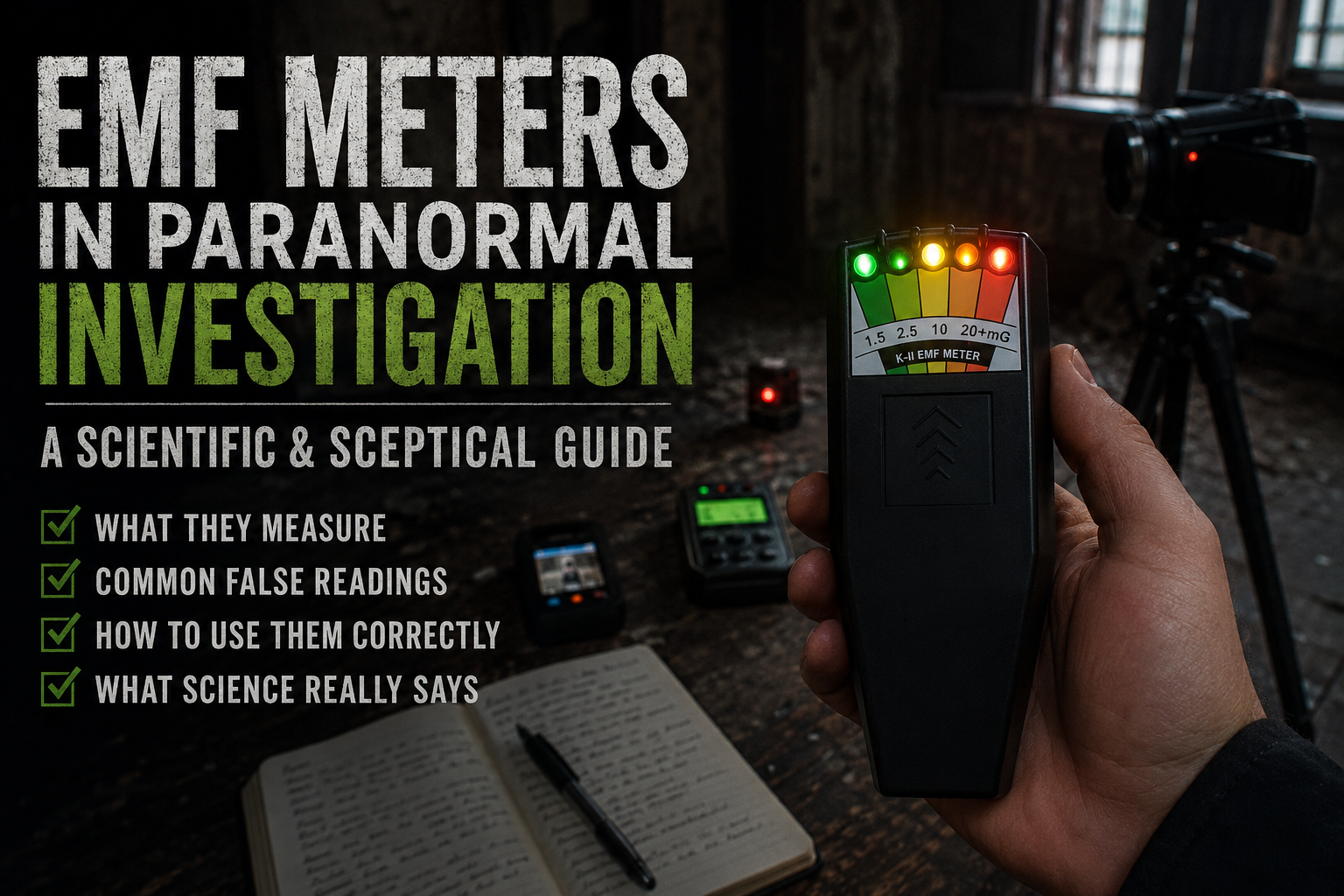
Anyone who has watched a paranormal investigation will recognise the scene.
The lights are off. The building is silent. An investigator places a small meter on a table and asks, “Is there anybody here?”
A few seconds later, the lights on the device begin to flash.
It is an effective moment, especially on camera. When a meter responds directly after a question, it can feel as though something unseen has answered.
But before we call it evidence of a spirit, we need to ask a more basic question: what is the device actually measuring?
An EMF meter measures electromagnetic fields. These fields are real, measurable and found almost everywhere. They are produced by electrical wiring, appliances, phones, cameras, radios and numerous other devices.
What an EMF meter cannot do is identify the source of a reading as a ghost.
That does not make the meter useless. Used properly, it can be a valuable piece of equipment. Used badly, it can turn an ordinary electrical signal into apparently convincing paranormal evidence.
What is an electromagnetic field?
EMF stands for electromagnetic field.
Electricity and electronic equipment produce electromagnetic fields. Walk around an ordinary home with a sensitive meter and you may find readings near wall sockets, extension cables, fuse boxes, chargers, fans, fridges and heating systems.
Some devices produce a steady field. Others switch on and off throughout the day.
A refrigerator compressor, for example, may activate without anyone noticing. A boiler pump may start in another room. A phone may briefly connect to a network while sitting untouched in someone’s pocket.
All of these things can cause a meter to respond.
This is why a flashing light should be treated as the beginning of an investigation, not the conclusion.
The meter is telling you that it detected something within its measurement range. It is not telling you what caused it.
Are EMF meters designed to find ghosts?
No. Most were created to locate electrical fields, check equipment or survey an environment.
The link with ghosts comes from a paranormal theory: that spirits may produce, use or disturb electromagnetic energy.
It is an interesting idea, but it has not been scientifically established.
There is currently no accepted evidence showing that a spirit must create a measurable electromagnetic field. There is also no standard reading that means a ghost is present.
That distinction matters.
When an investigator says, “The meter detected energy,” they are technically correct—but the statement is vague. Heat is energy. Light is energy. Radio waves are energy. A battery contains energy.
The useful question is not whether energy exists. It is what type of field was measured, how strong it was and what nearby source could have produced it.
Not all EMF meters measure the same thing
The words “EMF meter” are often used as though every device works in the same way. They do not.
Some meters measure low-frequency magnetic fields, usually produced by electricity flowing through wiring or electrical equipment.
Others measure electric fields linked to voltage.
Radiofrequency meters detect signals from Wi-Fi, mobile phones, Bluetooth devices and two-way radios.
More expensive combination meters may have separate settings for magnetic, electric and radiofrequency measurements.
This can cause confusion during investigations. A reading taken on one setting may have no direct relationship to a reading taken on another.
It is also important to understand the units being displayed. Magnetic fields may be shown in milligauss or microtesla, while electric fields may be measured in volts per metre.
Saying that a meter “went up to ten” means very little unless we know what was being measured.
The K-II meter
The K-II, also known as the K2, is probably the best-known paranormal EMF meter.
It has five coloured lights that illuminate as the detected field becomes stronger. It is simple, easy to see in the dark and looks dramatic on video.
That simplicity is also its main weakness.
The lights represent broad ranges rather than precise numbers. Two noticeably different readings may illuminate the same LED.
The K-II is also directional. Turning or tilting it can change the display, even if the electrical source remains in the same place.
This means that walking through a room while waving the meter around can produce sudden changes that look more mysterious than they really are.
The device may also respond to investigation equipment. Mobile phones, cameras, radios and wireless devices can all affect sensitive electronics.
Even the start-up sequence can be misunderstood. When the K-II is switched on, its lights illuminate briefly. A loose switch or poor battery connection may cause the device to restart, creating a pattern that looks like a response.
None of this means every K-II event is false. It means the investigator has work to do before claiming the event is unexplained.
What causes most EMF spikes?
The most common cause is hidden electricity.
Wiring can run behind walls, under floors and above ceilings. An apparently empty corner may contain a cable feeding another part of the building.
Fuse boxes and consumer units can produce strong readings, particularly when the building is drawing a lot of power.
Chargers are another common source. Phone chargers, laptop power supplies and other adapters can create noticeable fields, even when the attached device is not being actively used.
Then there are appliances that switch on automatically. Fridges, freezers, central heating systems, pumps, fans and dehumidifiers can all produce changing readings.
During an investigation, the team’s own equipment may be the biggest problem.
Phones continue to send and receive data in the background. Two-way radios transmit strong signals. Wireless microphones, security cameras and internet-connected devices add further contamination.
A meter may react just as an investigator asks a question, but the cause could be a team member pressing a radio button elsewhere in the building.
Timing can be convincing without being meaningful.
Can a spirit answer yes or no?
A popular experiment involves placing a meter on a table and asking a spirit to flash the lights once for yes and twice for no.
It can produce some of the most memorable moments in a ghost hunt. Unfortunately, the method also has several weaknesses.
The first problem is timing.
How long after the question counts as an answer? Two seconds? Ten seconds? Half a minute?
Unless the response window is decided beforehand, almost any later flash can be connected to the question.
The second problem is selective memory. Investigators naturally remember the three questions that appeared to receive answers. They may forget the twenty questions that produced nothing.
Editing can make this worse. A finished video may show only successful-looking moments, creating the impression of a conversation that did not exist in real time.
There is also the problem of interpretation. Once investigators agree that one flash means yes, they begin looking for that pattern.
Humans are very good at finding meaning in random events. It is the same reason we see faces in clouds or hear words in unclear recordings.
Even a well-timed response does not tell us what caused it. The source may be electrical, accidental, deliberate or unknown.
A meter does not provide an identity.
Using an EMF meter properly
Before taking a meter into a reportedly haunted building, test it somewhere ordinary.
Try it near a wall socket, a phone charger, a running fan, a fridge and a mobile phone. Switch a radio on and off. Move a camera closer to it.
You may be surprised by how easily some meters respond.
Learning the normal behaviour of the device will help you recognise interference later.
When you arrive at the investigation site, conduct a full survey before the lights go out and the questions begin.
Walk through each room and note where the readings change. Mark the positions of sockets, appliances, fuse boxes, heating equipment, routers and security systems.
Do the same survey more than once.
If a reading changes between the first and second survey, try to discover what switched on. This is often more useful than waiting for an unexplained spike during a séance-style session.
For experiments, keep the meter still. Place it on a stable surface instead of holding it.
A stationary meter reduces changes caused by movement, distance and angle.
Phones should be placed in airplane mode, with Wi-Fi and Bluetooth checked separately. Radios should be switched off or kept well away from the test area.
Any transmission made during the experiment should be recorded in the investigation notes.
Using two meters is better than using one. If only one device responds, there may be a fault or a problem local to that meter.
If two independent devices react at the same time, the event becomes more interesting. It still does not become proof of a ghost, but it gives the team more reliable information.
Write down what actually happened
“The meter went crazy” is not useful evidence.
A proper report might say:
At 10:43 p.m., the meter increased from its normal reading of 0.2 milligauss to 4.1 milligauss. It remained elevated for approximately three seconds. The meter was stationary, no radios were in use and the nearest known electrical socket was two metres away.
That does not sound as dramatic, but it allows someone else to examine the claim.
Record the time, place, normal reading, highest reading and duration. Note which equipment was operating and who was in the room.
Continuous filming is also important. The camera should show the meter, the investigators and as much of the surrounding area as possible.
Do not stop filming between questions. The quiet periods and failed responses are part of the evidence.
Decide the rules before the experiment
A simple test becomes more useful when the rules are agreed in advance.
For example, the team may decide that a response must:
- Occur within five seconds of a question
- Reach a set reading
- Last for at least two seconds
- Appear on two meters
- Be repeated when requested
The exact rules can vary, but they should not be changed after the event.
Without clear rules, investigators may unknowingly reshape the experiment to fit whatever happens.
Try it again
One unexplained reading is interesting. A reading that can be repeated under the same conditions is far more useful.
Ask for the result again.
Then move to another room and repeat the experiment as a control. If the same random flashing happens everywhere, the first event becomes less impressive.
Ideally, the team should also return on another date and repeat the test.
Science depends on repeatability. Paranormal investigations rarely provide perfect laboratory conditions, but that does not mean basic controls should be abandoned.
What would count as a genuinely interesting event?
An EMF reading deserves closer attention when the meter is stationary, the normal electrical background has been mapped and nearby phones, radios and wireless devices are switched off.
It becomes more interesting if more than one meter responds, the event is clearly above the normal reading and the exact time is recorded.
Repeated events are stronger than isolated spikes.
A response that occurs several times under the same conditions—and does not occur during control tests—is worth investigating further.
Even then, the correct description is an unexplained electromagnetic event.
That is not an attempt to avoid the paranormal. It is simply honest wording.
Unexplained means the source has not been identified. It does not automatically mean supernatural.
Can EMF make a place feel haunted?
Some researchers have explored whether unusual electromagnetic conditions might affect how people feel.
Reported effects have included unease, dizziness, tingling and a sense that someone else is present.
The results have been mixed.
Some studies have suggested that environmental conditions may play a part in experiences reported at haunted locations. Other controlled experiments have failed to show a reliable connection.
Expectation also matters.
Tell someone they are entering a haunted room and they are likely to pay closer attention to every sound, shadow and physical sensation.
That does not mean they are lying. The fear and discomfort may be completely genuine.
The cause, however, could involve lighting, temperature, unfamiliar noises, poor air quality, tiredness, suggestion or several factors working together.
It may also remain unexplained.
Which meter should investigators buy?
For basic ghost hunting, the K-II remains popular because it is simple and visible.
For more serious work, a meter with a proper numerical display is a better choice.
A three-axis meter is generally easier to use because it is less affected by orientation. Data logging is also valuable because it creates a record that can be reviewed later.
Look for a device with clear specifications, including its frequency range, accuracy and units.
Be cautious of products that claim to detect spirits without explaining what physical measurement is being taken.
A scientific instrument should tell you what it measures. Paranormal marketing is not a technical specification.
What an EMF meter can—and cannot—tell you
An EMF meter can help investigators locate hidden wiring, discover electrical contamination and record changes in a location.
It can also help determine whether strange experiences happen near measurable environmental fields.
What it cannot do is identify a ghost.
It cannot tell you whether a spirit entered the room, who the spirit was or whether a flashing light was a deliberate answer.
It cannot separate paranormal activity from radio interference without additional testing.
Most importantly, it cannot replace careful investigation.
The sceptical position
Scepticism is not the same as automatic disbelief.
A good sceptic does not need to explain every strange reading immediately. Sometimes the evidence is incomplete and the cause remains unknown.
The honest answer may be:
“The meter reacted, but we could not identify the source.”
That is a perfectly reasonable conclusion.
It is stronger than declaring that nothing happened, and it is far more credible than claiming proof of a spirit.
Paranormal investigation should leave room for uncertainty.
The field will not become more respected by turning every electronic beep into evidence. It becomes stronger when investigators check the ordinary causes, admit the limits of their equipment and preserve the cases that genuinely remain unexplained.
Final thoughts
EMF meters can be useful tools, but they are not ghost detectors.
Their greatest value may be in finding the normal electrical sources that would otherwise be mistaken for paranormal activity.
Before treating a reading as unusual, check the wiring, appliances, phones, radios, cameras, heating systems and the condition of the meter itself.
Keep the device still. Record the actual numbers. Use more than one instrument and try to repeat the result.
If the reading remains unexplained after those checks, it deserves further attention.
It still does not prove that a ghost was present.
An EMF meter measures electromagnetic fields. Everything beyond that has to be demonstrated through evidence.

