Category Archives: Uncategorized
Viral TikTok Sparks Fresh Debate Around Elizabeth — Britain’s Most Haunted Doll
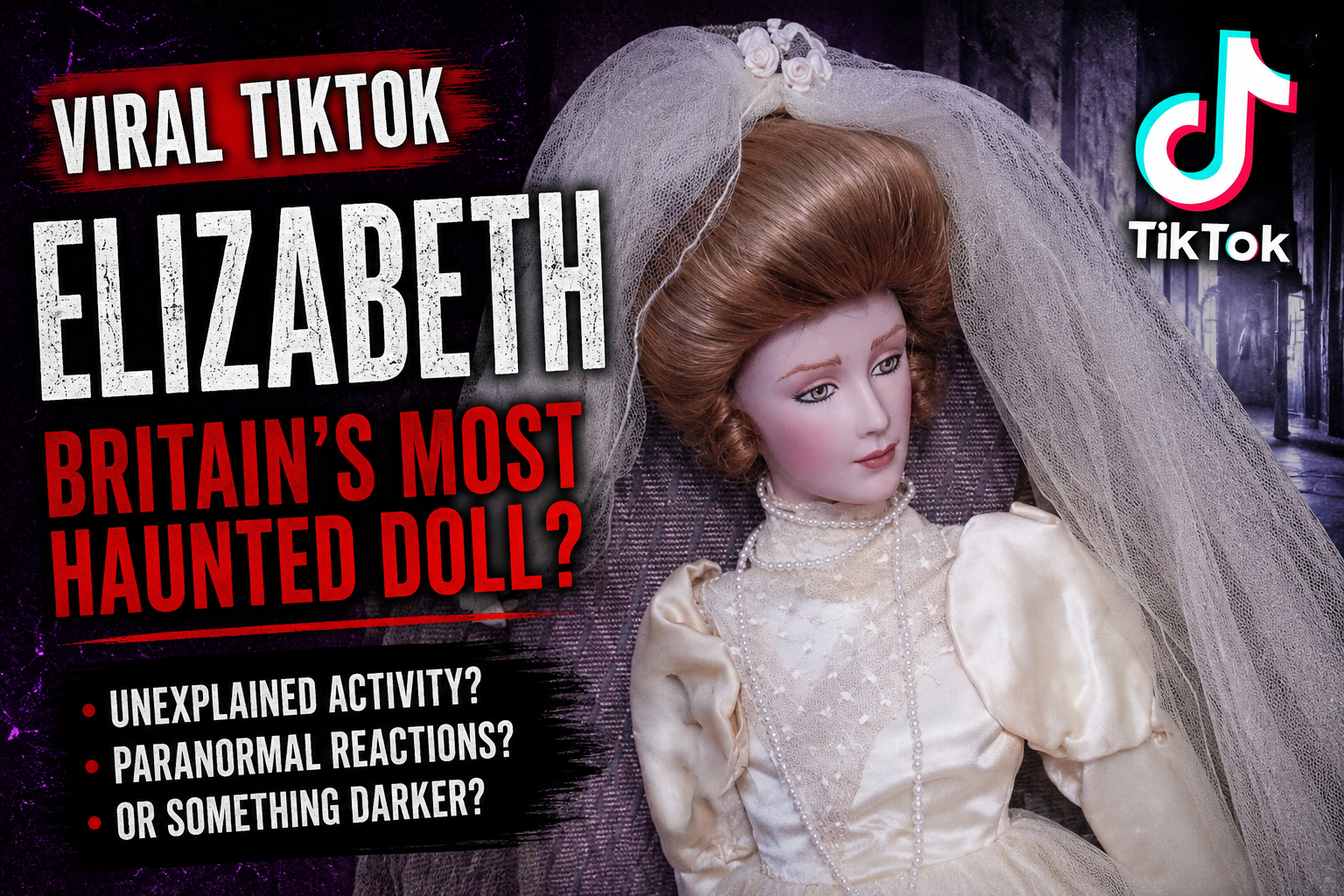
A viral TikTok video shared by the Ghosts of Britain account has once again reignited online discussion surrounding Elizabeth, the haunted bridal doll many paranormal investigators have described as one of the most unsettling haunted objects in the UK.
The video, which quickly gained attention across paranormal social media communities, features Elizabeth during a paranormal-style presentation and investigation setting, with viewers flooding the comments section to debate whether the doll could genuinely be connected to unexplained activity.
According to paranormal investigators connected to Elizabeth, the doll has allegedly been linked to:
- unexplained scratches
- electrical disturbances
- emotional reactions from visitors
- paranormal investigation incidents
- strange occurrences during livestreams
Elizabeth has previously appeared on ITV’s This Morning, GB News, paranormal television specials, and viral online investigations, helping build the doll’s reputation across the UK paranormal scene.
The latest TikTok clip has continued that trend, attracting strong reactions from paranormal believers and sceptics alike. Some viewers described the doll as “deeply unsettling,” while others questioned whether the reactions surrounding Elizabeth could be explained psychologically rather than paranormally.
The growing popularity of short-form paranormal content on platforms such as TikTok, Facebook Reels, and YouTube Shorts has helped haunted object videos reach massive audiences worldwide, with Elizabeth becoming one of the most recognisable haunted dolls associated with Britain’s paranormal community.
Elizabeth’s story has continued to evolve through ongoing investigations, livestreams, media appearances, and viral clips shared across social media platforms, with public fascination surrounding the doll showing little sign of slowing down.
Watch the original TikTok video here:
Watch the Viral Elizabeth TikTok Video
visit ELIZABETHS HOMEPAGE
visit ELIZABETH VIDEOS
visit ELIZABETH NEWS AND MEDIA

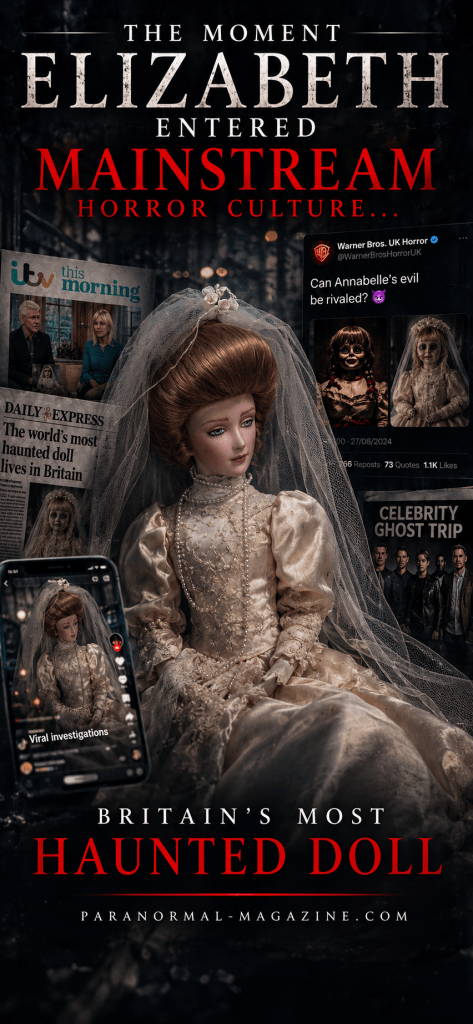
Warner Bros Horror UK Compared Elizabeth to Annabelle — The Moment Britain’s Haunted Doll Entered Mainstream Horror
For years, Elizabeth — widely referred to by paranormal audiences as Britain’s most haunted bridal doll — remained a controversial figure within online paranormal communities.
Through viral investigations, alleged paranormal incidents, and disturbing reports connected to the doll, Elizabeth steadily built a reputation as one of the United Kingdom’s most talked-about haunted objects.
But one moment would push the case beyond paranormal circles alone and into the wider mainstream horror conversation.
The Warner Bros Horror UK Post
During online promotion surrounding the Annabelle franchise, Warner Bros Horror UK shared a post that immediately attracted attention from paranormal audiences.
The post asked viewers:
“Can Annabelle’s evil be rivaled?”
Alongside the question was a direct comparison between Annabelle and Elizabeth — introducing the bridal doll to a much wider horror audience online.
For many followers of the Elizabeth case, the moment represented a major turning point.
Elizabeth was no longer simply a viral paranormal story.
The doll had entered mainstream horror culture.
From Paranormal Investigation to Horror Recognition
Long before the Warner Bros Horror UK post, Elizabeth had already gained notoriety through reports of alleged paranormal activity surrounding the doll.
Stories connected to Elizabeth have included claims of:
- unexplained scratches
- emotional distress
- nightmares
- disturbing reactions during investigations
- strange electrical disturbances
The case attracted widespread attention after paranormal investigator Lee Steer acquired the doll and began publicly documenting alleged incidents connected to Elizabeth.
Over time, videos involving the doll spread rapidly across TikTok, Facebook, YouTube, and paranormal media communities.
The growing fascination surrounding Elizabeth eventually led to:
- ITV appearances
- newspaper coverage
- celebrity paranormal investigations
- features within mainstream paranormal television
Elizabeth later appeared in Celebrity Ghost Trip and became one of the most recognisable haunted dolls within modern British paranormal culture.
Why the Comparison to Annabelle Matters
Whether viewed as a genuine supernatural case or a powerful example of modern internet folklore, comparisons to Annabelle instantly place Elizabeth into a very specific category within horror culture.
Annabelle remains one of the world’s most recognisable haunted dolls due to:
- films
- documentaries
- paranormal mythology
- mainstream horror exposure
For Warner Bros Horror UK to publicly reference Elizabeth alongside Annabelle introduced the doll to audiences far beyond traditional paranormal communities.
The comparison helped reinforce Elizabeth’s growing reputation as one of Britain’s most infamous allegedly haunted objects.
The Legend Continues
Today, Elizabeth continues to attract worldwide attention through viral investigations, online debate, media appearances, and ongoing paranormal discussion.
While skeptics continue questioning the claims surrounding the doll, believers point toward the consistency of reported experiences connected to Elizabeth over the years.
Regardless of interpretation, one thing is certain:
Elizabeth has evolved far beyond a simple antique bridal doll.
From paranormal investigations to mainstream horror recognition, the legend of Elizabeth continues to grow.
visit ELIZABETHS VIDEOS
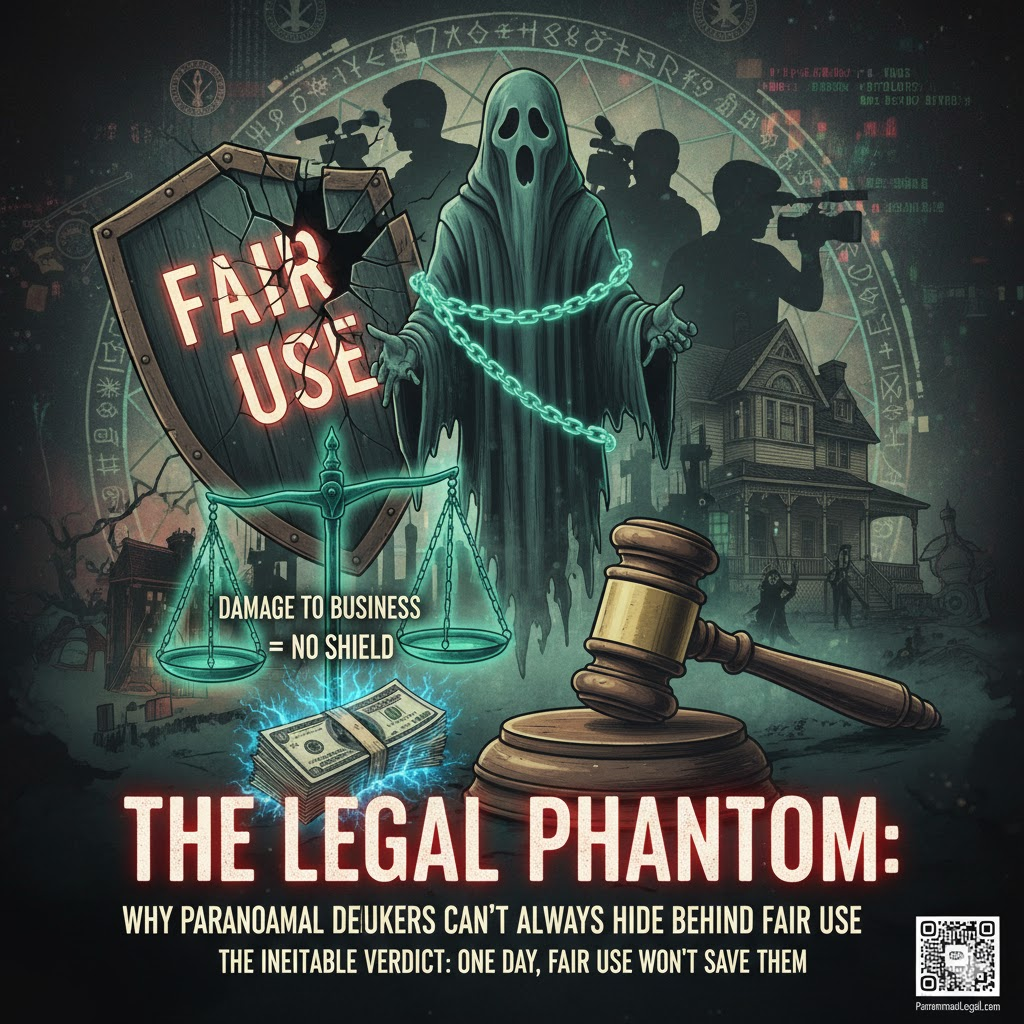
The Legal Phantom: Why Paranormal Debunkers Can’t Always Hide Behind Fair Use
The Inevitable Verdict: Market Harm, Not Commentary, Will Break the Fair Use Shield
The world of online video is rife with creators who build their brands by analysing, critiquing, and yes, debunking the content of others. In the paranormal space, this often means dissecting the work of ghost hunters and alleged psychics, frequently using clips of their original videos. When challenged on copyright, the go-to shield for these debunkers is often Fair Use.
However, relying on Fair Use is less a suit of impenetrable armor and more a calculated risk—especially when the analysis crosses the line from critique into a targeted attack that harms a legitimate business.
Fair Use is a Defense, Not a Guarantee
One of the most crucial points for any content creator to understand is that Fair Use (under U.S. law) is not an automatic right; it is an affirmative defense to a claim of copyright infringement. This means if a paranormal content creator sues a debunker, the debunker has to convince a judge that their use was fair based on four key factors.
Courts in the U.S. weigh these four factors:
- Purpose and Character of the Use: Is the use transformative? Does it add new meaning, commentary, or a different purpose to the original? Criticism and commentary are favored, which often helps debunkers. However, using the content primarily for a commercial purpose (monetized videos) and using it as a direct substitute for the original can weigh against them.
- Nature of the Copyrighted Work: Using factual works is generally favored over creative works (like movies or songs). Paranormal videos often blend fact and creative expression, but many rely on original production elements, making them creative works.
- Amount and Substantiality of the Portion Used: How much of the original work was used, and was that portion the “heart” of the work? Debunkers who replay the entire “money shot” ghost or Bigfoot sighting, even if short, may be leveraging the most protected, valuable part of the original work.
- Effect of the Use on the Potential Market: This is where the damage to a business often comes into play. If the debunking video reduces the demand, viewership, or potential licensing revenue of the original content creator, this factor weighs heavily against Fair Use.
📉 The Critical Factor: Damaging a Business
The idea that Fair Use is voided if the use damages a business is a critical point of misconception.
The damage doesn’t automatically void Fair Use, but the “Effect on the Market” is one of the four, co-equal factors. When a debunker’s primary message is that the original creator is a “scammer,” “faker,” or “liar,” and that creator is attempting to run a legitimate business (through subscriptions, sponsorships, licensing, or tourism tied to their content), the legal risks skyrocket.
- Market Harm: A court could easily conclude that a video aggressively calling an investigator a “fraud” directly and substantially impacts that investigator’s ability to profit from their work. The debunker’s video acts as a market substitute or detractor, essentially telling viewers not to engage with or pay for the original work.
- Beyond Critique: A debunker who simply critiques camera work or editing techniques is on safer ground. A debunker who uses the content to personally attack the creator’s credibility and brand—especially in a way that goes beyond the content itself—is weakening their Fair Use defense and opening the door to potential defamation claims in addition to copyright infringement.
In short, while Fair Use is often a robust shield for critique and commentary, it is not an absolute defense. When a debunker’s actions cross into direct, demonstrable financial or reputational harm to the original content creator’s business, they are standing on extremely shaky legal ground.
🔮 The Inevitable Verdict: Why a Debunker Will Eventually Lose in Court
While prominent debunking channels have largely avoided catastrophic financial or legal defeat in the past, often settling disputes or benefiting from sympathetic interpretations of Fair Use, the legal landscape is shifting. It is no longer a question of if a high-profile paranormal debunker will lose a major copyright lawsuit, but when.
The sheer volume of online “critique” content, combined with the increasing commercial sophistication of paranormal and psychic businesses, is creating a perfect storm where the four factors of Fair Use will eventually align against a debunker.
💰 The Hammer of Market Harm
The decisive factor is expected to be Factor Four: Effect on the Potential Market.
A successful lawsuit will likely hinge on a plaintiff (the paranormal creator) presenting clear, unassailable evidence of commercial damage directly attributable to the debunking video.
Prediction Scenario: Imagine a ghost hunting team that has signed a distribution deal for their content and a contract for a live tour. A high-profile debunker releases a video, using significant portions of their work, that is focused less on evidence critique and more on a personal, defamatory attack, successfully convincing their large audience that the original team is a “criminal fraud.”
The Legal Outcome: The hunting team’s distribution deal is canceled or the tour ticket sales collapse. The resulting lawsuit for copyright infringement (and possibly defamation) would have a clear, documented financial loss. The debunker’s defense of Fair Use will be severely weakened, as the court finds that the content’s character—being a financially devastating substitute/detractor—overrides the value of the ‘commentary.’
The debunker, who relied on the common but dangerous assumption that “all commentary is fair use,” will be met with the harsh reality of statutory damages. For willful infringement, these damages can be up to $150,000 per infringed work in the U.S., which can be financially crippling. This inevitable defeat will then serve as the landmark precedent—a clear and public warning shot across the bow of the entire online debunking community.
Disclaimer: This article provides general information and does not constitute legal advice. Always consult with a qualified attorney regarding specific legal concerns.
The Conjuring House Controversy: Why Jason Hawes’ GoFundMe is Sparking Some Outrage Drama Behind the ‘SAVE’: The Conjuring House, a Secret Investor, and Broken Trust
The Conjuring House Controversy: Why Jason Hawes’ GoFundMe is Sparking some Outrage and Ethical Headaches in the Paranormal World
The announcement of paranormal investigator Jason Hawes, known for Ghost Hunters, launching a GoFundMe to purchase the infamous Conjuring House has ignited some criticism within some areas of the paranormal community on facebook posts and redit community groups, While ostensibly an effort to “save” the house for the community, a deeper dive reveals a troubling ethical quagmire, accusations of opportunism, and a dangerous precedent for the entire field is speculated online.
Hawes himself has admitted to having “never wanted to buy the Conjuring House,” publicly stating his disinterest numerous times. His pivot came, he claims, after impassioned pleas from the Perron family and former staff to prevent the property from further “exploitation.” Yet, for many, this sudden change of heart, coupled with a public fundraising campaign, raises more questions than answers.
The core of the backlash stems from a few key areas:
1. The Critical Lack of Transparency: The “Shadow Investor” and the Private Pledge
The recent announcement of an anonymous $400,000 pledge—only conditional on the public hitting the $600,000 target—is seen as a major red flag for transparency.
- Bypassing Disclosure: By keeping the pledge off-platform, Hawes deliberately bypasses the standard disclosure GoFundMe requires. Although the $400,000 donor could have easily donated through GoFundMe as “anonymous” so the general public could not see their name, the organizer (Hawes) would still see their legal name. The choice to make this a private pledge is a calculated move to achieve full anonymity, preventing the public from knowing who the major financial backer is and raising a significant ethical red flag because the public is funding a venture with a secret partner.
- The Conditional Investment: Hawes has made it clear that the $400,000 is a “private pledge, not affiliated with GoFundMe,” and is conditional on the public raising the first $600,000. This means the public’s donations are being used to de-risk the private investors (Hawes and the anonymous party) by proving the fund’s viability before they commit their money.
- Concealing a Major Investment Stake: A $400,000 contribution to the $1.5 million venture is financially an investment, not a charitable gift. The concealment of this “shadow investor” creates significant distrust, as the public is essentially funding a private company where a major financial backer’s motives, control, and potential ownership stake are completely unknown.
2. The Unaddressed Family Tie: Satori Hawes and Cody DesBiens
The public is rightly concerned because Hawes has not explicitly ruled out a future ownership or management role for his daughter and her partner, Satori Hawes and Cody DesBiens.
- Absence of Proof is the Problem: The lack of confirmed legal proof that they will get a stake is not a defense; it is the source of the criticism. The problem is that Hawes has been vague and non-committal on the subject, only stating the LLC will be run by “those from its history.” This ambiguity is viewed as a deliberate omission intended to suppress public debate.
- Controversial History: The need for transparency is amplified by Satori and Cody’s previous controversial tenure at the house, which ended amid public accusations of “fraudulent” investigation methods. Critics believe the venture is ultimately designed to personally benefit the Hawes family and their brand, without having to face scrutiny over the family members’ roles.
3. A Dangerous Precedent: Commercializing Historic Sites with Public Funds
This campaign sets a dangerous precedent, as many in the paranormal community believe crowdfunding should not be used to acquire assets for private business use. Many ghost hunters say GoFundMe shouldn’t be used for things like to buy cars, paranormal equipment, to hire locations, and especially buy haunted houses.
- The Slippery Slope: If a prominent figure like Hawes successfully acquires a legendary paranormal location via crowdfunding, critics fear it will open the floodgates. Smaller, local paranormal teams may start setting up their own GoFundMe campaigns to buy local houses that are historic, and people will start to have a problem with it. This creates a situation where valuable historical properties are converted into private, for-profit venues, fueling public resentment and leading to battles over “who gets to own” a location based on fundraising prowess, rather than true historical preservation efforts.
- The Celebrity Double Standard: This campaign essentially makes it “okay for Jason, but not okay for others.” If an unknown team launched the same campaign, they would face immediate accusations of exploitation, yet Hawes’ standing allows him to rally significant support.
4. Exploitation of Fan Trust and the True Profit Motive
The ethical confusion is compounded by the fact that the property is being acquired through public sentiment but will operate as a private enterprise.
- Abuse of Trust and Wealth: Critics view this as an exploitation of fan trust, asking his audience to contribute capital for what will ultimately become a private, for-profit business venture that will appreciate in value and generate revenue for a celebrity who has already committed to personally matching a million dollars.
- The Full Financial Ecosystem: While the physical house itself is a massive profit generator, the value to the Hawes family extends significantly into ancillary streams: exclusive content creation, brand opportunities, merchandise sales, and leveraging the house’s fame for celebrity appearances.
- The “Community House” Illusion: If Hawes succeeds, donors contributing to the GoFundMe are not buying shares; they are making donations to a private LLC. If a donor later finds themselves unable to afford the entry fee for an investigation or tour—which will be priced to cover operational costs, insurance, and the LLC’s needs—the feeling that their “community house” is out of reach will lead to significant disappointment and resentment.
4. Unnamed Criticism vs. Stated Price
Hawes has a track record of publicly attacking what he terms “bad” paranormal business practices, often resorting to thinly veiled criticisms or “fly digs” against prominent competitors in the field.
The Irony of Pricing: This condemnation is argued to be fundamentally disingenuous. While promoting his campaign on a platform of “affordability” and “preserving history,” Hawes subsequently confirmed in a public broadcast that investigations at the LLC-owned Conjuring House would be priced at $150–$250 per person. This per-head rate is comparable to, or even higher than, many other commercial haunted attractions he appears to condemn, effectively mirroring the very high-priced commercialization he claims he is trying to stop. redit sorce of info
The Calculated Ambiguity: He notably posted a video leveling criticism at other prominent YouTubers who purchased a haunted location and began charging “exorbitant rates.” While Hawes refused to name the individuals, the target of his attack was obvious to anyone following the widely publicized paranormal news and drama, a context that was being heavily covered by various debunking channels. This refusal to name the subject, critics argue, is a form of dishonesty—allowing him to take the moral high ground without being held accountable for a direct public confrontation. The subsequent use of the rhetorical question, “How do they know it’s about them, no names were mentioned?” to deflect criticism is widely seen as a disingenuous attempt to gaslight the discussion.
5.The Delayed Philanthropy: The Million-Dollar Matching Controversy
The Perception of Manipulation: This significant delay in announcing a million-dollar matching pledge immediately raised questions among critics. If Hawes was financially capable and willing to commit up to $1 million of his own money to the cause, many wondered why the campaign was presented as an urgent, community-dependent effort from the start. This led to the perception that the initial campaign was designed to validate community demand and collect grassroots funding before Hawes committed his own capital, rather than leading with a strong, transparent financial plan from day one.
The Question of Necessity: Hawes initially launched the GoFundMe campaign appealing to the “paranormal community” to contribute to the $1.5 million goal, stating he “can’t do this alone.” Several days after the campaign was launched and thousands of dollars had been donated by the public, Hawes announced a significant update: a commitment to personally match every dollar raised, up to $1,000,000.
(if there is any updates or changes that need to be made please comment below with what needs to be added)
this article is just highlghts many things what people have discussed online and placed in one area to compile.
DO YOU AGREE with the conjuring house go fund me? honest answers please.

