Why Beardo Gets Scared Accepting GTI’s Invitation Could Matter to the Paranormal Community
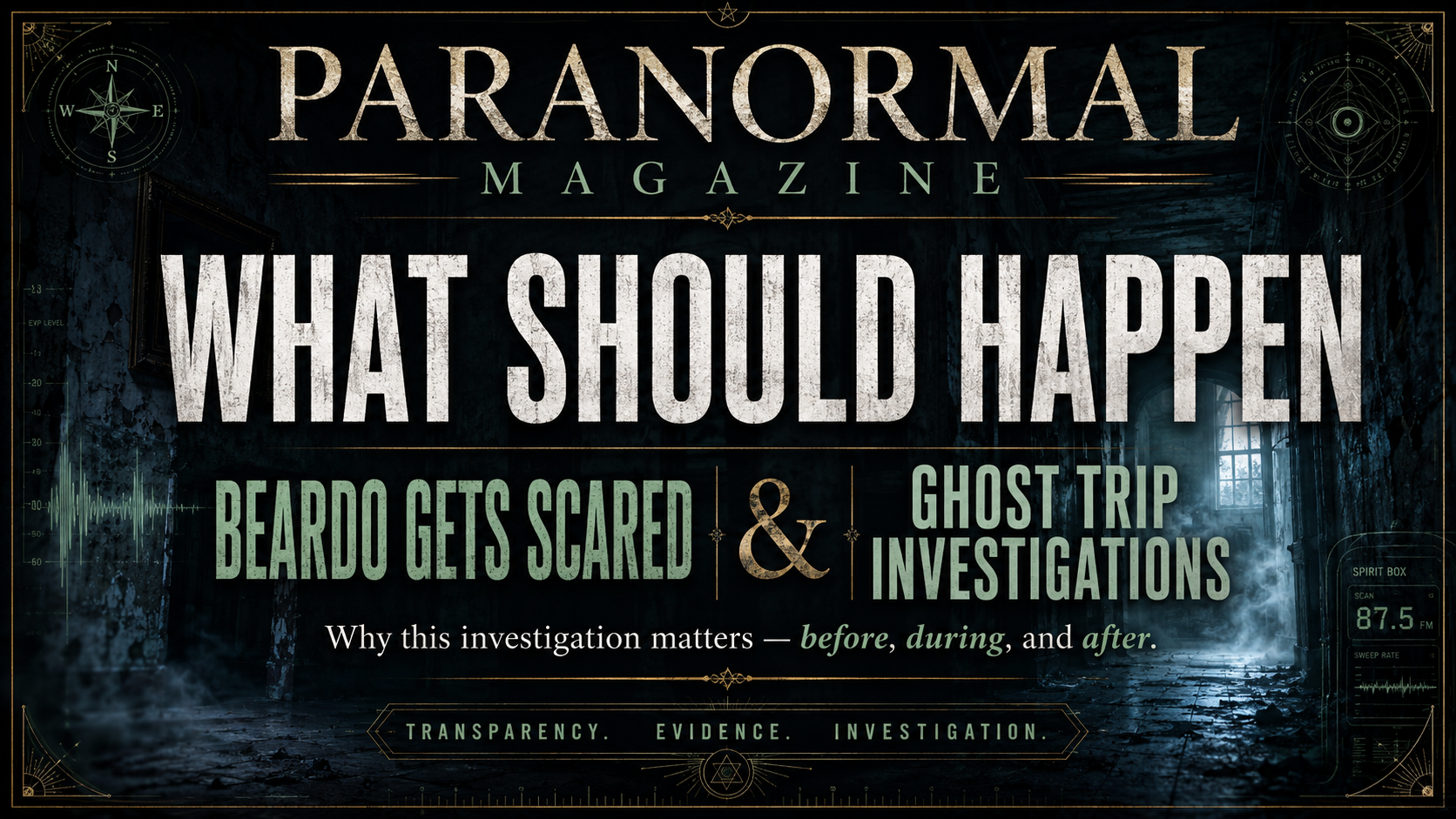
The online arguments have happened. The evidence has been questioned. Now Beardo Gets Scared has accepted Ghost Trip Investigation’s invitation to investigate alongside them. If handled properly, what happens next could be far more important than another YouTube disagreement.
There are plenty of arguments in the paranormal world.
One investigator captures something they cannot explain. A sceptic examines the footage and offers another explanation. Viewers choose sides, comment sections explode, response videos appear and, before long, the original question — what actually happened? — can become buried beneath personalities, loyalties and algorithms.
The developing situation between Beardo Gets Scared and Ghost Trip Investigation (GTI) has the potential to be different.
GTI, the UK paranormal team led by Dan Spragg and Adam Oakley, publicly invited Beardo to accompany them on an investigation, describing it as a genuine opportunity to investigate together in a transparent, open and honest way. Beardo subsequently publicly accepted the invitation.
That acceptance matters.
Because instead of continuing the discussion exclusively through edited videos, livestreams and social-media posts, two very different approaches to paranormal content now have an opportunity to meet in the place where these questions should ultimately be tested:
inside an investigation.
Why Beardo Saying “Yes” Is Important
Beardo Gets Scared has built his platform around examining paranormal evidence critically.
His own website describes an approach based around investigating claims, analysing footage using his knowledge of video editing, challenging weak evidence and attempting to separate genuine mysteries from misidentification or fakery. Importantly, his stated position is not simply that everything paranormal must be false, but that the evidence should be followed wherever it leads.
That distinction is important.
A useful sceptic should not enter a paranormal investigation determined to prove that nothing can happen.
Equally, a paranormal investigator should not enter determined that every unexplained noise, light or equipment response must be supernatural.
The interesting territory exists somewhere between those positions.
GTI describes its own philosophy as being centred around live exploration, audience involvement and allowing viewers to witness investigations and decide for themselves what they believe happened.
Putting those philosophies together could create something genuinely useful.
Beardo gets the opportunity to see GTI’s investigation process from beginning to end rather than analysing selected footage after publication.
GTI gets the opportunity to demonstrate its methods directly in front of someone who has been critical of paranormal evidence.
And the audience gets something even more valuable:
context.
This Should Not Be Beardo Versus GTI
The biggest mistake everyone involved could make would be treating this investigation as a boxing match.
It should not be about Beardo trying to catch GTI doing something wrong.
It should not be about GTI trying to manufacture an experience dramatic enough to convert him to their way of thinking.
And it certainly should not become several hours of people attempting to win an internet argument.
The paranormal community has enough tribalism already.
This investigation has the chance to demonstrate something considerably healthier: that people can fundamentally disagree about evidence while still being willing to stand in the same building, use the same equipment, watch the same rooms and examine the same incidents together.
Being challenged should not automatically be considered an attack.
Neither should scepticism.
If somebody claims that an event is paranormal, questions should be expected. If somebody offers a normal explanation, that explanation should also be questioned.
That is how investigations become stronger.
So What Should Actually Happen on the Investigation?
If this collaboration is going to mean something, transparency cannot simply be a slogan attached to the promotional material. It needs to be built into the investigation itself.
Before anything begins, GTI should explain exactly how they normally investigate. Beardo should explain what controls or additional observations he believes are necessary.
Then everybody should agree on the conditions.
There should be continuous cameras covering important areas wherever practically possible. Equipment should be inspected and demonstrated before use. Environmental factors should be noted. People entering and leaving investigation areas should be accounted for.
Most importantly, everybody should be allowed to observe.
If something strange happens, the first reaction should not immediately be:
“Ghost.”
It should be:
“What just happened?”
Then investigate it. That process does not destroy paranormal investigation. It improves it.
Because if ordinary explanations are properly tested and eliminated and something still cannot be explained, the remaining evidence becomes considerably more interesting.
Let Beardo Be Beardo — And Let GTI Be GTI
Another mistake would be forcing either side to abandon its identity.
GTI should conduct the investigation in the manner its audience recognises.
Beardo should be allowed to question what he sees.
If he believes an equipment response has a conventional explanation, he should say so.
If GTI disagrees, they should explain why.
And if Beardo witnesses something he genuinely cannot account for?
He should say that too.
There is an enormous difference between saying “I cannot explain that” and saying “therefore it was paranormal.”
That small distinction is one the wider paranormal community could benefit from hearing more often.
Unexplained should be allowed to remain unexplained.
Sometimes that is the most interesting answer available.
The Raw Footage Could Be More Important Than the Investigation
What happens after the lights come back on may ultimately determine whether this experiment succeeds.
Both sides will presumably produce content about the experience. That is perfectly reasonable.
But edited videos should not become the only record of what happened.
Where practical, the original footage surrounding significant incidents should be preserved and made available for examination. If an event becomes controversial, viewers should be able to see what occurred immediately before and immediately afterwards rather than only a dramatic ten-second clip.
Beardo should also be willing to show moments that challenge his expectations.
GTI should be willing to show moments where apparently paranormal activity turns out to have an ordinary explanation.
That symmetry matters. Transparency cannot mean releasing everything that supports your position while quietly forgetting everything that does not.
Bigger Than One YouTube Collaboration
GTI has grown a substantial online paranormal community, while Beardo Gets Scared has built an audience around questioning paranormal footage and claims.
That is exactly why this meeting has significance.
Paranormal entertainment increasingly exists in an environment where dramatic claims generate attention, sceptical response videos generate attention, and arguments between communities can generate even more.
But underneath all of that remains the question that brought most people into the paranormal world in the first place:
Is something genuinely unexplained happening?
The best way of exploring that question is not by surrounding ourselves exclusively with people who already agree with us.
Believers need sceptics. Sceptics need investigators willing to open their doors.
Investigators need people who will challenge methodology. And debunkers occasionally need to leave the editing desk, enter the allegedly haunted building and experience the unpredictable reality of field investigation for themselves.
That is why Beardo accepting GTI’s invitation is potentially important. Not because somebody is going to be proven right. Not because somebody is going to be proven wrong.
But because two sides of a frequently divided paranormal community have an opportunity to investigate the same place, at the same time, under the same conditions.
Now the challenge is to make the investigation worthy of the conversation surrounding it. Keep it civil.
Keep the cameras rolling. Keep questioning everything.
And afterwards, show us what happened — including the parts that do not fit anybody’s preferred conclusion.
Because if the paranormal community genuinely wants to understand the unexplained, that is what transparency should look like.
Paranormal magazine will be watching with interest.

Posted on August 11, 2026, in Uncategorized and tagged Books, debunked, ghosts, horror, paranormal, writing. Bookmark the permalink. Leave a comment.
 Paranormal Magazine UK
Leave a comment
Comments 0