Is There More Paranormal Fakery Today Than 20 Years Ago… or Even in Victorian Times? MUST READ!
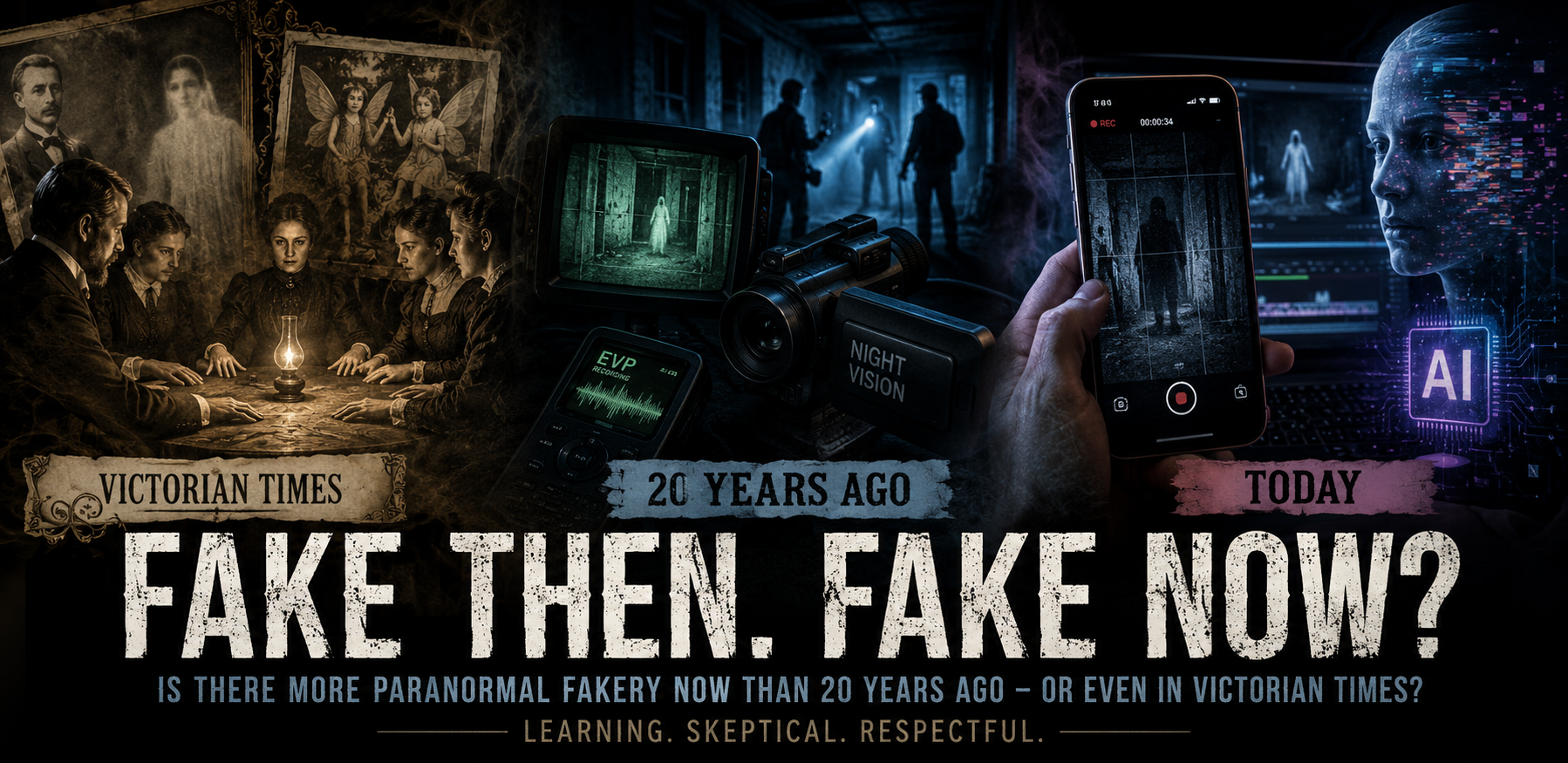
Every generation seems convinced that it lives in an age of unprecedented deception. Today we have artificial intelligence, deepfake videos, edited ghost-hunting clips on social media, and viral paranormal stories that can reach millions of people within hours. It is tempting to conclude that fakery has never been worse.
But history tells a more interesting story.
The Victorian era (1837–1901) was arguably one of the greatest periods of paranormal deception ever recorded. Twenty years ago, television was flooded with ghost-hunting programmes, many of which blurred the line between entertainment and investigation. Today, social media has transformed paranormal content once again, making it easier than ever to create convincing evidence—but also easier than ever to expose it.
So, are there really more fakes today? Or are they simply different?
As sceptics with open minds, it is worth looking at each era fairly.
The Victorian Age: When Ghosts Became Big Business

If there was ever a golden age of paranormal fraud, many historians would point towards the Victorian period.
Several factors came together perfectly:
High mortality rates, Frequent outbreaks of disease, Wars that left countless families grieving, The rapid rise of photography, A growing fascination with science and the afterlife
Many people desperately wanted proof that loved ones survived death. Unfortunately, some individuals saw an opportunity.
Spirit Photography
One of the most famous examples involved American photographer William Mumler.
He claimed his camera could capture spirits standing beside living relatives.
To modern eyes, the photographs are clearly double exposures or manipulated negatives. Yet during the 1860s, photography was still mysterious enough that many people believed the images were genuine. Mumler even photographed Mary Todd Lincoln, supposedly with the ghost of Abraham Lincoln standing behind her. Eventually, investigators demonstrated numerous ways such photographs could be faked, although Mumler avoided conviction due to insufficient evidence.
Britain experienced similar scandals.
William Hope became famous for “spirit photography” until paranormal investigator Harry Price demonstrated that photographic plates had apparently been switched during sittings, strongly suggesting deliberate fraud.
Fake Mediums
Victorian séances were often theatrical performances.
Some mediums used:
hidden assistants, concealed wires, glowing paint, fake ectoplasm made from cheesecloth or paper, musical instruments operated in darkness, secret compartments
Many audiences genuinely believed spirits were communicating with them.
Professional magicians such as Harry Houdini later spent years exposing fraudulent mediums because they recognised stage illusions being presented as genuine supernatural events.
The Cottingley Fairies
Perhaps the most famous British paranormal hoax involved two young girls who photographed cardboard fairy cut-outs.
Even Sir Arthur Conan Doyle accepted the photographs as genuine evidence.
The images fooled many intelligent people—not because they lacked intelligence, but because they genuinely wanted them to be true.
Twenty Years Ago: The Television Boom

Around twenty years ago, paranormal television exploded in popularity.
Ghost hunting moved from niche hobby to mainstream entertainment.
Programmes often featured: night vision cameras, infrared footage, EVP recordings, dramatic music, suspenseful editing, cliff-hangers before advert breaks
Most presenters never claimed outright that every piece of evidence proved ghosts.
However, television naturally rewarded exciting moments over uneventful investigations.
A five-hour investigation producing nothing interesting rarely made good television.
That doesn’t automatically mean evidence was fabricated—but editing sometimes created a stronger impression than the raw investigation might have deserved.
Meanwhile, digital photography introduced a new wave of misunderstandings.
Many famous “ghost photographs” from the early 2000s later turned out to involve: camera straps, dust illuminated by flash (“orbs”), motion blur, compression artefacts, lens flare
Unlike Victorian frauds, many of these images were probably honest mistakes rather than deliberate hoaxes.
Today: The Age of AI and Viral Content
Today’s paranormal world is completely different.
Almost everyone carries a 4K video camera, multiple editing apps, AI image generators, voice cloning software, instant access to millions of viewers
Creating convincing fake evidence has never been easier.
Neither has exposing it. Communities of photographers, visual effects artists and experienced investigators frequently analyse videos frame-by-frame within hours of publication.
Ironically, modern fakery often has a much shorter lifespan. Twenty years ago, a questionable photograph might circulate for months.
Today, it can be debunked worldwide before the day ends.
Have We Become Better Skeptics?
In many ways, yes.
The average person today understands photography and video editing far better than a Victorian audience.
People commonly ask:
- Could this be AI?
- Is there another camera angle?
- Has the original file been uploaded?
- Was this edited?
- Can someone reproduce the effect?
This level of healthy questioning simply wasn’t possible in the nineteenth century.
However, social media has also created another challenge.
Algorithms reward dramatic content.
A genuine investigation that produces nothing unusual rarely gains millions of views.
A shocking ghost video—even if fake—often does.
That creates a financial incentive for some creators to exaggerate or fabricate evidence.
Why People Still Believe
This question is more complicated than simply asking who is gullible. Throughout history, belief has often been driven by emotion rather than ignorance.
People may seek comfort after bereavement. Others have experienced something they genuinely cannot explain.
Many investigators who later exposed fraud actually began as believers. Equally, some sceptics have witnessed events they cannot easily dismiss. These experiences remind us why respectful discussion matters. Being sceptical does not mean dismissing every claim.
Being open-minded does not mean accepting every claim. The strongest investigations sit somewhere in the middle.
So… Which Era Had the Most Fakery?
Victorian Times
- Probably had the highest proportion of organised paranormal fraud.
- Fake mediums often charged significant sums.
- Many relied on the public’s limited understanding of new technologies.
- Some frauds continued for years before being exposed.
Twenty Years Ago
- Television encouraged sensational presentation.
- Digital cameras created countless accidental anomalies.
- Some investigations blurred the line between entertainment and research.
Today
- The sheer quantity of fake paranormal content is likely greater than ever because anyone can create and upload it instantly.
- AI, editing software and social media make fabrication easier.
- At the same time, independent investigators and online communities can often identify hoaxes much faster than in previous generations.
Paranormal Magazines Ending Statement.
History suggests that paranormal fakery is not a new problem—it simply evolves with technology, Victorian fraudsters mastered photographic plates and darkened séance rooms.
Television producers mastered editing and suspense, Today’s creators have AI, smartphones and global audiences, Yet one thing has remained remarkably consistent, most people interested in the paranormal are not looking to be fooled. They are searching for answers, That is why respectful scepticism remains the best approach.
We should investigate unusual claims with curiosity rather than cynicism, ask difficult questions without ridicule, and remember that exposing fraud ultimately protects genuine investigation. Every fake uncovered helps ensure that any truly unexplained evidence receives the careful attention it deserves.
After all, if the paranormal is real, then it has nothing to fear from honest scepticism. It is only deception that cannot withstand careful scrutiny.

Posted on July 29, 2026, in Uncategorized and tagged Books, debunked, ghosts, history, paranormal, writing. Bookmark the permalink. Leave a comment.


Leave a comment
Comments 0