Fallout Grows Over Warren Legacy Interview as Jason Hawes and Ryan Buell Trade Public Statements
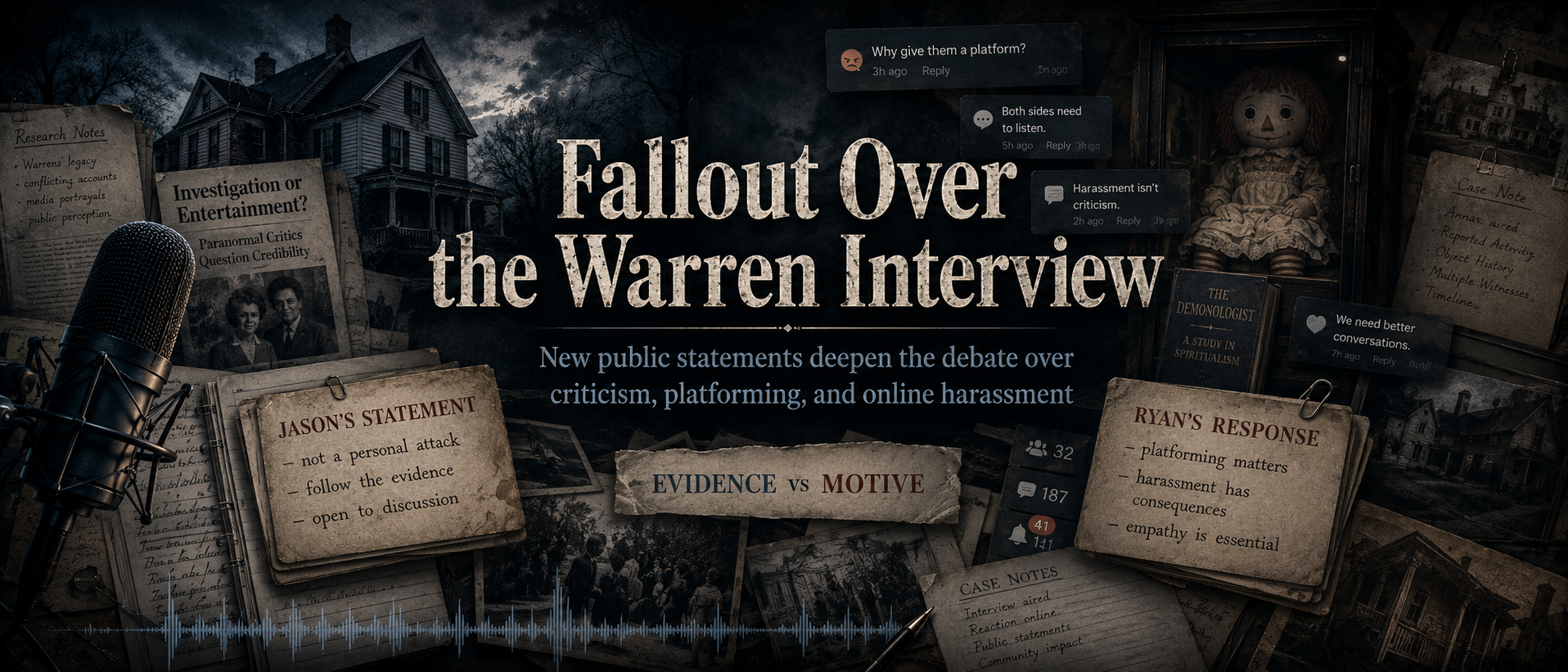
A debate that began with questions about Ed and Lorraine Warren’s historical claims has widened into a dispute over platforming, cyberbullying, editorial responsibility and the difference between criticism and harassment.
The controversy surrounding a recent discussion of Ed and Lorraine Warren’s legacy has intensified after paranormal investigators Jason Hawes and Ryan Buell issued sharply different public statements about the programme and its consequences.
The original video featured Hawes speaking with Stevie Etay of the Truth or Demons Podcast. During the lengthy conversation, the pair examined the Warrens’ history, the origins of several well-known stories and alleged inconsistencies involving cases and objects associated with the New England Society for Psychic Research, commonly known as NESPR.
The discussion included legitimate historical questions, personal recollections, disputed allegations and criticism of how the Warrens’ legacy has been presented to the public. It also touched briefly on an uncomfortable allegation involving Ed Warren’s private life.
Following criticism of the episode, Hawes defended the programme by saying it was never intended as a personal attack or smear campaign. Buell has now challenged that explanation, arguing that Hawes gave a major platform to someone Buell accuses of engaging in repeated online harassment.
The result is no longer simply a disagreement about whether old paranormal stories withstand modern scrutiny. It has become a wider argument about how paranormal researchers investigate one another, how serious accusations should be presented and what responsibility influential creators carry when promoting controversial voices.
Jason Hawes defends the purpose of the interview
In his public response, Hawes said the programme was about determining whether historical claims still hold up when compared with documented evidence.
According to Hawes, some people are willing to accept extraordinary claims without sufficient support but become uncomfortable when researchers discover records that contradict established narratives.
“This field should always be about searching out the truth, not just taking somebody’s word for it,” Hawes wrote.
That principle is difficult to dispute. Paranormal claims should not be protected from examination because they involve respected investigators, famous families or culturally important cases. Newspaper archives, police reports, recordings, photographs and contemporary witness accounts can all help determine how stories developed over time.
Hawes also addressed the personal allegation mentioned near the end of the video. He said it was raised briefly because ignoring it could have led viewers to accuse the programme of deliberately overlooking a major part of the controversy.
There is some merit to that position. When a serious allegation has already become part of the public historical discussion, complete silence may appear selective. However, acknowledging an allegation and proving it are not the same thing. Such subjects require careful attribution, context and language that makes clear what has been established and what remains disputed.
Ryan Buell questions the guest and the platform
Buell’s response does not primarily defend the historical accuracy of the Warrens’ paranormal claims. Instead, he focuses on the conduct and reputation of Hawes’s guest.
Buell accuses Etay of having an extensive history of cyberbullying and targeting people within the paranormal community, particularly NESPR and its supporters. He also alleges that she uses an alias to conceal her identity and personal history.
These are serious allegations. In the post provided, however, Buell does not include screenshots, links, dates or a detailed chronology demonstrating the conduct he describes. His claims should therefore be reported as allegations rather than established facts.
Using a professional name or online alias is not, by itself, evidence of dishonesty. Many writers, performers, researchers and creators use pseudonyms for privacy or branding. It would become relevant if someone were using an alias to impersonate others, avoid legal accountability, conceal important conflicts of interest or return after being removed from platforms. Buell’s statement does not document those circumstances.
Buell further argues that Hawes failed to challenge the guest’s motives, research methods or personal conduct. By featuring her on a large platform and repeatedly praising her work, Buell believes Hawes gave her credibility and may have emboldened people involved in hostile online behaviour.
This criticism raises a legitimate editorial question.
Inviting someone onto a programme does not automatically mean endorsing everything that person has ever said or done. Journalists, podcasters and investigators frequently interview controversial people. Nevertheless, when an interview is overwhelmingly supportive and contains little meaningful challenge, audiences may reasonably perceive the appearance as an endorsement of the guest’s work and reliability.
Was the original discussion fair and balanced?
The programme contained several defensible lines of inquiry.
The speakers discussed changing accounts of the Annabelle story, questioned whether certain legends can be linked to police or newspaper records and examined the degree of the Warrens’ involvement in cases later dramatized by Hollywood. They also raised questions about the provenance of objects promoted as haunted.
Such claims should be investigated.
However, the programme was not a formally balanced debate. No representative from NESPR, no member of the Warren family and no historian presenting a different interpretation appeared during the discussion. Hawes and his guest agreed on most major points, and several claims were accepted without rigorous questioning.
The discussion also blended different standards of evidence.
At various moments, the speakers referred to historical articles and recordings. Elsewhere, they relied on personal conversations, unnamed sources, visual comparisons, internet searches and speculation about motives. Those sources do not all carry equal evidentiary weight.
A contemporary newspaper report may establish that a person made a statement at a particular time. It does not automatically prove the statement was true. A reverse-image search may show that an object resembles a commercial product. It does not necessarily establish the history of the exact object in a museum. An inability to locate a record may make a story doubtful, but it does not always prove that the event never occurred.
The video would have been stronger had it consistently labelled each point as documented fact, reasonable inference, disputed testimony, unverified claim or personal opinion.
Criticism is not automatically harassment
Buell is correct that cyberbullying and targeted harassment are genuine problems.
Criticism can cross a line when people encourage followers to overwhelm an individual, repeatedly tag family members, publish private information, make threats, contact employers or relatives, or coordinate efforts intended to frighten and exhaust someone.
The paranormal community’s interest in public cases does not justify attacking private individuals or grieving families.
At the same time, repeated criticism of a public organisation or influential investigator does not automatically constitute harassment. Researchers are allowed to revisit claims, identify contradictions and publish critical conclusions. Even forceful or uncomfortable commentary is not necessarily bullying.
Determining whether Etay or her associates engaged in harassment would require examining the actual posts, messages, context and patterns of conduct. Buell’s characterisation alone cannot settle that question.
It is also important to separate the researcher from the research. A person may behave poorly and still identify a genuine contradiction. Conversely, someone may be respectful and sincere while promoting an inaccurate claim.
The history of Annabelle, Enfield or any other Warren case must be evaluated through evidence, not solely through opinions about the people discussing it.
Questions about editorial responsibility
Buell criticises Hawes for apparently failing to contact NESPR or members of the Warren family before releasing the interview.
If no opportunity for comment was offered, that was a missed opportunity.
A response from NESPR would not have guaranteed agreement, but it could have clarified dates, corrected errors, supplied documentation or shown viewers exactly where the two sides differ. Even a statement that NESPR declined to participate would have demonstrated an attempt to include the organisation’s position.
Hawes was under no absolute obligation to create a formal debate. His programme is not a court proceeding. However, the more serious and personal the allegations become, the stronger the case for contacting those accused before publication.
Buell goes further by warning that someone will eventually be hurt and suggesting that Hawes may share responsibility because he helped amplify the guest.
That argument currently goes beyond the available evidence.
There is no indication in the programme that Hawes instructed viewers to threaten, contact or harass anyone. Promoting a creator may increase that person’s influence, but it does not automatically make the host responsible for every future action taken by the guest, her followers or unrelated commenters.
Jason’s responsibility would depend on what he knew, what he encouraged and how he responded to credible evidence of abuse. Those facts have not been publicly established in the statements examined here.
The significance of Buell acknowledging his own past
Buell anticipates that critics may question his authority to speak about harmful conduct because of his own widely discussed history.
He openly acknowledges that he hurt people while struggling with active drug addiction and says he faced consequences and worked to change his life. He argues that this experience gives him insight into misconduct and accountability.
Acknowledging previous wrongdoing is preferable to pretending it never occurred. It does not automatically prove that Buell’s current allegations are correct, but neither does his past disqualify him from raising concerns.
The accuracy of his claims must be judged on evidence, just as the claims made in the original Warren discussion must be judged on evidence.
Where Jason’s response falls short
Hawes is justified in rejecting the idea that historical claims should become off limits simply because they involve famous or deceased investigators.
However, his description of the programme as an examination of claims against documented evidence is incomplete.
The discussion also included opinions about character, speculation concerning financial motives, private allegations, hearsay and openly dismissive comments. At points, the tone included laughter and ridicule.
That does not mean the entire programme was a smear campaign. A smear campaign generally involves knowingly spreading false or misleading information for the purpose of damaging someone. That intention has not been demonstrated.
Nevertheless, a programme can be created without malicious intent and still be one-sided, insufficiently challenged or unnecessarily personal. Intent and effect are not always identical.
Where Ryan’s response goes too far
Buell is justified in asking whether Hawes properly vetted his guest and whether NESPR should have been contacted.
He is also justified in warning that online disagreements can become harmful when followers begin treating criticism as permission to target individuals.
But Buell’s post relies heavily on accusations about Etay’s character without presenting the evidence necessary for readers to assess them. Calling someone a relentless cyberbully is a significant claim. It should be supported with examples that distinguish research, criticism and sarcasm from actual harassment.
His prediction that someone “will” be hurt also escalates the dispute. Unless there are specific threats or documented plans that have not been included publicly, the statement risks implying a certainty that has not been established.
What is actually known?
At present, several points can be stated with reasonable confidence.
Hawes hosted a strongly critical discussion of the Warrens with a guest whose work he openly praised. The programme questioned multiple established paranormal narratives and included a serious personal allegation.
Hawes says the purpose was historical scrutiny rather than personal attack.
Buell believes the guest has engaged in harmful online conduct and argues that Hawes irresponsibly amplified her. The public statement provided does not independently document those allegations.
The video was not fully balanced in the conventional journalistic sense, and it appears that no representative from NESPR or the family participated.
There is currently no evidence in the material reviewed that Hawes directly encouraged harassment.
These facts leave substantial room between the two most extreme interpretations.
A dispute now overshadowing the evidence
The original conversation began with a worthwhile question: Do the stories surrounding the Warrens withstand examination against contemporary records?
That question risks being lost as the disagreement shifts towards accusations about personalities, hidden motives and online behaviour.
NESPR and the Warren family should be able to respond to factual criticism without being harassed. Researchers should be able to examine the Warren legacy without automatically being branded enemies or trolls. Critics who make serious allegations should support them. Defenders who dispute research should answer the evidence rather than relying only on character testimony.
Hawes was not wrong to host a critical discussion. He should, however, have challenged the evidence more consistently and made a stronger effort to include a response from those being criticised.
Buell was not wrong to raise concerns about platforming and online conduct. He should support his allegations with material that readers can independently evaluate and avoid assigning responsibility for hypothetical future harm without a clearer factual basis.
The paranormal field frequently asks the public to distinguish unexplained experiences from assumption and legend. Its leading voices should apply the same discipline to disputes within their own community.
Until further evidence is produced, neither side has established that the other acted as part of a deliberate campaign. What has been established is that the discussion was one-sided, the response was highly accusatory and the original historical questions remain largely unresolved beneath the growing personal conflict.
Editor’s note: This article reports and analyses public statements supplied to the publication. Allegations of cyberbullying, harassment and private misconduct have not been independently established within the material reviewed and are presented as claims rather than proven facts.

Posted on July 28, 2026, in Uncategorized and tagged debunked, jason hawes, news, paranormal, politics, ryan buell, technology, writing. Bookmark the permalink. 1 Comment.


Pingback: The Warren Legacy Under Fire: What the Evidence Shows—and What It Does Not | Paranormal Magazine UK