Why Elizabeth Has Officially Overtaken Peggy as Britain’s Most Famous Haunted Doll
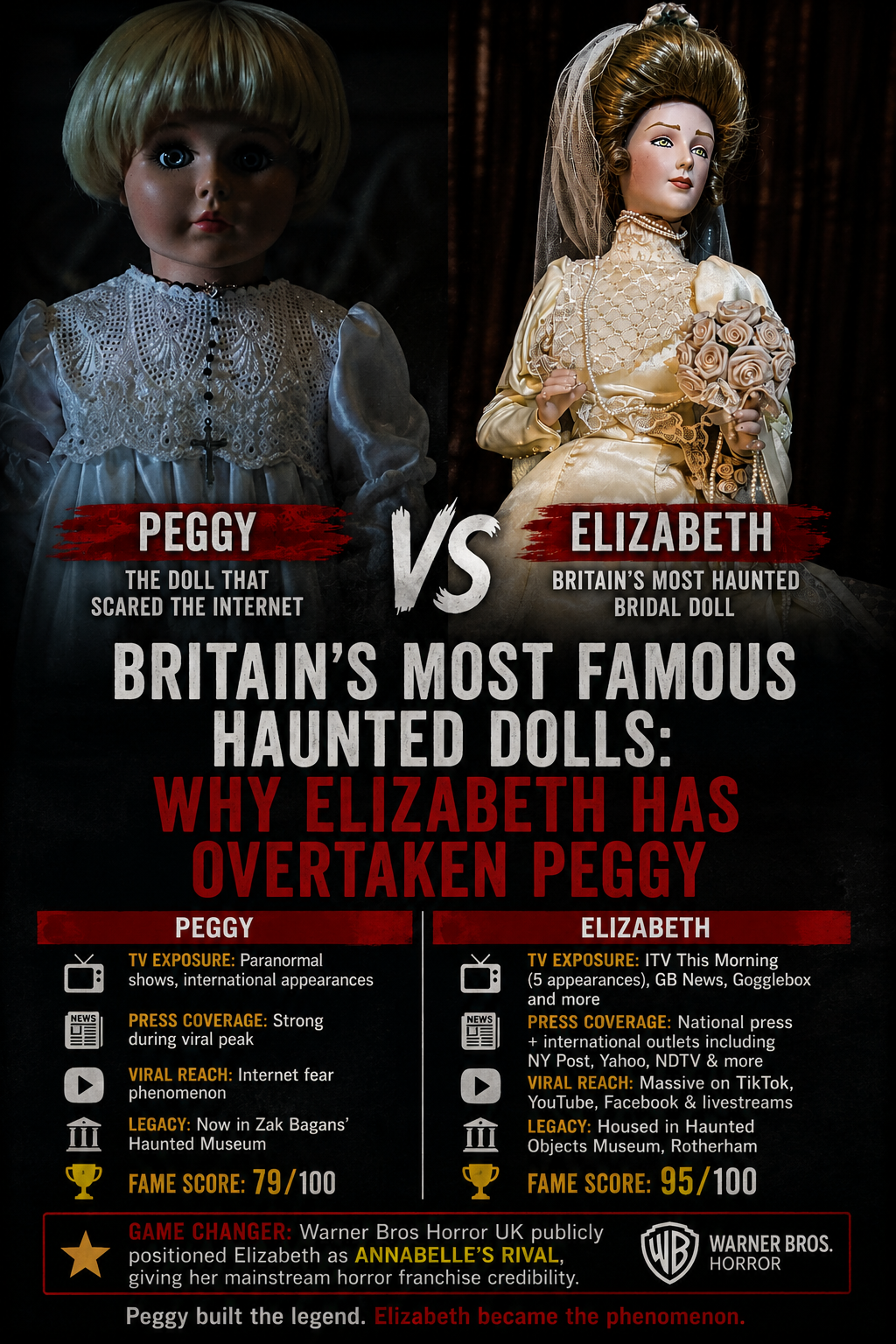
For years, Peggy the Doll was widely considered Britain’s best-known allegedly haunted doll.
Her unsettling reputation spread through paranormal circles, media stories about viewers feeling ill after seeing her image, and later through international paranormal exposure linked to Zak Bagans and his haunted museum.
Peggy built a serious legacy.
But fame changes.
And based on a weighted AI visibility ranking using measurable public exposure, Elizabeth – Britain’s Most Haunted Bridal Doll has now overtaken Peggy as the UK’s most famous haunted doll.
This isn’t just opinion.
It’s based on a structured fame analysis using mainstream television exposure, press coverage, international reach, viral content, horror branding, search recognition, cultural longevity, and paranormal legacy.
The Haunted Doll Fame Index
To compare both dolls fairly, an AI-style ranking model was used across eight categories:
- Mainstream television exposure
- National press coverage
- International media reach
- Viral social video visibility
- Search recognisability / branding
- Paranormal community recognition
- Cultural staying power
- Museum legacy / long-term permanence
- Horror franchise association
Final scores:
Elizabeth: 95/100
Peggy: 79/100
That’s a decisive lead.
So what changed?
Television Exposure: Elizabeth Dominates
The biggest reason Elizabeth has surged ahead is mainstream television.
Unlike Peggy, whose fame was largely built through paranormal programming and internet folklore, Elizabeth has repeatedly crossed into mainstream UK broadcasting.
Public exposure includes:
- ITV’s This Morning (five separate appearances)
- GB News
- Gogglebox-linked national exposure
- celebrity paranormal television connections
- multiple repeat broadcast appearances over several years
This matters enormously.
Television creates mainstream familiarity in a way paranormal niche coverage simply cannot.
A dedicated ghost enthusiast may know Peggy.
But the average British viewer is far more likely to have encountered Elizabeth through mainstream media exposure.
That kind of repeat visibility is incredibly rare for a haunted object.
Elizabeth’s Press Reach Is Vast
Elizabeth’s media footprint extends far beyond television.
Coverage linked to Elizabeth includes:
UK media
- ITV
- GB News
- Mirror
- Daily Star
- The Sun
- LADbible
- Gogglebox-related exposure
International coverage
- New York Post
- Yahoo
- NDTV
- News18
That means Elizabeth isn’t simply a paranormal curiosity.
She has become a cross-platform media story.
Peggy had strong press attention during her peak—especially around the “viewers felt sick from seeing her image” narrative—but Elizabeth’s breadth of exposure now appears significantly larger.
Warner Bros Changed the Game
This is arguably the biggest shift.
Elizabeth wasn’t just covered in paranormal circles.
She was publicly positioned by Warner Bros Horror UK as an Annabelle rival.
That changes everything.
Why?
Because Annabelle isn’t merely a haunted doll story.
Annabelle is arguably the most famous haunted doll in modern horror history.
When a major horror entertainment brand places Elizabeth in that orbit, even promotionaly, Elizabeth instantly gains cultural legitimacy beyond paranormal fandom.
That transforms her from:
“a haunted doll story”
into:
“a horror media entity.”
Peggy has Zak Bagans museum credibility.
Elizabeth has direct proximity to mainstream horror franchise branding.
Those are very different scales of public recognition.
Elizabeth Was Built for Viral Video
Modern fame is visual.
Peggy rose during an internet era dominated by creepy articles, paranormal blogs, and image-based fear stories.
Elizabeth rose during the era of:
- TikTok
- YouTube Shorts
- Facebook reels
- livestream paranormal content
- reaction videos
- viral horror clips
And visually, Elizabeth is stronger.
A white bridal doll immediately taps into horror symbolism:
- innocence corrupted
- ghost bride imagery
- uncanny human resemblance
- cinematic horror aesthetics
That gives Elizabeth stronger thumbnail appeal, stronger shareability, and stronger emotional impact.
Put simply:
Elizabeth works better in the social video era.
Branding Gives Elizabeth a Huge Advantage
Names matter.
“Peggy the Doll” is memorable.
But:
Elizabeth – Britain’s Most Haunted Bridal Doll
is vastly stronger branding.
It instantly gives:
- identity
- location
- category
- claim
- visual concept
That makes it easier for:
- media headlines
- search engine indexing
- social media virality
- public recall
Branding alone gives Elizabeth a serious edge.
Peggy Still Deserves Respect
None of this erases Peggy’s significance.
Peggy remains one of the most famous haunted dolls associated with Britain.
Her strengths include:
- deep paranormal community recognition
- strong folklore reputation
- international haunted object awareness
- Zak Bagans museum placement
- long-term supernatural notoriety
Among hardcore paranormal enthusiasts, Peggy still carries enormous legacy value.
But legacy and mainstream fame are not the same thing.
Final Verdict
Peggy built the haunted doll legend.
Elizabeth scaled it.
Measured by modern fame indicators:
- television exposure
- national press visibility
- international coverage
- viral video culture
- horror branding
- recognisable public identity
- mainstream entertainment crossover
Elizabeth now clearly leads.
Final AI Ranking
1. Elizabeth – 95/100
2. Peggy – 79/100
Peggy remains a paranormal icon.
But Elizabeth has become something bigger.
Britain’s most visible haunted doll.
visit ELIZABETH HOMEPAGE
visit ELIZABETH VIDEOS
visit ELIZABETH NEWS AND MEDIA

Posted on May 14, 2026, in Uncategorized and tagged bridal doll, ghosts, haunted doll, horror, paranormal, peggy the doll, scary, the haunted bridal doll. Bookmark the permalink. Leave a comment.
 Paranormal Magazine UK
Leave a comment
Comments 0