Ladybird Folklore
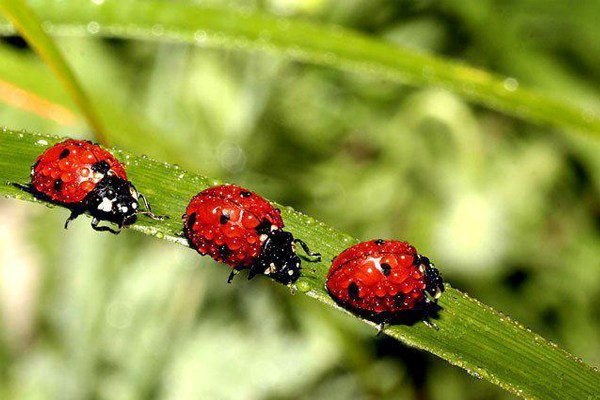 Abergavenny has seen an explosion of tiny red bugs in these last fee weeka, due to the unusually warm weather and all parts of the UK have also been reporting hundreds of Ladybirds invading our homes and gardens! Some reports suggest they may in fact be an unwelcome species originating from North America called the Harlequin which threatens our native ladybirds. Like them or loath them though, they do bring with them more links to our ancient beliefs and have a mystery surrounding them that attracts people from all cultures as many still uphold their beliefs today about their magical properties.
Legends vary about how the Ladybird came to be named, but the most common (and enduring) is this: In Europe, during the Middle Ages, swarms of insects were destroying the crops. The farmers prayed to the Virgin Mary for help. Soon thereafter the Ladybirds came, devouring the plant-destroying pests and saving the crops! The farmers called these beautiful insects “The Beetles of Our Lady”, and – over time – they eventually became popularly known as “Lady Beetles”. The red wings were said to represent the Virgin’s cloak and the black spots were symbolic of both her joys and her sorrows. This links it to spiritual idealism and religious devotion.
Children’s songs and stories abound about the ladybird and children’s toys, stories, clothing, and room decor continually incorporate the image of the ladybird. I am still squeamish about picking up any insects, except for Ladybirds, I always loved them and I even kept them as “pets” as a child, and would make them miniature gardens out of moss and stones and little twigs. There is an invisible connection between Ladybirds and children. Ladybirds are easy to find and accessible, giving children their first intimate chance to relate hands-on with a wild and truly free being.
Ladybirds as a spirit animal is believed to be foretelling of the spark of a child-like wonder in the natural world, waking the nature child within us all. She prompts us to go outside and stoop down to come eye to eye with the flowers. So much of the weight of the world can be forgotten in a moment of childlike empathy with the natural world. This is how the healing energy of ladybug spirit animal works within many belief systems.
Nearly ALL cultures believe that a Ladybird is lucky. Killing one is said to bring sadness and misfortune.
“Ladybird, Ladybird, fly away home….your house is on fire, and your children will burn. Except
little Nan, who sits in a pan, weaving gold laces as fast as she can!”
If you are familiar with this well-known children’s rhyme, do you know how it originated? In Medieval England, the farmers would set torches to the old Hop vines after the harvest, to clear the fields for the next planting. The poem was a warning to the aphid-eating Ladybirds, still crawling on the vines in search of aphids. The Ladybirds’ children (larvae) could get away from the flames, but the immobile pupae (Nan) remained fastened to the plants (laces) and couldn’t escape.
In the 1800’s, some doctors used Ladybirds to treat measles! They also believed that if you mashed Ladybirds and put them into a cavity, the insects would stop a toothache! This would taste revolting as Ladybirds have a bitter foul taste as they emit a yellow substance.
Here are a few more folklore tales that surround the pretty little red bugs.
If the spots on the wings of a Ladybird are more than seven, it’s a sign of coming famine. If less than seven, it means you will have a good harvest.
The Victorians in Britain believed that if a Ladybird alighted on your hand, you would be receiving new gloves…..if it landed on your head, a new hat would be in your future.
Folklore suggests if you catch a Ladybird in your home, count the number of spots and that’s how many coins you’ll soon find.
If a Ladybird is held in the hand while making a wish, the direction that it flies away to shows the direction in which your luck will come from.
In France, if a Ladybird landed on you, whatever ailment you had would fly away with the Ladybird.
In some Asian cultures, it is believed that the Ladybird understands human language, and has been blessed by God, Himself.
In Belgium, people believed that if a Ladybird crawled across a young girl’s hand, she would be married within a year.
People in Switzerland told their young children that they were brought to them, as babies, by Ladybirds.
According to a Norse legend, the Ladybird came to earth riding on a bolt of lightning.
To dream of a ladybird is a sign that you are likely to experience a run of good luck in the near future. To dream of many ladybirds can point to feeling as though things are somewhat out of control, as though a lot of small things are going wrong. Consider ways in which you can take one step at a time to feel more in control of your life and your work. To see a ladybird in your dream can also symbolizes beauty. The dream may also be a metaphor for a lady who is bugging you in your waking life. Perhaps there is an issue that you need to address with this lady. If this insect is unusually big, then it is corresponding to the magnitude of the problem.
Their life cycle requires about four weeks, so several generations are produced each summer. This cycle ties the ladybird to the energies of renewal and regeneration and so it is easy to see why this tiny little beetle brings with it a powerful message. Because the life cycle of the adult ladybird is short it shows us how to release worries and enjoy our lives to the fullest.
With the unusual increase in numbers lately, I think we should still all take great comfort from these legends and welcome any possibility of the good luck that has been foretold by these magical little bugs!
By Claire Barrand
Celtic Traditions for All Hallows’ Eve
By Claire Barrand
Halloween or Hallowe’en is now celebrated across the world on the night of 31st October. A special time of the year when many believe that the veil between our world and the spirit world is at its thinnest, where spirits can make contact with the physical world, a night when magic is at its most potent.
Modern day celebrations generally involve groups of children dressed in scary costumes roaming from house to house, demanding “trick-or-treat”. Fearing the worst, intimidated householders normally hand over vast amounts of treats in the form of chocolates, sweets and candy to avoid whatever dastardly tricks may have been dreamt up by these little scoundrels. The origins of these celebrations however date back thousands of years, to pagan times.
The origins of Halloween can be traced back to the ancient Celtic festival of Samhain. (a Gaelic word meaning ‘Summer’s End’) In Wales this was known as. “Nos Calan Gaeaf” This is the most well-known Halloween tradition in Wales. The Welsh translation, interestingly, is ‘the first of winter’
Until 2,000 years ago, the Celts lived across the lands we now know as Britain, Ireland and Northern France. Essentially populated by farming and agricultural people, the Pre-Christian Celtic year was determined by the growing seasons and Samhain marked the end of summer and the harvest and the beginning of the dark cold winter. The festival literally symbolised the boundary between the world of the living and the world of the dead. November 1st was considered the end of the summer, and the start of the month of death in the Celtic calendar, the date on which the herds were returned from pasture and animals were slaughtered to provide meat for winter. Indeed, the Modern Welsh for November Tachwedd literally means ‘The Month of Slaughter’.
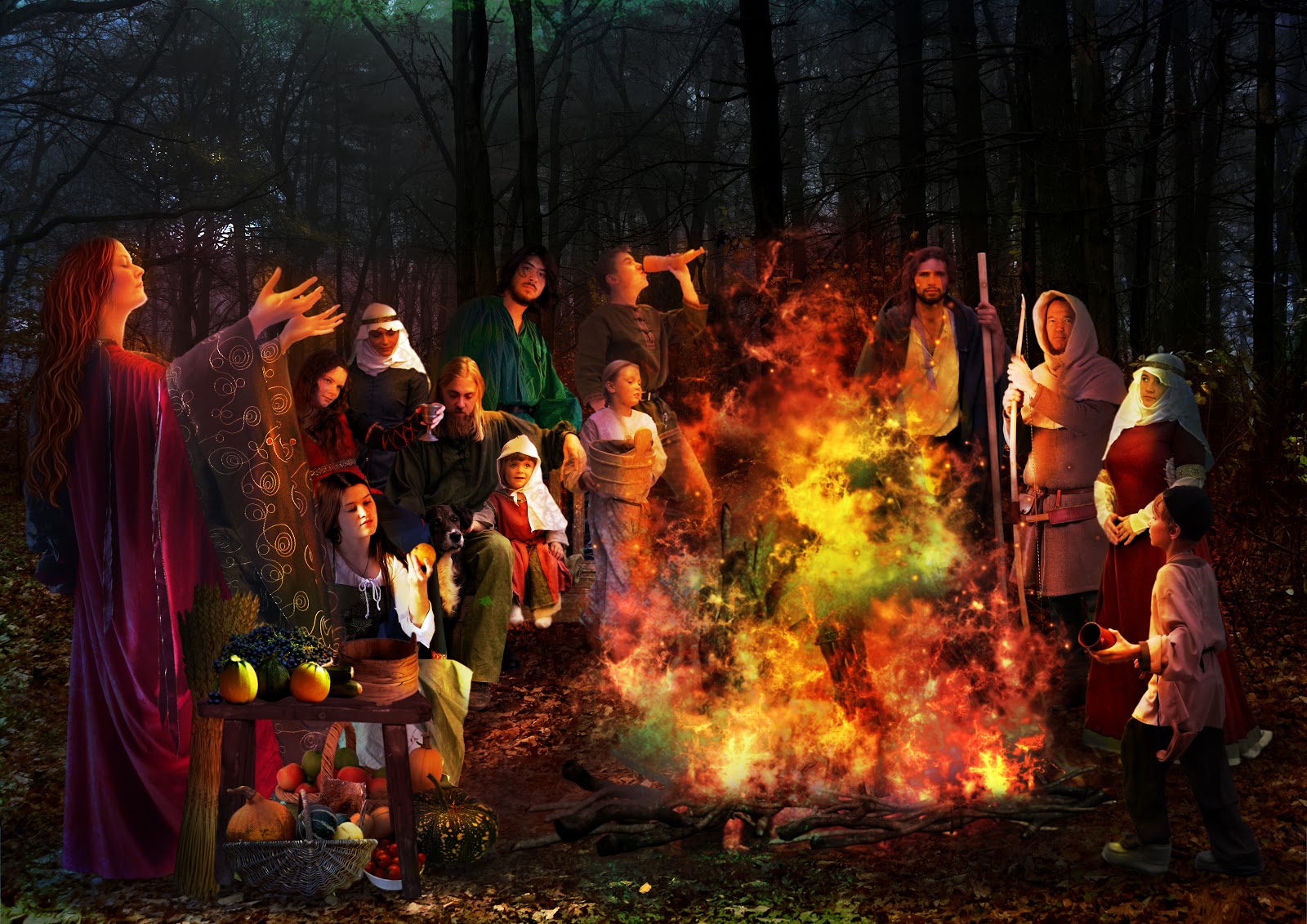
It was believed by the Celts that on the night of 31st October, ghosts of their dead would revisit the mortal world and large bonfires were lit in each village in order to ward off any evil spirits that may also be at large. Celtic priests, known as Druids, would have led the Samhain celebrations. It would also have been the Druids who ensured that the hearth fire of each house was re-lit from the glowing embers of the sacred bonfire, in order to help protect the people and keep them warm through the forthcoming long, dark winter months.
Carved pumpkin Jack O lanterns were in fact originally made from turnips and lit to guide the dead back to earth, and the Celts also dressed in costumes much as we do today, but they would have worn animal skins, masks and other disguises to avoid being recognized by the ghosts thought to be present. It was in these ways that beings such as witches, hobgoblins, fairies, and demons came to be associated with the day. The period was also thought to be advantageous for foretelling on matters such as marriage, health, and death. On tradition observed was once the bonfire had been lighted, each member of the family would throw into the blazing heap a white stone containing some mark or cabalistic sign. Next morning, among the charred ashes these stones are sought for, and if by any chance one of them has disappeared, it is believed that the luckless thrower will never see another All Saints’ Day.
In the decades that followed, Britain was invaded by a new religion. Christianity arrived bringing the Christian Festivals and amongst them “All Hallows’ Day”, also known as “All Saints Day”, a day to remember those who had died for their beliefs, but this was in fact originally celebrated on 13th May.
Pope Gregory had the date of the All Hallows’ feast moved to 1st November sometime in the 8th century. He announced that Christian missionaries were to convert pagans to the Christian religion and where possible, incorporate the beliefs, festivals and sacred sites of pagan beliefs into the Christian religion. It is thought that in doing so, he was attempting to replace or assimilate the Celtic Samhain festival of the dead with a similar “church approved” celebration.
The night or evening of Samhain therefore became known as All-hallows-even then Hallow Eve, still later Hallowe’en and then of course Halloween. The Christian Church may have intended that people would spend their time praying for the souls of the dead on an important holy day. However, the fact that this was a day off from work gave many people even more of an excuse to celebrate Halloween with more excitement and excess than ever
In the eleventh century, a further festival was added to the church calendar; All Souls Day on 2 November. The three festivals of All-Hallows Eve, All Saints and All Souls were together known as Hallowmas.
Despite the Church’s success in establishing a Christian basis for the autumn celebrations, many of the ancient customs and traditions associated with them were still practiced by the population. The carving of gourds and the wearing of costumes and masks to scare away malevolent spirits are typical of the superstitions carried over from these celebrations into the All Hallows Eve.
The custom of “trick-or-treating” has its origins in a ritual wherein the elders of a village or town would go from house to house and receive offerings of food and gifts for the souls of dead friends and relatives thought to visit on this night. This practice evolved during the Middle Ages, when beggars would travel from village to village and beg for “soul cakes”. Villagers would offer prayers along with the cakes to those who had died in the past year for their transition to heaven.
Fire sticks and torches clearly anticipated the Guy Fawkes revels on the 5th of November and naturally lead to bonfires, which had a grimmer significance on the eve of All Saints’ Day.
Queen Mab is a fairy referred to in Shakespeare’s play Romeo and Juliet, where “she is the fairies’ midwife, described as a miniature creature who performs midnight pranks upon sleepers, sometimes relieving desires but sometimes leaving nasty blisters on the lips should she so choose.
The Daily Telegraph reported in 1882…
“It may be all very foolish and inconsistent with the severity of this extremely matter-of- fact age, but there are scores of country folks, even of today, who have the utmost faith in the existence of some Queen Mab “that plats the manes of horses in the night, and bakes the elf locks in foul sluttish hairs, which once entangled much misfortune bodes.”
Such Mabs and elves and witches must be guarded against in order to ward off their evil eyes and mischievous influence. It is fire that is their bane. Let the farmer carry a bunch of straw fired about his corn and all will be well with the crop; let him murmur some such incantation as “, Fire and red low light on my team now,” and he is likely to avoid any subsequent danger or mischance; let the laborer light a torch and flash the fiery cross in the air, and away will fly the witches, baffled and undone”
This is why fire sticks were among the commonest asset of a well-considered Halloween. The same use was to be found in the scarlet -berries of the rowan tree or mountain ash, and in a coil of scarlet wool. They say in Scotland, “Rowan tree and red thread. To gar the witches and dance them dead,” which, being interpreted, means to dance down until they die from exhaustion.
Variations of these bonfire ceremonies were observed in all parts of the country. The love ceremonies in connection with Halloween are almost as numerous as those connected with St. Valentine’s Day, and apples as well as nuts play a curious part in the accurate adjustment of the destinies of the young people. To burn two nuts side by side in order to see if the flame is mutual, steadfast, and enduring, or sudden, fitful, and impetuous, was common as was the old trick of flinging orange or apple peel over the shoulder to see what initial it would form. Many young women also believed that if they took a candle and stood in front of a mirror, where she had to eat an apple before it and comb her hair. If lucky, she will see the face of her future husband peeping over her shoulder.
The Evening Express in 1910 observed,
“It is the night of nights in the year when the spirits of the dead take deep delight to walk abroad and disturb trembling humanity”
This Halloween, Abergavenny will see many celebrations going on across town, many of them, sadly now Americanized and not at all sympathetic to our Celtic roots. But whatever your method of celebration or even if your choice is to abstain, I hope we can respect that this is a historical and fascinating custom that we are keeping alive in 2016, so enjoy your evening and stay safe!
The Moon’s Effect- Does A Full Moon Have An Effect On Paranormal Activity?

By Ian Ainsley
For centuries tales of the moon and links to the supernatural have circulated amongst the masses in particular full moons.
Many ancient beliefs and practices believed that the spirit world is more noticeable during the phases of a full moon and would use the full moons as a chance to perform rituals to speak to the spirit realm.
Now it could be that this is a genuine occurrence that activity increases during a full moon but then again it could also be put down to Luna Madness or the Luna Lunacy Effect or quite simply it could all just be a myth passed down through the ages gaining credibility as it goes.
There are many paranormal teams that will say activity is greater during the full moon then there are others that will say it doesn’t have much of an affect on activity at all.
It is widely believed that a full moon can affect people in certain ways. We all know that the moon’s gravitational pull affects the tides but can it actually affect a person? If we look at what is known about the human body and how it is made up of 75-80% of water there is a strong chance that when the moon is full and at its strongest it could in theory affect a person in terms of what they are thinking.
Say for instance a person has hidden emotions of anger then it is quite possible that during a full moon that emotion could manifest itself stronger than it usually is causing a person to act out of character. This could very well explain some if not all of the folklore tales of werewolves not in terms of a physical change but on a mental level it certainly could make a person behave more animal like acting off basic animal instincts.
So in theory it is possible that full moons could cause a person who is inclined to thoughts of the paranormal to believe they are experiencing something paranormal or quite possibly it could cause that individuals mind to trick itself into hallucinating and seeing what they believe to be an apparition.
In conclusion not enough is known on the topic of the paranormal and the full moon to be able to pass judgement as to a definitive answer to whether full moons have an influence on paranormal activity or not so I will leave it up to you to decide whether or not you believe it does or not.
It’s certainly a topic that intrigues me and one I would like to attempt to put to the test with my team Project Paranormal at some point.
Harry Price: Dweller on the Threshold
By David Fox

‘Harry fought a long, lone battle against, on the one hand, the Victorian educated scientists who derided the occult and, on the other, fanatical believers in spiritualism whose favourite mediums he exposed as frauds.’
Dennis Wheatley
Harry Price (1881 to 1948) is remembered today as perhaps the most famous ghost hunter and psychical investigator of all time. The intrepid scientist’s study ofBorley Rectory in Suffolk, purported to be ‘The Most Haunted House in England’, from 1929 until his death brought him international recognition and cemented his reputation as a colossus within the field of occult research. Nonetheless, this extraordinary figure became an object of both acclaim and disdain during his lifetime. Some commentators viewed Price merely as a sensationalist who sought publicity by courting the supernatural, whilst others championed him as a genuine truth seeker – selflessly dedicated to unlocking the mysteries of the universe.
Indeed, Price’s commitment and dedication to the investigation of preternatural phenomena cannot be understated. He founded The National Laboratory for Psychical Research, compiled one of the largest libraries of the occult in the world, and was one of the first scientists to apply a rigorous and methodical approach when testing the authenticity of psychics and hauntings. Price utilised state-of-the-art technologies such as pressure sensors and infra red photography in his quest into the unpredictable and inhospitable shadow realm of spirits, poltergeists and demons. His capacity and appetite for conducting painstaking research – in often freezing and isolated locations in the dead of night – has set the bench mark exceptionally high for all psychical explorers. In Borley Rectory alone Price recorded no fewer than sixty different types of supernatural occurrence.

Borley Rectory in Suffolk – The Most Haunted House in England.
Contemporary ‘ghost hunters’ frequently pay homage to Price’s considerable influence and achievements, but few are actually aware of his background in the art of conjuring and legerdemain. A lifelong member of the prestigious Magic Circle, his interest in this amazing art form began at an early age when he witnessed a performance of The Great Sequah in Shrewsbury market place. The young Price was mesmerised by the magician and this profound experience clearly catalysed an inner yearning for the mysterious.

‘The Conjurer’ by Bosch. Magic and the Occult have always been closely linked.
Thus, like the great Harry Houdini (who successfully debunked numerous fraudulent psychics in the US), an understanding of the art of magic allowed Price to deduce what secret artifices or methods, if any, were being deployed by supposed soothsayers and mediums during his research. The story of the famous ‘spirit photographer’ William Hope is well documented and is an example of one of Price’s many skirmishes withSpiritualists who normally felt threatened by his research. The scientist was more than aware of how accomplished magicians can surreptitiously ‘switch’ objects, undetected by audiences, in order to achieve startling outcomes. This was precisely what Hope was doing with the photographic plates, and Price quickly concluded that his ‘spirit images’ were actually frauds. Indeed, this damning revelation set the tone for most of Price’s investigations into Spiritualists and clairvoyants. He attended hundreds of séances and was rarely convinced by the authenticity of the spectacle. Lifelong friend Sir Arthur Conan Doyle (best known as the creator of Sherlock Holmes – but himself an ardent Spiritualist) frequently expressed his anger at Price’s findings and urged him to be more sympathetic towards individuals of a psychical disposition.

Like the Great Houdini, Price’s knowledge of magic helped him ‘debunk’ fraudulent mediums.
Nonetheless, in the midst of a seemingly incessant tide of fraudulence and deceit, Price did encounter some incredible individuals who genuinely appeared to possess exceptional extra sensory talents. The most notable is perhaps Ms Stella C who, unlike the majority of clairvoyants and mediums, did not accept money for conducting séances and was not interested in forging a career in this field. Price and others observed the occurrence of genuine telekinetic phenomena in her presence, and she also incredibly predicted (with an uncanny accuracy which startled even Price) what would appear on the front page of The Daily Mail several weeks in advance.
Price was further led to speculate that it may be ‘highly probable’ that some individuals actually can communicate with the deceased. A séance in 1930 with the clairvoyant Mrs Eileen Garrett, who was not a Spiritualist, provided some of the most extraordinary results ever obtained in the field of psychical exploration. Garrett claimed to be in communion with Flight-Lieutenant H Carmichael Irwin, the captain of the doomed R101 Airship which had tragically crashed in France two days earlier. All the crew and passengers had been killed, but the psychic was accurately able to relay intricate details about the sequence of events which led to the fatal accident. Specialised technological information about the airship itself, of which Garrett could not possibly have known, were also provided. Price contacted the RAF with his findings and they concluded that 70% of Eileen Garrett’s account was exactly precise, 20% was ‘most likely’ and the remainder was rather confused.

The medium Eileen Garrett recounted intricate details of the R101 disaster.
Such examples of Price’s work reveal that as well as earning a reputation as a sceptical man of science, he did have a sensitivity towards psychics and was prepared to reveal instances of what appeared to be genuine ‘supernatural’ phenomena. Indeed, his feud with fellow magicians the Maskelynes would reveal how he was often prepared to defend psychics who he believed were genuine. Nevil Maskelyne had long claimed that his brother Clive could duplicate all types of ‘supposed spiritual phenomena’ a medium could create in a séance. However, Price challenged this statement and alleged that he had witnessed events in séance rooms which even the most accomplished of conjurers would struggle to produce.

Magicians can amaze audiences with seemingly ‘psychical phenomena’.
Enigmatic and complex, the life of Harry Price is arguably even more perplexing than the mediums, spirits and poltergeists he documented along the way. It is intensely intriguing when a talented and highly intelligent individual is drawn to devote his entire life to the study of a fringe subject such as the occult. They run the risk of being ostracised, condemned and ridiculed by their peers. So why did Harry Price decide to embark upon such an atypical and arduous journey which would ultimately lead him to the bowels of desolate dilapidated mansions, the icy spectral solitude of cemeteries, and the sinister sultry environs of fraudulent medium’s séance parlours? Was he merely a deluded moonstruck eccentric shying away from the harsh realities of life? Or should we celebrate him as a heroic pioneer who conducted invaluable research into an area which has been largely ignored or overlooked by many of the greatest minds over the centuries?

Psychical researchers can easily become objects of ridicule. Why did Price choose this path?
The author of the article is David Fox, a professional magician and freelance writer.

